
You’re probably reading this after another long day of trying to build something out of nothing.
You finished your job, or maybe your client work. You opened your laptop again. You bounced between Shopify, Figma, Notion, Slack, your notes app, and a dozen tabs with advice from strangers who all sound confident and somehow useless. You’re doing “everything right,” but it still feels weirdly lonely.
That feeling isn’t weakness. It’s a warning.
Most founders don’t fail because they lack information. They fail because they spend too long carrying the load alone. If you want to know how to find your tribe, stop thinking about networking and start thinking about survival, trust, and shared standards. The right people won’t just cheer you on. They’ll help you make better decisions, avoid dumb mistakes, and keep your head straight when things get messy.
The Myth of the Lone Wolf Founder
At 2 AM, the lone wolf story sounds noble.
It’s not. It’s a trap.
The internet loves the image of the solo genius who disappears into a garage and comes back with a company. Real life looks different. Real life looks like uncertainty, bad timing, second-guessing, awkward early sales calls, and a thousand tiny decisions you have to make with incomplete information.

And if you’re doing that without trusted people around you, the work gets heavier fast.
A 2022 Kauffman Foundation study on entrepreneur well-being found that 82% of entrepreneurs suffer from founder loneliness, and it hits hardest in the early stages. That tracks with what I’ve seen. The idea stage and the pre-traction stage are where your brain plays the most tricks on you. You don’t have enough proof yet. You don’t have enough feedback yet. And many individuals in your normal life can’t really help because they’ve never built a thing.
Why the myth sticks
The lone wolf myth survives because it flatters your ego.
It tells you that asking for help means you’re less capable. It tells you that if you were smarter, tougher, or more disciplined, you’d just figure it out yourself. That’s nonsense. Even strong founders need mirrors, pressure-testing, and honest feedback.
You don’t need more random contacts. You need a few people who can tell you when your idea is weak, when your fear is lying, and when you’re about to waste six months.
What a tribe actually does
A real tribe is not a room full of name tags and elevator pitches.
It’s more like a personal board of directors, except less formal and more useful. These are the people who know what you’re trying to build, understand the emotional cost, and care enough to tell you the truth. They share war stories. They open doors when it makes sense. They also call you out when you’re hiding behind “busy.”
Look at it like this:
- Books give you frameworks. They can’t ask follow-up questions.
- Courses give you tactics. They can’t read your face when you’re spinning.
- A tribe gives you context. They know you, your blind spots, and your actual situation.
If you’re serious about building something meaningful, finding your people is not optional. It’s infrastructure.
Define Your North Star Before the Search
This is often botched before it even begins.
They say they want “like-minded people,” then go look for people in the same industry, the same age range, or the same city. That’s lazy. Shared interests are fine for hobbies. They’re not enough for trust.
If you want to learn how to find your tribe, start with values, not vibes.
Shared interests are weak glue
You can both run an ecommerce brand and still be a terrible fit for each other.
One of you might be generous, direct, and calm under pressure. The other might be a self-promoter who treats every conversation like a lead funnel. Same industry. Totally different character. If you build your circle on surface-level sameness, it will feel good for a month and hollow after that.
I’d rather sit with someone from a different business model who shares my standards than someone in my exact niche who drains the room.
Pick your non-negotiables
You need a short list. Not ten fluffy words. Not a brand manifesto. Just the traits that matter when things get hard.
For me, I’d start with kindness and boldness.
Kindness matters because plenty of smart people are still toxic. Boldness matters because nice people who never act won’t help you build much. You want both. Someone who gives a damn and still moves.
Try this filter:
- Who do you respect? Write down a few people you admire.
- Why do you respect them? Don’t list achievements. List traits.
- Which traits are mandatory? Pick three to five.
- Which traits are disqualifiers? Ego, gossip, flakiness, opportunism, whatever keeps burning you.
Practical rule: If you can’t describe your ideal tribe member in plain English, you’re going to join random groups and call it strategy.
A simple founder values test
Use this on yourself first. If you don’t live these values, don’t expect your tribe to.
Ask yourself:
- What behavior do I want around me when I’m struggling? Calm honesty? Tough love? Generosity?
- What behavior makes me shut down? One-upping? Fake positivity? Hidden agendas?
- What kind of person do I want to become faster? More courageous? More disciplined? More grounded?
- What am I unwilling to tolerate anymore? This one matters more than people admit.
Write your answers down. Treat them like operating principles, not inspirational wallpaper.
If you need a practical reset before you do this, start with clear personal and business priorities. This guide on how to set business goals helps because it's hard to find the right circle when you haven’t even defined what you’re building toward.
Don’t look for clones
Your tribe should share values, not mirror your personality.
You don’t need five versions of you. You need people who bring different experience, sharper judgment, and complementary strengths. Consider building a band. Same taste in music helps, but what matters is whether each person can play, listen, and stay in rhythm.
That’s your North Star. Character first. Everything else second.
The Hunt Where to Actually Find Your People
You walk into a big networking event, grab a warm drink, make eight polite conversations, and leave with nothing except a stack of LinkedIn connections you will never trust.
That approach fails because it rewards visibility, not character.
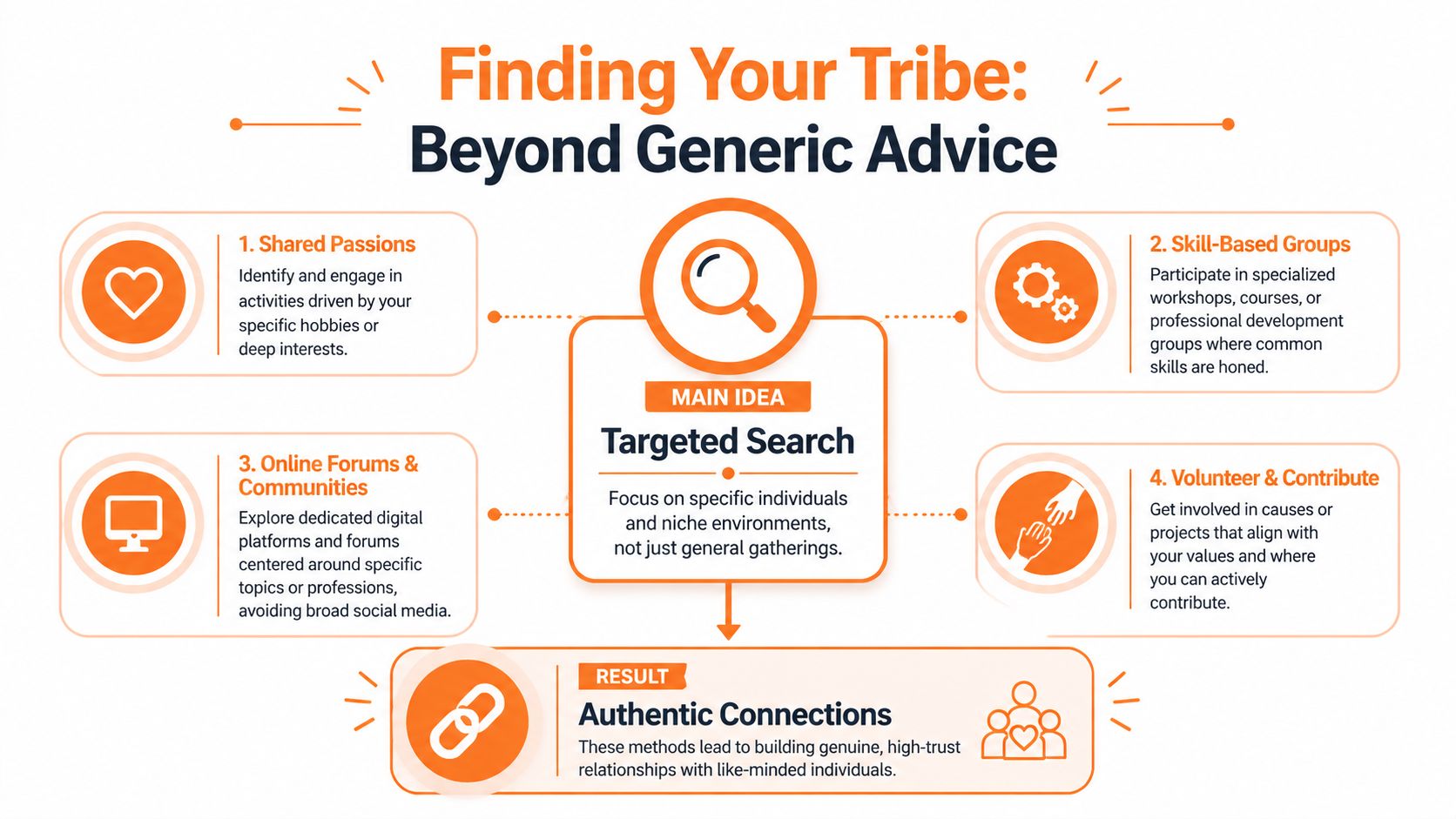
Founders looking for real community should stop treating "shared interests" as the main filter. Shared values matter more. I want people around me who are kind under pressure and bold when it counts. You do not learn that from a name tag and a two-minute intro. You learn it by watching how someone behaves in a room with stakes, limits, and other humans.
Pick rooms that reveal people
Open networking events are a weak filter. The loudest person often wins, and the safest person rarely advertises it.
Small, private gatherings give you better signal. Six to twelve people is enough. Dinner tables beat convention halls. Workshops beat mixers. Curated roundtables beat "come one, come all" events every time.
Why? Because small rooms force people to show their habits. You can see who listens, who hogs airtime, who helps the new person settle in, and who turns every conversation into self-promotion.
Where I would actually look
Start with places where contribution is visible and repeat attendance matters.
- Private founder dinners: Small invite-only meals are one of the best formats. People drop the performance faster when there is no audience to impress.
- Hands-on workshops: Go where people are building, fixing, or testing something. Competence is easier to judge when there is actual work in the room.
- Curated peer groups: A well-run mastermind or operator circle can work if the group is selective and the expectations are clear.
- Volunteer roles in founder communities: Help behind the scenes at serious local programs. You will quickly learn who is generous when nobody is clapping.
- Small recurring gatherings at trusted hubs: In Chicago, places like 1871 can still be useful if you focus on side conversations and repeat encounters, not stage energy.
Online matters too, but use it to qualify people for better conversations, not as the final destination.
- Niche Slack or Discord groups: Smaller groups tied to a real craft or stage are stronger than giant communities full of spectators.
- Paid groups with active moderation: Payment alone means nothing. Clear standards and active hosts matter.
- Smaller forums and subreddits: Look for detailed posts, honest questions, and evidence of actual work.
- Webinar chats: The audience often tells you more than the speaker. Sharp questions and respectful disagreement are good signs.
Use a simple playbook
Do not wander. Build your own filter.
Pick one or two rooms. Show up more than once. Talk to the host. Watch who people trust. Notice who makes introductions without acting like a gatekeeper. Then invite two or three promising people to something smaller.
A private coffee trio works well. So does a six-person dinner with one clear rule. Everyone shares one hard problem and one thing they can help with. That structure cuts the fluff fast.
If you keep getting pulled into one-sided dynamics, fix that before you expand your circle. This guide on how to stop being taken advantage of will help you tighten your standards.
The signals that matter
Look for kindness with a backbone.
Good signs:
- They make room for quieter people.
- They tell the truth without turning cruel.
- They offer specific help.
- They keep small promises.
- They care who else is in the room, not just who can benefit them.
Bad signs:
- They scan the room while you are talking.
- They pitch before they understand you.
- They confuse dominance with leadership.
- They gossip to create closeness.
- They act charming in public and careless in private.
One useful option if you’re in Chicago
Chicago Brandstarters runs small-group events instead of open-room networking. That format is more useful for founders who care about trust, consistency, kindness, and boldness, not just collecting contacts.
Raise your standards for the room before you raise your standards for the people in it. The room shapes what people reveal.
The Vetting Process How to Spot Givers and Takers
People tend to get naïve.
They meet someone smart, energetic, and ambitious, then assume that means safe. Wrong. Some of the most draining people you’ll ever meet are competent and charismatic. If you don’t vet, you will pay for it in time, attention, and momentum.
I don’t care if this sounds harsh. Your circle needs a bouncer.
Start with a clean outreach message
Don’t overcomplicate the first reach-out. You’re not trying to impress them. You’re trying to reveal whether they’re worth knowing.
Use something like this:
Hey, I’ve seen a few of your posts and liked how you think about building. I’m putting more energy into meeting grounded founders who value honesty over hype. If you’re open, I’d be up for a quick coffee sometime and swapping notes on what you’re building.
Why it works:
- It’s direct.
- It names the kind of relationship you want.
- It filters out people who only respond to status games.
If they reply with warmth, clarity, and a real effort to schedule, good.
If they reply with a pitch deck, a Calendly for a sales call, or a paragraph about how busy and important they are, that’s useful too.
Run the coffee test
Coffee is not about coffee. It’s a low-cost stress test.
You’re watching for how they handle attention, curiosity, and reciprocity. Keep it simple. One hour. Public place. No big expectations. Then pay attention.
Here’s the checklist.
| Behavior | Red Flag (Taker) | Green Flag (Giver) |
|---|---|---|
| Conversation balance | Talks at you the whole time | Asks questions and leaves room |
| Listening | Waits to speak | Tracks what you said and follows up |
| Challenge response | One-ups your problem | Helps you think more clearly |
| Intent | Angles for a sale fast | Looks for fit before asking for anything |
| Follow-through | Makes vague promises | Sends the intro or resource they mentioned |
| Energy after meeting | You feel drained or handled | You feel clearer and more grounded |
Ask better questions
First meetings are often wasted on biography.
I’d rather know how someone behaves under pressure.
Try questions like:
- What’s been harder than you expected lately?
- What kind of people do you work best with?
- What do you wish more founder groups did less of?
- When someone asks you for help, how do you decide whether to lean in?
You’re not interrogating them. You’re looking for clues. Do they answer sincerely? Do they dodge? Do they sound thoughtful or rehearsed?
Watch for this: The taker usually reveals themselves through pace. They rush intimacy, rush extraction, or rush status.
Don’t ignore your body
Your nervous system is smarter than your ego.
If someone checks all the obvious boxes but leaves you tense, guarded, or weirdly tired, that matters. I’m not saying trust every irrational reaction. I am saying don’t override repeated discomfort because the person seems useful.
That’s how people get trapped in bad circles.
If this has been a pattern for you, read how to stop being taken advantage of. A lot of founders don’t need more openness. They need better boundaries.
Use a slow yes
You do not need to decide quickly.
In fact, I’d avoid fast intimacy. Let people earn trust through repetition. One coffee. Then maybe another. Then maybe a small dinner. Trust should grow like a credit score. Over time, based on actual behavior.
That’s not being cold. That’s being responsible.
From Connection to Community Your First Inner Circle
Once you’ve found a few solid people, don’t wait for magic.
Build the room.
The easiest way to do that is a small private gathering. Not a mixer. Not a panel. Not some awkward “community event” with plastic name tags. I mean a real table with a handful of people you’ve vetted.

Keep the group small on purpose
I like 6 to 8 people because it’s big enough for range and small enough for depth. Everyone can talk. Nobody disappears. You can feel when the room is honest and when it’s drifting into performance.
A SAMHSA overview of Community Readiness Assessment says CRA-guided processes can lift community ownership and engagement by 75% within 12 months, and that readiness work helps prevent the 65% of community initiatives that fail due to misaligned readiness. The startup version is simple. Don’t cram random people together and hope chemistry appears. Pick people who are ready for the same kind of room.
Set the rules before the meal starts
Say the rules out loud. Don’t imply them.
Use plain language:
- Confidentiality: What’s said here stays here.
- No fixing people too fast: Ask before advising.
- No selling: Nobody came to get funnelled.
- Equal airtime: One person doesn’t get to hijack the night.
- Honesty over polish: We want the actual problem, not the PR version.
This part matters more than the menu.
A simple format that works
You don’t need a fancy agenda. You need structure that creates safety and usefulness.
Run a round like this:
- Win
Something that went well. Keep it short. - Challenge
The core issue. Not the fake one. - Ask
What help do you want?
That’s it.
This format works because it forces balance. People don’t just dump. They share progress, admit friction, and make a concrete ask. It also trains everyone to help with precision instead of rambling.
Don’t ask, “How can we support you?”
Ask, “What is the one thing you want help with tonight?”
Facilitate like a host, not a guru
Your job is to guide the rhythm.
If one person talks too long, cut in kindly. If the room stays shallow, ask a sharper question. If someone shares something real, protect it from getting steamrolled by advice too fast.
A few prompts I like:
- What are you avoiding?
- What assumption are you making that might be wrong?
- Where do you need courage, not more research?
- What would make this week feel like progress?
Here’s a useful example of the kind of conversation rhythm you want to create:
End with one next step per person
Don’t end on vibes. End on action.
Go around once more and have each person say the one thing they’ll do before the next meeting. Keep it small and real. One call. One landing page. One inventory email. One hard conversation.
Then follow up a few days later with a simple message asking how it went.
That’s how a dinner becomes an inner circle. Not because everyone felt inspired for two hours, but because people told the truth, got useful help, and came back better.
Your Next Move in Chicago Join the Brandstarters
You can do this from scratch. Plenty of people should.
But let’s be honest. Building a trusted founder circle on your own takes effort. You need standards, patience, social courage, and enough judgment to say no to people who look good on paper and bad in practice. The longing for a tribe is widely felt. Fewer people are willing to build one carefully.
That’s why pre-vetted communities matter.
A future-dated claim in the provided research says a 2026 Startup Genome finding referenced here ranks Midwest startup ecosystems 15% higher in founder retention than coastal hubs, and ties that to a more collaborative, kindness-driven culture. The same source says 68% of founders report tribe fatigue from mismatched groups. Whether you’re in Chicago proper or somewhere else in the Midwest, that should tell you something. Your environment matters. The character of the room matters.
What I’d do if I were you
If you’re serious, take one of these paths.
- Build your own circle: Start with two or three vetted people and host the first dinner.
- Join a curated local group: Better if you want structure and don’t want to screen everyone yourself.
- Do both: This is often the smartest move. A wider trusted network plus a tighter inner circle.
What I would not do is keep drifting through giant events hoping your people magically appear.
The standard is simple
I’d rather build with people who are kind, bold, and hard-working than people who are impressive and slippery.
That’s not soft. That’s practical. Kind people share. Bold people act. Hard-working people stick. Put those three in one room and useful things happen.
If you’re in this region and want a place that already leans into small, confidential founder dinners instead of transactional networking, you can look at Chicago Brandstarters. The fit is straightforward. It’s for kind, bold, hard-working Chicagoans and Midwesterners building brands from idea stage through growth who want real conversations, not performance.
If that sounds like you, stop lurking and make a move.
If you're tired of doing founder life alone, apply to Chicago Brandstarters. It’s a free, vetted community for kind, bold, hard-working builders in Chicago and the Midwest who want confidential small-group dinners, honest conversations, and a real support system while they build.
Leave a Reply