
You open the chicago tech week schedule, scroll for a minute, then feel your chest tighten.
Too many events. Too many neighborhoods. Too many people who all seem sharper, richer, and farther along than you. You start thinking the only winning move is to sprint from panel to panel and hope something good happens.
That’s the wrong game.
I’ve spent enough time around founders in Chicago to tell you this plainly. The people who get the most out of chicago tech week aren’t the busiest. They’re the clearest. They know what they want, they move with intention, and they treat people like humans instead of lottery tickets.
Your Game Plan for Chicago Tech Week
The first mental shift is simple. Stop treating chicago tech week like a festival. Treat it like a one-week asset acquisition sprint.
You’re not there to “get out there.” You’re there to come home with something useful. A sharper point of view. A future hire. A customer conversation. A founder friend who tells you the truth. One warm intro that actually matters.

I like to think about the week as your temporary in-house M&A team. You’re not buying companies. You’re acquiring tiny pieces of advantage. One idea here. One relationship there. One hard truth you needed to hear six months ago.
That framing matters because Chicago will tempt you into activity for activity’s sake. The calendar is broad because the ecosystem is broad. TechChicago Week is the modern evolution of the city’s annual tech celebration, building on an ecosystem that supports 37 Fortune 500 companies and has generated 253,000 total tech-related jobs. Chicago is also the #1 best big city for five consecutive years and #1 for corporate expansions, which is exactly why the week attracts serious builders and operators from different corners of the market, as noted in the TechChicago Week media kit.
What most founders get wrong
Most first-timers make three mistakes.
- They optimize for volume: Too many events, too many shallow chats, too little memory.
- They chase status: They hover around the biggest names instead of talking to the person next to them.
- They confuse visibility with progress: A full camera roll and a dead inbox still means you lost.
I’ve watched founders burn an entire week this way. They come back with lanyards, selfies, and no follow-up worth sending.
Practical rule: If an event doesn’t help you learn, meet, or close something specific, skip it.
The Chicago advantage
Chicago tech works best when you bring Chicago energy. Be ambitious. Be warm. Be on time. Don’t posture. Don’t talk like you’re raising your Series Z when you haven’t talked to ten users.
That’s also why I tell people to study the wider scene before they pick a single event. A good place to orient yourself is this roundup of technology events in Chicago. It helps you see where chicago tech week sits in the bigger rhythm of the city.
The founders who win here usually aren’t the loudest. They’re the ones who combine kindness and hard work. That combo travels fast in Chicago. People remember it.
What a real win looks like
A real win from chicago tech week is boring on the surface.
It might look like this:
- One customer insight: You finally hear why buyers hesitate.
- Two founder peers: People you’ll text when things break.
- One partner lead: Someone who can open distribution.
- One honest no: Clarity that saves you months.
That’s enough. More than enough.
If you carry that mindset into the week, the schedule stops looking chaotic. It starts looking like a menu. You don’t need to eat everything. You just need to order well.
The Pre-Week Mission Briefing
The week starts before the week starts. If you show up without a plan, you’ll drift toward whatever looks popular, and popular is not the same as useful.
I want you to define your win condition before you RSVP to anything else.
The organizers already do this at the ecosystem level. TechChicago Week is built around themes such as “Solving Grand Challenges” across healthcare, finance, and energy, with anchor events and pitch opportunities like TechRise offering $25,000 in non-dilutive funding. That structure matters because Chicago’s tech ecosystem has grown 18% over the past decade, far ahead of the overall economy, according to the TechChicago Week overview. You should borrow that same discipline for your own calendar.
Pick one main objective
Don’t pick five goals. Pick one primary objective and one backup.
Bad goal: “Meet people in tech.”
Good goals sound like this:
- Validate an idea: Talk to potential users and test whether the problem is real.
- Find a co-founder: Meet technical or commercial counterparts with matching values.
- Open a sales path: Get warm intros to likely buyers or channel partners.
- Prepare for capital: Learn what investors need to believe before you pitch.
If you try to do all of them, you’ll do none of them well.
I’d rather see you leave with three strong conversations tied to one goal than thirty random chats tied to nothing.
Reverse-engineer the schedule
Once you know your mission, stop browsing events like a tourist. Start filtering them like an operator.
Ask four questions for every event:
- Who will likely be in the room
- What kind of conversation does this room allow
- How tired will I be by the end of it
- What specific outcome could come from attending
A giant keynote can be useful if it attracts the exact people you want to meet afterward. A small panel can be better if the room is narrow and the conversation sticks. A party can be excellent if it’s hosted by a trusted connector. A party can also be a useless blur.
Build your week around one theme
I tell founders to create a simple weekly theme. Think of it as the headline for your own mini-campaign.
Here are a few examples:
- Customer discovery week
- Healthcare buyer week
- AI infrastructure week
- Future co-founder week
- Midwest founder friendship week
That theme becomes your filter. If an event doesn’t fit the theme, it needs a very good reason to stay on your calendar.
My practical checklist
Use this before the week starts.
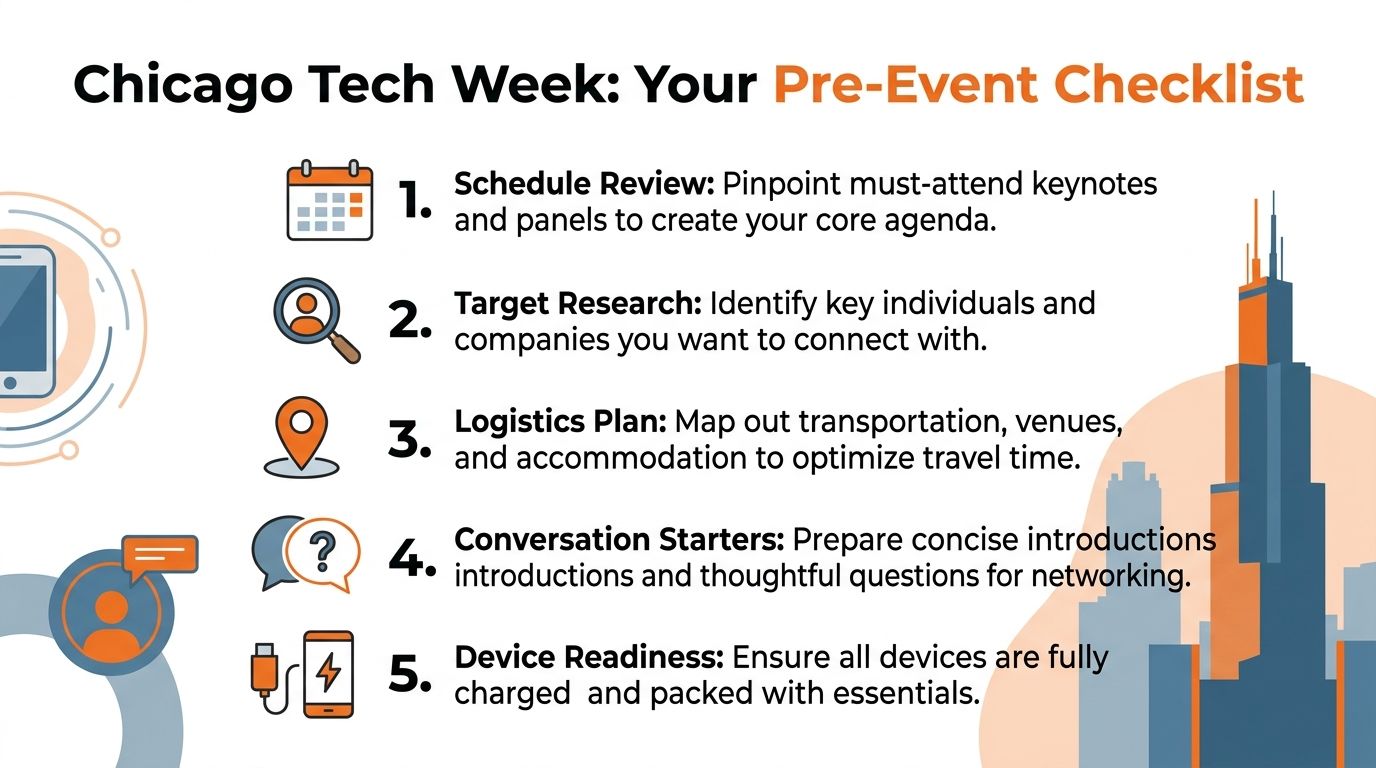
- Trim your schedule: Pick one anchor event per half-day. Leave open space between them.
- Make a target list: Write down names of people, startups, funds, or companies you are keen to meet.
- Send outreach early: Use LinkedIn or email to ask for a short coffee near an event you’re both attending.
- Prep your intro: Practice a short, natural answer to “What are you working on?”
- Carry proof: Put your landing page, prototype, or one-page memo on your phone so you can show it fast.
- Plan your movement: Check neighborhood jumps in Google Maps. Chicago punishes optimistic travel plans.
- Protect your energy: Pick one late night max if you know crowds drain you.
- Set your follow-up system: Create a Notes app template before the week begins.
Your 30-second founder intro
Don’t ramble. Don’t recite your whole deck. Don’t say, “We’re disrupting X with AI-powered Y.”
Say what you do, who it’s for, and what you’re learning.
A better structure:
- What you’re building
- Who feels the pain
- What you’re testing right now
Example:
I’m working on a B2B SaaS tool for ops teams that lose time chasing internal approvals. Right now I’m validating where the workflow breaks hardest and who owns the budget.
That opens a door. It doesn’t trap the other person in your monologue.
What to bring besides your laptop
A lot of founder prep advice is too cute. Here’s the actual list.
| Item | Why it matters |
|---|---|
| Charged phone | You’ll live on maps, messages, and QR codes |
| Portable charger | Chicago days run longer than planned |
| Notes app template | Memory gets foggy fast after your fifth conversation |
| Comfortable shoes | Your feet decide your mood by 4 p.m. |
| One clean link | A landing page, deck, or waitlist people can actually remember |
The point of prep isn’t to look polished. It’s to make good decisions under pressure. That’s all.
A Sample 3-Day Founder Schedule
Let me make this concrete.
Meet Sarah. She’s idea-stage. She’s building a B2B SaaS product for internal operations teams. She does not need more inspiration. She needs signal. Her job this week is to learn whether the problem is painful enough, who owns it, and whether the market is crowded with lookalikes.
That’s the right use of chicago tech week. The range of events has been broad for a long time. The original Techweek launched in Chicago in 2011 with 2,487 attendees and 220 speakers, then quickly expanded into startup competitions, job fairs, and cultural programming. That legacy helps explain why a modern week offers everything from large-stage talks to smaller rooms, inside a city that now has over 6,151 startups, as noted in the Techweek history overview).
Sarah’s schedule
| Time | Day 1 Idea Validation | Day 2 Lead & Partner Gen | Day 3 Relationship Deepening |
|---|---|---|---|
| Morning | Attend one sector-relevant panel and write down 3 buyer pain points | Go to a curated industry event where operators gather | Coffee with the strongest contact from Day 1 |
| Midday | Work from a hub space and invite 2 people for short chats | Lunch with a founder serving the same buyer persona | Quiet work block to send warm follow-ups |
| Afternoon | Join a smaller discussion and ask one sharp question | Attend a partner-heavy session with service providers filtered out | Attend one final event only if it supports an active conversation |
| Evening | One dinner or mixer, then leave early | One selective social event with likely buyers or connectors | Small thank-you meetups, then rest |
Day 1 is for signal, not ego
Sarah starts with one panel tied closely to her buyer. She doesn’t attend a big-name keynote just because everyone else is going. She listens for repeated frustrations, budget ownership language, and words buyers use to describe the mess.
After that, she plants herself in a high-traffic founder hub for a couple of hours. At this stage, many people blow it. They keep moving because movement feels productive. Sarah stays put. People can find her. Conversations stack.
Stay in one good room long enough for the room to start working on you.
That afternoon, she chooses a smaller session where she can ask a direct question. Not a fake-smart question. A useful one. Something like, “When this workflow breaks, who feels it first and who pays to fix it?”
The evening is not for chaos. She goes to one dinner or mixer where conversation is possible, then leaves before she turns into a zombie.
Day 2 is for commercial paths
Now Sarah has language. She knows a bit more about the problem. Day 2 shifts from discovery to opportunity.
She chooses rooms where likely buyers, operators, or distribution partners gather. She doesn’t waste time in rooms full of people selling to founders unless she actively needs what they sell. If five agencies and three fractional consultants are circling one founder, she keeps walking.
Her lunch goes to another founder who serves the same market but doesn’t compete directly. That’s often where the best insight lives. Adjacent builders know where budgets hide and where buying cycles stall.
In the afternoon, she attends a session with stronger partner density. She’s looking for someone who can say, “You should meet our head of ops,” not someone who says, “Let’s jam sometime.”
The night event matters only if the guest mix makes sense. If it’s all noise, she skips it and saves energy.
Day 3 is where adults separate themselves from tourists
By Day 3, plenty of people are fading. Sarah gets sharper.
She uses the morning for a coffee with the most promising contact from earlier in the week. That’s the move. Not one more random panel. Not another tote bag. A real conversation with someone already warmed up.
Her midday block is for follow-up while memory is still fresh. She sends notes. She introduces two people who should know each other. She acts like a peer, not a taker.
By the end of the week, Sarah doesn’t know everyone. Good. She shouldn’t. She knows exactly who mattered.
How to Network Without Feeling Gross
Let’s say the quiet part out loud. Most networking feels bad because it's often approached like low-grade hunting.
They scan the room for status. They ask dead questions. They wait for their turn to talk. Then they hand you a pitch you didn’t ask for.
That’s not networking. That’s emotional littering.

The better approach is simple. Replace extraction with curiosity. You are not trying to “work the room.” You are trying to understand people, spot alignment, and create enough trust that a second conversation feels natural.
That works better morally and practically. Founders who use curated, inclusive networking opportunities can see a 4x network expansion, and 80% of shortlisted pitchers at events like TechRise gain investor introductions, compared with 25% of non-participants, according to the TechChicago Week old program details. Prepared, intentional networking beats random mingling.
Use the giver’s opening
The easiest fix is to stop asking boring questions.
Don’t lead with “What do you do?”
Try one of these instead:
- What are you excited about right now?
- What problem are you spending a lot of time on lately?
- What brought you to this event specifically?
- What are you building your week around?
These questions do two things. First, they wake people up. Second, they tell you how the person thinks, not just what their LinkedIn headline says.
If you’re more introverted, this matters even more. You don’t need to become louder. You need a better script. I like this guide on how to network as an introvert because it lines up with the same principle. Depth beats performance.
Small talk is not fake if you use it correctly
A lot of founders hate small talk because they think it’s fluff. I think of it as a runway.
You don’t start a plane at cruising altitude. You use a little runway to find lift.
Ask about neighborhoods. Ask what event they came from. Ask whether this is their first chicago tech week. Ask what they’ve found surprisingly useful so far. Those questions help both of you settle into a normal human rhythm before business enters the room.
The point of small talk isn’t to stay shallow. It’s to find the doorway into something real.
How to handle common awkward situations
You will run into these. Plan for them now.
The service seller ambush
Someone corners you and launches into a pitch before learning anything about you.
Say this:
“Thanks. I’m keeping this week focused on founder and customer conversations, so I’m going to keep moving. Hope you have a great event.”
Short. Polite. Closed.
The private dinner with mixed status people
Don’t perform. Don’t dominate. Ask thoughtful questions, then make room.
Good dinner behavior looks like this:
- Include the quiet person: Pull them in with a simple question.
- Keep your story short: Nobody wants your whole cap table history over salad.
- Don’t flex access: If you know someone famous, act normal.
- Thank the host properly: Hosts remember grace.
The person who asks for too much too fast
Maybe they want a deep intro, a product review, and half your afternoon.
Use this:
“I can’t do that well this week, but if you send me a short note with context, I can tell you whether there’s a fit later.”
That protects your time without turning cold.
My favorite outreach templates
Pre-event outreach should feel human. If your note sounds like a growth hack, delete it.
LinkedIn message
“Hey [Name], I saw you’ll be at chicago tech week. I’m building [short description] and spending the week talking to people around [problem space]. You seem close to that world. If you’re open, I’d love to grab a quick coffee near one of the events. No pitch. I’d mostly love to compare notes.”
Email version
“Subject: Quick coffee during chicago tech week?
Hi [Name],
I’ll be at chicago tech week and I’m focused on learning more about [specific problem or market]. I came across your work through [real reason].
If you’re around, I’d love to buy you a quick coffee near one of the venues. I’m not selling anything. I’m trying to get smarter about the space and thought you might have a useful perspective.
Either way, hope your week goes well.
Best,
[Your Name]”
Later in the week, this kind of mindset helps too:
Aim for a handful of real conversations
You do not need a giant contact list.
You need a few conversations with people who are smart, generous, and relevant to your path. If you leave chicago tech week with a small cluster of people who would answer your text, you won.
That’s how careers compound in this city. Organically. Through trust.
Turn Connections into Business Outcomes
Most founders waste the week after the week.
They come home tired, tell themselves they’ll follow up tomorrow, then watch the momentum rot in their inbox. That’s amateur behavior. Advantage is gained when everybody else gets lazy.
I use a simple rhythm. 24/48/7. It’s not fancy. It works.
The 24-hour note
Within a day, send a short message while the conversation still feels alive.
Not a newsletter.
Not a deck dump.
Not “great to connect” with no memory attached.
Say what you talked about and why it mattered.
Example:
“Great meeting you at chicago tech week. I kept thinking about your point on how ops teams struggle to get internal approvals across departments. That was helpful context for what I’m building. Thanks again for the honest take.”
That’s enough. It proves you listened.
The 48-hour value move
Inside two days, send something useful. A relevant article. A short intro. A screenshot. A thoughtful answer to a question they raised.
Value creates a second reason to reply.
Here are solid options:
- Make one clean intro: Only if the fit is real.
- Share one useful resource: Keep it specific to your conversation.
- Answer the open loop: If they asked a question, close it.
- Send a quick memo: Summarize what you’re learning if they care about the same market.
Follow-up works best when it feels like continuation, not conversion.
The 7-day check-in
A week later, ask for the next small step. Not the biggest possible ask. The next one.
That could be:
- a user interview
- a short feedback call
- a pilot conversation
- a customer intro
- a founder coffee
- a second meeting with more context
Many people blow it by jumping straight to “Can you invest?” or “Can you introduce me to ten people?” Don’t do that.
Sort people into simple buckets
You don’t need a giant CRM for this. You need clarity.
I sort new contacts into four buckets in my Notes app or Airtable:
| Bucket | What they might become | What I do next |
|---|---|---|
| Buyer | Customer or user | Schedule discovery or demo |
| Builder | Founder or operator peer | Keep regular contact and trade notes |
| Backer | Investor, mentor, connector | Send sharper updates over time |
| Bridge | Someone who can introduce, distribute, or partner | Look for one concrete collaboration |
That’s enough structure to stay disciplined without turning into a robot.
Use a simple relationship tracker
Here’s the lightweight system I like:
- Name
- Where you met
- What you talked about
- What matters to them
- Next action
- Follow-up date
You can keep this in Notion, Apple Notes, Google Sheets, or whatever tool you’ll open. The best system is the one you use.
If you need help thinking about the sales side of these follow-ups, this primer on a B2B sales process is worth reading. Not because every conversation is a sale, but because clear next steps matter in both relationships and revenue.
Copy-paste follow-up templates
For a potential customer
“Good meeting you this week. You mentioned your team runs into friction around [specific issue]. I’m speaking with a few people in that world and would love to learn from your experience if you’re open to a short call next week.”
For a founder peer
“Really enjoyed our conversation. You’re one of the few people I met this week who seems to think carefully about the problem, not just the optics. If you’re up for it, I’d love to keep comparing notes once every few weeks.”
For a connector or mentor
“Thanks again for the time. Your point about [specific insight] stuck with me. I’m tightening my thinking around it now. If helpful, I can send a short update once I’ve had a few more market conversations.”
What outcomes to look for over the next 90 days
Don’t judge your week by what happens in the next 24 hours. Judge it by whether it creates movement over the next stretch of time.
Useful outcomes look like:
- clearer customer language
- better positioning
- a pilot conversation
- one strategic intro
- an honest advisor relationship
- a founder friendship with actual substance
That’s what business development often is at the early stage. A chain of small, clean, trust-based next steps.
Your Questions Answered
Founders ask me a lot of the same practical questions about chicago tech week. Here are the straight answers.
What should I wear
Wear what helps you move, think, and stay comfortable for a long day.
Chicago tech is less impressed by costume than people think. Clean, simple, comfortable works. Good shoes matter more than trying to look like a venture capitalist from a TV show.
I’m introverted. How do I survive the week
Don’t try to win by brute force. Win by design.
Use this approach:
- Choose fewer events: Pick rooms where conversation is easier.
- Book one-on-ones early: Coffee beats crowded chaos.
- Take resets seriously: Step outside. Walk a block. Breathe.
- Leave before you crash: Protect tomorrow.
If you’re thoughtful, prepared, and present, you can outperform louder people easily.
Should I pay for expensive dinners
Sometimes yes. Often no.
Use a simple filter. Pay if the room is relevant, the host is trusted, and the format gives you a real shot at conversation. Skip it if you’re mostly buying access theater.
A free event with the right people beats a pricey dinner with the wrong incentives.
How many events should I attend in one day
Fewer than your anxious brain wants.
One strong anchor event in the morning and one in the afternoon is plenty for most founders. Add one evening thing only if it has clear upside. White space is not wasted. White space is where follow-up, serendipity, and actual thinking happen.
What if I don’t have a polished product yet
That’s fine. Plenty of founders show up too late because they think they need to look finished.
You don’t need polished. You need honest. Show people what you’re exploring. Ask clean questions. Admit what you don’t know. Early-stage honesty creates better conversations than fake polish.
How do I leave a bad conversation
Use direct kindness.
Try one of these:
- “Good meeting you. I’m going to circulate a bit before the next session.”
- “I need to catch someone before they head out, but I’m glad we connected.”
- “I’m keeping this week pretty focused, so I’m going to jump to my next conversation.”
That’s enough. You don’t owe anyone a hostage situation.
Is it worth going if I don’t know anyone
Yes, if you act like a participant and not a spectator.
Arrive with a point of view. Ask better questions. Stay in rooms long enough to let conversations develop. The fastest way to know people is to be useful, calm, and memorable for the right reasons.
What’s the biggest unwritten rule
Don’t treat people by rank.
The founder with no funding, the operator from a big company, the community builder, the student volunteer, the overlooked early employee. Any of them could matter to your life in a year. Chicago is smaller than it looks. Your reputation moves before you do.
If you’re a kind, ambitious builder who wants relationships that outlast one event, Chicago Brandstarters is worth knowing. It’s a free, vetted community for Chicago and Midwest founders who care more about honesty, hard work, and durable friendships than performative networking.
Leave a Reply