Category: Uncategorized

  • How to Start Ecommerce Business: A No-BS Guide for Kind, Hard-Working Founders

    How to Start Ecommerce Business: A No-BS Guide for Kind, Hard-Working Founders

    Here’s the deal: when you’re just starting an ecommerce business, your real job is to find a market where the competition is lazy, figure out a problem people are desperate to solve, and then get really good at selling the solution.

    Forget about building a beautiful brand for now. Your one and only goal should be getting that first sale. That single transaction proves you’ve built something people actually want to buy. Everything else comes after.

    Find Weak Competitors, Not Empty Niches

    The classic advice to “find an untapped niche” is a total trap. A market with zero competitors is a bad sign. It’s like finding an empty field—it looks wide open, but it’s probably empty because nothing can grow there.

    The real gold isn’t in empty fields. It’s in fertile ground where competitors are making tons of money despite being very weak. Maybe their product is bad, or their marketing is terrible. Their weakness is your way in.

    This is more important than ever. The global ecommerce market is projected to hit $6.86 trillion in sales by 2025, with over 2.77 billion shoppers online. With that much money flying around, you don’t need to invent something new; you just need to be better. If you want to dive deeper into the market stats, sellerscommerce.com has some great insights.

    Spotting the Weak Giants

    Think of your research like walking into a poker game where everyone is showing their cards. You’re looking for the players who are winning by sheer luck, not skill. Here’s how you spot these “weak giants”:

    • Bad Marketing: Their ads are generic, their social media is a ghost town, and their emails feel like they were written by a robot in 2005. They’re making sales, but their message isn’t connecting with anyone.
    • Poor Product Quality: Go read their customer reviews. I mean really read them. Do you see the same complaints over and over about cheap materials, things breaking, or just not working as advertised? This is a huge sign that customers are settling, not celebrating.
    • Customer Dissatisfaction: Look for comments like, “It’s the only option out there,” or “It gets the job done, but I wish it did X.” These are breadcrumbs leading you directly to a market that’s hungry for something better.

    Your mission isn’t to create a market from scratch. It’s to walk into a proven, profitable market with a superior product or a message that actually resonates. That’s where you find the million-dollar opportunities hiding in plain sight.

    “A common mistake is thinking you need a completely original idea. Most successful businesses are just a better, faster, or kinder version of something that already exists. Find the pain point an existing company is ignoring, and build your entire business around solving it.”

    Analyze Your Competition Like a Detective

    Once you’ve found a promising niche, it’s time to go undercover. Buy your competitor’s product. Sign up for their email list. Follow them on every social media platform. Experience their entire customer journey, from the first ad you see to the moment the package arrives.

    Where did you get frustrated? Was the checkout process a nightmare? Did the product feel cheap and flimsy in your hands? Was getting a response from customer service like pulling teeth?

    Every single one of those frustrations is an opportunity. It’s a competitive advantage you can build your business on. Your brand doesn’t start with a fancy logo; it starts with a simple promise: “We can do this better.” That’s how you build a business that actually lasts.

    Solve Painful Problems Before Building Products

    Hand-drawn medical diagram illustrating a heart, painkillers, and vitamins with text labels and arrows.

    Before you waste a single dollar on a logo, a website, or a pile of inventory, I need you to ask yourself one brutally honest question: Are you selling a tourniquet, a painkiller, or a vitamin?

    This simple framework, from the book Nail It Then Scale It, is the single most important filter for any new business idea. It forces you to stop admiring your product and start living in your customer’s reality. Real, durable businesses aren’t built on cool ideas; they’re built on solving genuinely painful problems.

    Tourniquets, Painkillers, and Vitamins

    Think of yourself as an ER doctor. Your job is to diagnose the severity of the problem your customer is facing.

    • Tourniquet Problems: These are the “bleeding out” issues. Your customer is in a crisis and needs a solution right now. Price is almost an afterthought because the pain of not solving the problem is unbearable. People feel like they are dying. This is the absolute gold standard for a new ecommerce brand.
    • Painkiller Problems: These are the nagging, persistent headaches. Your customer is in real pain, and while it’s not a life-or-death emergency, they will happily pay to make the annoyance go away for good.
    • Vitamin Problems: These are the “nice-to-haves.” They offer a potential improvement or a little boost, but life is perfectly fine without them. Vitamins are the toughest sell because there’s zero urgency.

    I see so many new founders fall in love with Vitamin ideas. They’re fun and sound cool. But when your customer’s budget gets tight, what’s the first thing they cut? The vitamins. They will never cut the tourniquet.

    A common mistake I see way too often is people focus on building a brand when they should be focused on selling a solution to a painful problem. Your brand is a byproduct of how well you solve that problem.

    If you want to build a business that actually lasts, you have to become completely obsessed with finding and fixing painful problems.

    How to Find Tourniquet-Level Needs

    Finding these urgent problems isn’t about sitting in a room brainstorming cool products. It’s about getting out there and listening to what people are already complaining about. Go where your potential customers hang out and just listen for the pain.

    Seriously, go read the 1-star reviews for products in your niche. What are people furious about? What keeps breaking? What feature did they assume was included but wasn’t? Every angry review is a potential million-dollar idea staring you in the face.

    Look for phrases like “I’ve tried everything,” “nothing works for me,” or the holy grail: “I’d pay anything for a solution.” Those are the tell-tale signs of a customer with a Tourniquet-level problem.

    Problem Severity Framework for Ecommerce Products

    To help you get honest with yourself, I’ve put together a simple table. Use this to classify your own idea and see where it truly lands on the pain scale.

    Problem Type Customer Urgency Willingness to Pay Example Product
    Tourniquet Immediate and desperate High—price is not the main concern A specialized car seat for premature infants that major brands don’t offer.
    Painkiller High and consistent Moderate to High—will pay for relief An ergonomic office chair that eliminates the back pain from sitting all day.
    Vitamin Low and optional Low—highly price-sensitive A decorative phone case with a trendy pattern.

    At the end of the day, your goal isn’t just to sell a product. It’s to become the answer to someone’s desperate prayer.

    When you can do that, you don’t need fancy marketing or a slick website to get your first sale. The customer’s pain will do all the selling for you.

    Master Selling, Not Just Website Design
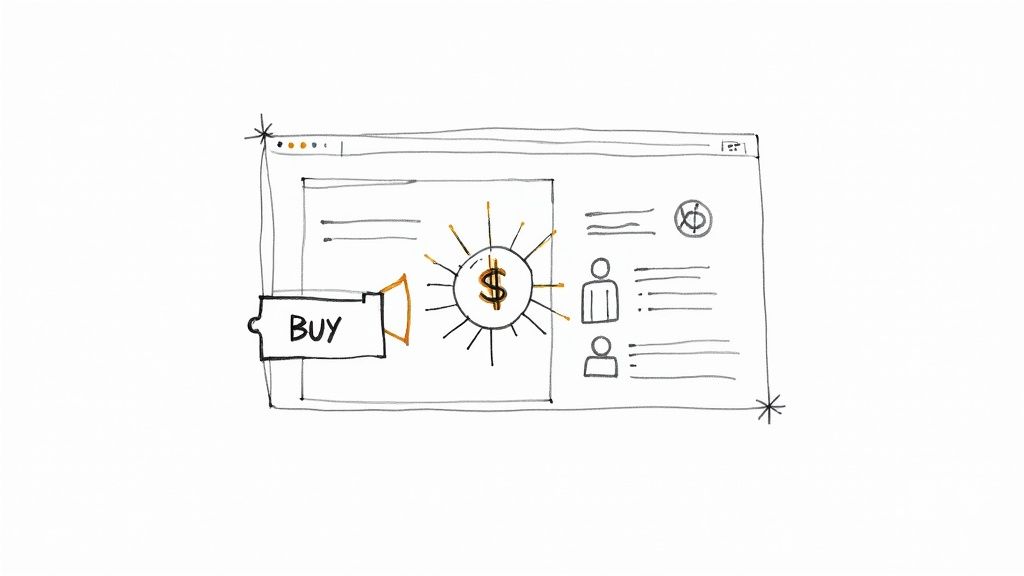
    Sketch of a web browser showing a 'BUY' button and a glowing dollar sign, representing an online purchase.

    I once knew someone who burned through their entire life savings—$80,000—building the most beautiful, perfect ecommerce website you can imagine. Every pixel was flawless.

    But there was one huge, fatal problem.

    A designer built the site, not a salesperson. For all its beauty, it couldn’t convince a single person to actually buy something. It was a beautiful, expensive failure.

    This is a huge problem I see way too often. People focus way too much on Brand when they should be focusing on SELLING. From your first dollar to your first million, the key skill you must learn is how to sell.

    Your First Million Is Made by Sales, Not Style

    A free website that can persuade people to buy is worth way more than an $80k website that can’t persuade anyone. I’m serious. A basic Shopify theme that actually convinces a stranger to pull out their credit card is infinitely more valuable than a slick, custom-coded site that can’t.

    Think of your website like a car. A beautiful paint job is nice, but it’s the engine that gets you somewhere. In ecommerce, the engine is persuasion—your ability to use words, images, and offers to make someone feel that your product is the answer to their problem.

    This means you need to become a student of salesmanship. Learn direct response marketing. Learn how to write product descriptions that speak directly to a customer’s real-life frustrations. Your words are the salespeople working for you 24/7. They have to be good.

    A hard truth: No one cares about your brand in the beginning. They only care about what your product can do for them. Focus relentlessly on making that clear, compelling, and urgent.

    Focus on Function Over Form

    Look, a functional, sales-focused website doesn’t have to be ugly. But it absolutely must be ruthlessly effective. This is especially true for mobile shoppers, who are the lifeblood of modern ecommerce.

    The numbers don’t lie. Mobile commerce sales are projected to hit $2.51 trillion in 2025, with smartphones driving a staggering 85% of global online shopping. With billions of digital buyers, your site must work flawlessly on a small screen. A fast, simple mobile experience is far more critical than any fancy desktop design.

    So, before you spend a dime on custom design, prioritize these functional elements above all else:

    • Fast Loading Speed: If your site takes more than a few seconds to load, you’ve already lost them. Game over.
    • Clear Call-to-Action Buttons: Make the “Add to Cart” and “Buy Now” buttons big, bold, and impossible to miss.
    • Simple Checkout Process: Get rid of every unnecessary field. Integrate one-click payment options like Apple Pay; it can give your conversion rates a serious boost.
    • High-Quality Product Photos: Show your product from every angle. Even better, show it being used by a real person in a real situation.

    These simple, functional details will make you more money than any branding exercise ever will. For more practical advice on building a lean but effective online presence, check out our collection of startup resources.

    Writing Words That Actually Sell

    The single most powerful tool you have is your copywriting. It costs you nothing but time and can be the difference between a failing store and a seven-figure business.

    Your goal isn’t to describe your product’s features. It’s to sell the outcome.

    Imagine you’re selling a high-quality kitchen knife.

    • A designer writes: “This 8-inch chef’s knife is forged from high-carbon German steel with a full tang and an ergonomic polymer handle.”
    • A salesperson writes: “Stop struggling with dull knives that just crush your food. Effortlessly slice through a ripe tomato without squishing it. Feel the perfect balance in your hand as you chop vegetables faster and safer than ever before. Spend less time prepping and more time enjoying your meal.”

    See the difference? The first is a list of facts. The second sells a better life. Focus on writing like a salesperson, and you’ll be on the right path.

    Find Manufacturers Without Getting Scammed

    Finding a reliable manufacturer is probably one of the scariest parts of launching a brand. And for good reason. Every single person I know has been ripped off by their first manufacturer. BEWARE.

    It’s almost a painful rite of passage, but it doesn’t have to be yours.

    Think of finding a manufacturing partner like dating. You’re looking for a serious, long-term relationship. If they seem too slick, too eager, or just plain desperate to get you on board, that’s a massive red flag. Run.

    The Dating Game Red Flags

    Here’s the secret: the worst manufacturers almost always have the best marketing. If they are TOO EAGER to onboard you, that is a RED FLAG. If they have really good marketing—or any form of marketing whatsoever—that is a RED FLAG.

    A truly great manufacturer is busy. They are slammed with work from their existing clients and have zero time or need for slick marketing. They aren’t trying to win your business; you have to win theirs.

    Here are the biggest red flags I’ve learned to watch for:

    • They’re way too eager to get started. If they’re rushing you, throwing out huge discounts to sign immediately, or making everything sound incredibly easy, they’re probably desperate for cash. That often means they’ll cut corners on quality the second your payment clears.
    • They have any real marketing. A great factory gets business through word-of-mouth and reputation, period. A flashy website, paid ads, or aggressive sales emails are huge signs they might be a trading company in disguise or have quality issues causing high client churn.
    • They don’t ask you any hard questions. A serious partner will vet you just as much as you vet them. They’ll want to know about your sales projections, your business plan, and your quality standards. If they just say “yes” to everything, they don’t care about a partnership; they just want a purchase order.

    A GREEN FLAG for a manufacturer is when they don’t want to work with you. A good manufacturer should be very hard to convince. You have to chase them down and convince them. Just like dating, the best partners are often the hardest to get.

    Where to Find Real Partners

    Since the best manufacturers aren’t advertising, you have to find them where they actually hang out. This means doing some old-school detective work.

    A great place to start your search is on B2B marketplaces. The scale of B2B ecommerce is expected to hit a massive $32.11 trillion by 2025, and marketplaces like Alibaba command about 65% of that action. It’s a prime hunting ground, but you have to be strategic to find the gems among the millions of listings. Since roughly 70% of B2B deals in Asia now happen online, learning to navigate these platforms is a smart move. You can dig into more of these powerful B2B ecommerce trends from invespcro.com.

    Beyond scrolling through online marketplaces, here are the most effective ways to find a real partner:

    1. Trade Shows: This is the gold standard. Go to industry trade shows like the Canton Fair in China (or find its online equivalent). You can meet owners face-to-face, hold their products, and see instantly who is legit.
    2. Trade Show Websites: Can’t fly to a show? No problem. Look up the exhibitor lists from past trade shows online. This is a pre-vetted directory of serious players in your industry.
    3. Strategic Alibaba Searches: Use Alibaba, but use it wisely. Ignore the flashy profiles and sponsored listings at the top. Dig deep. Look for suppliers who have been on the platform for years and focus on those with detailed product specs, not slick marketing fluff.

    How to Make Your First Move

    Once you’ve got a shortlist, your first email is critical. Do not send a generic, copy-paste message. You need to show them you’re a serious, professional buyer who has done their homework.

    Keep your initial outreach short and to the point. Introduce your brand, clearly explain the specific product you want to make (with as much detail as you can), and state your expected initial order quantity. Be realistic but confident. This isn’t just about finding a supplier; it’s about building a solid foundation from day one, which is a core part of any good bootstrapping guide for entrepreneurs.

    And finally, always, always order samples before you even think about a production run. Pay for them. Test them ruthlessly. Try to break them. This small upfront investment can save you from an $80,000 mistake later on.

    Finding the right partner takes patience and a healthy dose of skepticism. Treat the process with the seriousness it deserves, and you’ll avoid the heartbreak—and wallet ache—that trips up so many new founders.

    Your Practical Ecommerce Launch Plan

    You’ve got the idea and you’ve got a plan. Awesome. Now comes the part where you actually make it real—connecting the paperwork and the pixels so you can start taking people’s money.

    The goal right now isn’t to build the perfect, flawless business. It’s all about momentum. We just want to get you moving, bank your first dollar, and start learning from real customers as fast as humanly possible. Don’t get stuck overthinking it.

    Laying the Foundation

    Before you can even think about that first sale, you need to build a proper container for your business. I know, this part sounds boring, but it’s what protects your personal assets and saves you from a world of hurt down the road. It’s not optional.

    First, make your business a separate legal entity. For most founders just starting out, forming a Limited Liability Company (LLC) is the way to go. It’s pretty simple to set up and, most importantly, it creates that critical wall between your business finances and your personal life.

    Next, open a separate business bank account. I can’t stress this enough: do not mix your personal spending with business revenue. Tangling those funds together is a nightmare waiting to happen come tax season, and it can even put your personal assets on the line if the business ever lands in legal trouble.

    Think of it like this: your LLC is the house, and your business bank account is the plumbing. You need both to be totally separate from your personal life to keep things clean, safe, and working right.

    Choosing Your Ecommerce Platform

    With the legal and money stuff sorted, you need a place to actually sell your stuff online. When you’re just starting, your choice of platform should come down to one single thing: speed to launch.

    Don’t overcomplicate this decision. Just start with a proven, effective tool like Shopify. It has everything you need to build a professional-looking store that actually turns visitors into customers. Seriously, you can get a basic site up and running in a single weekend. A simple site that sells is infinitely better than a beautiful, complex site that doesn’t.

    Your Scrappy First 100 Customers Plan

    Forget about fancy ads and complicated marketing funnels for now. Your one and only mission is to get your first 100 customers. That initial traction is built on hustle, not a huge budget.

    Here’s a simple, scrappy plan to get you there:

    • Jump into Online Communities: Find the Reddit subreddits, Facebook groups, or online forums where your ideal customers are already hanging out. The key is not to just spam your link. Become a real, helpful member of the community. Answer questions, offer advice, and only bring up your product when it’s genuinely a good fit for the conversation.
    • Lean on Your Personal Network: Make a list of everyone you know—friends, family, old coworkers—who might dig your product or know someone who would. Send them a personal message (not a mass email!) explaining what you’ve built and why you’re excited about it. Ask them to check it out and share it if they think it’s cool.
    • Try Some Direct Outreach: Find 10-20 small influencers or creators in your niche. Send them your product for free with a handwritten note and zero strings attached. If they genuinely like it, there’s a good chance they’ll share it with their audience.

    This early stage is all about doing things that don’t scale. If you’re looking for more inspiration, we’ve got a whole guide on how to start a business with no money that’s packed with creative, low-cost strategies.

    The infographic below breaks down a simple process for vetting the manufacturers you’ll need to bring your product to life.
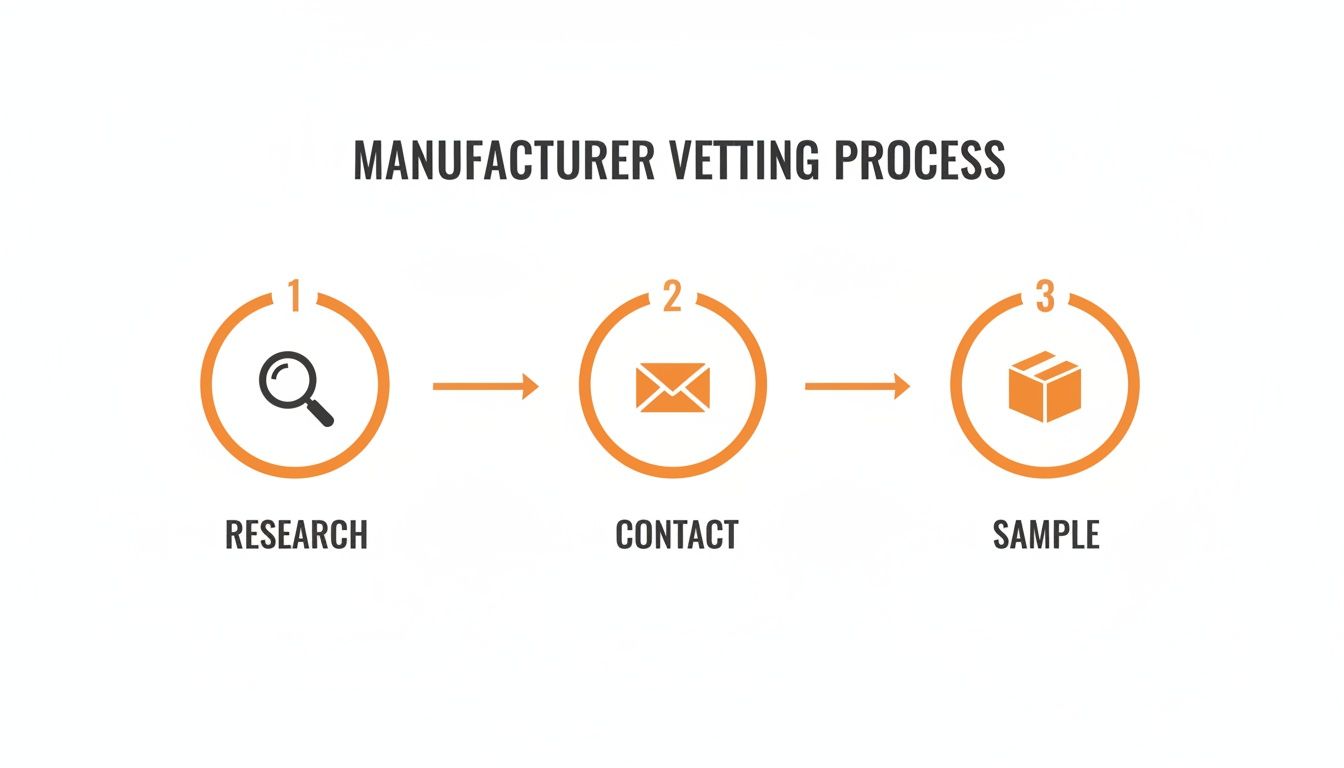
    Infographic illustrating the manufacturer vetting process, including research, contact, and sample stages.

    This three-step approach—digging deep with research, making professional contact, and being absolutely ruthless when you test samples—is your best defense against bad suppliers. Getting this part right is fundamental to building a business that can actually deliver on the promises you make to those first crucial customers.

    You’ve Got Questions? I’ve Got Answers.

    Alright, so your head is spinning with ideas and you’re ready to jump in, but a few questions are still holding you back. I get it. Let’s cut through the noise and tackle the big ones. No fluff, just straight talk from someone who’s been there.

    Should I Find a Niche with No Competitors?

    Absolutely not. A niche with no competitors is a bad sign.

    An empty market usually means there’s no money there. It’s like discovering a ghost town; it’s empty for a reason. You want to find a niche that has competitors making tons of money but are very weak. Maybe their product is bad, or their marketing is bad.

    Their success proves the market exists. Their weakness is your invitation to come in and do it better.

    The goal isn’t to invent demand out of thin air. It’s to find existing, hungry demand and serve it exceptionally well.

    How Much Money Do I Need to Start?

    Honestly, way less than you probably think.

    The days of needing $80,000 for some custom-coded website are long gone. You can get a great-looking Shopify store live for a few hundred bucks. Your first real investment shouldn’t be a fancy website; it should be getting your hands on that first round of product samples.

    The real number depends on your product and your hustle. I know founders who started with under $1,000. They hit up their personal network and used social media to make their first sales before ever placing a big inventory order.

    Focus on getting that first dollar of revenue. Don’t waste time and money building a perfect, expensive machine from day one.

    Do I Need a Brand Before I Launch?

    Nope. In the beginning, people focus WAY too much on Brand when they should be focusing on SELLING. It feels productive, but it doesn’t make you a single dollar.

    Your “brand” at this stage is simple: can you solve your customer’s problem? That’s it.

    Think about it this way—a brand is a reputation. You can’t have a reputation until you’ve actually done something. From $0 to $1 million, your one and only job is to learn how to sell. Your logo, your brand colors, your “voice”… none of it matters if you can’t convince someone to buy what you’re selling.

    What’s the Biggest Mistake New Founders Make?

    I see two that are tied for first place, and they’re both painful.

    1. Falling in love with a “Vitamin” idea. They build something that’s just a nice-to-have. You need to solve a “Tourniquet” problem—something deeply painful and urgent. The best problems are Tourniquet problems, next best are Painkillers, and finally Vitamins. When you solve a real pain, customers will practically rip the product out of your hands. They won’t just want it; they’ll need it.
    2. Getting ripped off by their first manufacturer. This happens to almost everyone. You get charmed by a slick website or a fast-talking sales rep and end up with a garage full of junk. Remember the dating analogy: a good manufacturer is busy and hard to get. A good manufacturer should be very hard to convince to work with you, not the other way around.

    Dodge these two bullets, and you’re already miles ahead of most people starting out.


    Ready to stop guessing and start building alongside people who actually get it? At Chicago Brandstarters, we believe the kind givers should be millionaires. We help hard-working founders in Chicago and the Midwest who are on the same journey. If you value real talk over performative networking, this is your community.
    Learn more and see if you’re a fit.

  • How to Start a Business with No Money: A Chicagoan’s Guide

    How to Start a Business with No Money: A Chicagoan’s Guide

    Starting a business with no money boils down to one simple, powerful truth: you have to sell a service first. This isn't about chasing venture capital or perfecting a 50-page business plan. It's about getting back to basics. Use the skills you already have to solve a real problem for someone willing to pay you for it.

    The whole game is about resourcefulness, not resources.

    Your No-Money Startup Is Closer Than You Think

    The biggest myth in business is that you need a mountain of cash to get started. That's just not true, especially in a city like Chicago that was built on pure grit and kindness. Most entrepreneurs begin right where you are now—with what they have.

    Think of it like a chef who creates a Michelin-star meal using just a handful of basic ingredients. You already have those ingredients: your skills, your time, and your unique perspective. The trick is to stop thinking, "I have no money," and start asking, "What can I create with what I have right now?"

    This isn't just wishful thinking; it's how most businesses actually start. A whopping 33% of businesses launch with less than $5,000, and the average startup cost is a surprisingly low $3,000. In fact, 66.3% of entrepreneurs fund their ventures themselves with personal savings or credit cards—no outside investors needed. You can dig into these small business statistics and see just how common this path really is.

    Before you can build a scalable business, you first have to unlearn the idea that you need a huge upfront investment. It’s a mental trap. The real currency in the beginning is action and the willingness to help someone.

    The No-Money Startup Mindset Shift

    Old Mindset (The Money Trap) New Mindset (The Giver's Edge)
    "I need to raise capital first." "I need to find a client first."
    "I have to build a perfect product." "I can offer my skills as a service."
    Focus on the business plan. Focus on solving a single person's problem.
    Waits for resources to appear. Creates resources by taking action.
    Sees money as the biggest asset. Sees skills and time as the biggest assets.

    Shifting your perspective from the "Money Trap" to the "Giver's Edge" is the most important first step you can take. It’s what separates the dreamers from the doers.

    The Real Starting Point

    So, how do you actually start a business with no money? It begins with a simple service. This is your engine for generating your first dollars. Forget about building a complex product or a fancy app for now. Your only goal is to get paid for your expertise.

    This could look like:

    • A graphic designer offering quick logo packages to local shops.
    • A writer creating a few blog posts for a tech startup.
    • A hyper-organized person managing calendars as a virtual assistant.

    Each of these examples uses an existing skill to bring in immediate revenue. That first payment is more than just money; it's validation. It's proof you have something people value enough to pay for. It is the single most important milestone for any new business.

    The fastest path to revenue is to stop thinking about what you need to build and start thinking about what you can do. Your service is your minimum viable product (MVP), and your first client is your first investor.

    This service-first approach tears down financial barriers and replaces them with opportunities built on your talent and kindness. It’s about being a giver, solving problems, and laying a foundation with pure effort.

    For more actionable playbooks like this one, check out our complete collection of founder guides. Let's get started.

    How to Land Your First Paying Client Without a Product

    Forget building a complex product. That’s the old way—a path littered with wasted time and zero cash. The fastest, kindest, and smartest way to start a business with no money is to simply sell a service.

    This isn’t some abstract theory. This is a real playbook for turning a skill you already have into actual revenue. Right now.

    Think of it this way: building a product is like trying to build a car from scratch. You need blueprints, parts, tools, and a factory. Selling a service is like offering to drive someone where they need to go in the car you already own—your skills. Your first goal isn't to build the factory; it's to complete that first trip and get paid for it.

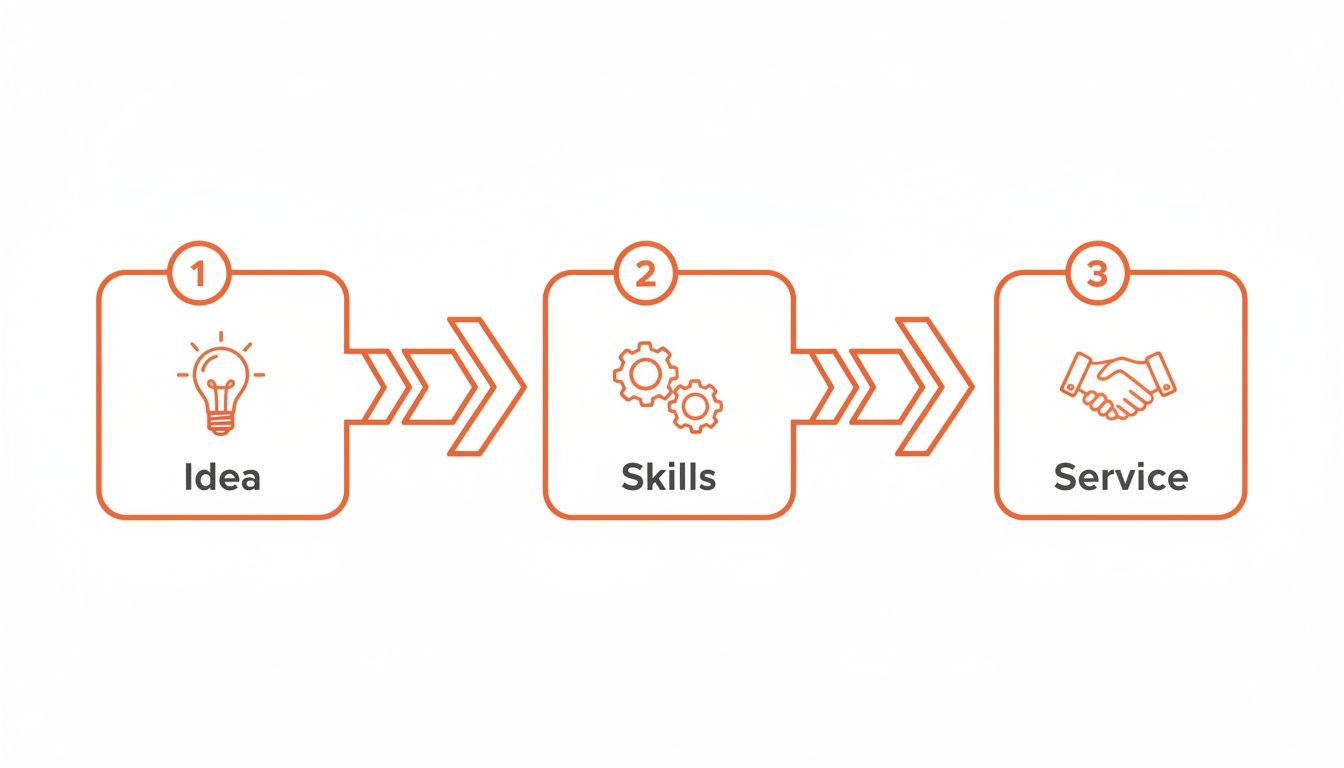
    The process is a simple, powerful shift from just having an idea to creating something that actually makes money.

    A three-step process diagram showing Idea, Skills, and Service with corresponding icons.

    The bridge between your idea and your first dollar isn't a product. It's the service you can offer today with what you already know how to do.

    Find the Problem Hiding in Plain Sight

    Your best business idea is probably something you already do without even thinking about it. What do friends, family, or colleagues constantly ask you for help with? That’s not a favor; it’s your first piece of market research.

    • Are you the one who organizes every group trip? You’re a natural project manager or virtual assistant.
    • Do your friends always ask you to proofread their resumes? You’re a copy editor in the making.
    • Do people compliment your home decor or your social media posts? You’ve got a designer's eye.

    These aren't just hobbies. They are legitimate, marketable skills. The key is to stop seeing them as casual talents and start seeing them as solutions to someone else’s problem. A small business owner in Logan Square doesn't have time to design her own flyers. A startup in the West Loop needs blog posts to attract customers, but their team is swamped. These are problems you can solve.

    Your first paying client isn't just buying a service. They are buying back their time and peace of mind. Your skill is the tool, but the relief you provide is the real product.

    Craft Your Simple Service Offer

    Okay, let's turn that skill into something you can actually sell. Don’t overcomplicate this. Your goal is to create one clear, simple offer.

    My advice? Think in packages, not hourly rates. Charging by the hour punishes you for being fast and efficient.

    Here are a few Chicago-specific examples to get you started:

    • For the writer: "I will write three 500-word blog posts for your local business website, optimized for your neighborhood (e.g., 'Wicker Park dog groomer'), for a flat fee of $300."
    • For the designer: "I will create a package of 10 professional social media graphics for your restaurant's Instagram page for $250."
    • For the organizer: "I will organize your digital files and set up a simple project management system in Trello for a one-time fee of $200."

    See how specific those are? They name the deliverable, the audience, and the price. This kind of clarity makes it dead simple for someone to say "yes."

    Your First Outreach Is Easier Than You Think

    With your simple service offer in hand, it’s time to find that first client. Forget cold calling hundreds of people. Your first client is almost always hiding in your existing network or local community.

    Your only job is to reach out with a spirit of kindness and helpfulness, not salesiness.

    Try this simple script and adapt it for an email, a LinkedIn message, or even a text:

    "Hey [Name], hope you're doing well. Quick question—I'm starting to offer [Your Simple Service, e.g., social media graphic design] for small businesses. You know so many people in the [Industry, e.g., restaurant] world, and I was curious if anyone you know has mentioned needing help with their online presence. I'm putting together a special introductory package to build my portfolio. Any thoughts would be super helpful!"

    This approach does three things perfectly:

    1. It’s low-pressure. You're asking for advice, not a sale. People love giving advice.
    2. It clearly states what you do. No confusion, no fluff.
    3. It gives them an easy way to help you. People genuinely love to be connectors.

    Another powerful tactic is to just show up in local online communities. Join a Chicago neighborhood Facebook group or a niche subreddit for local entrepreneurs. Don't just spam your offer. Instead, look for questions. When someone asks, "Does anyone know a good designer?"—that’s your cue to jump in and be helpful.

    This service-first method is exactly how you start a business with no money. You build momentum, you gain confidence, and—most importantly—you get that first dollar in the bank. Trust me, that single payment is the most powerful form of validation you will ever get.

    Building Your Business Foundation for Free

    That first payment is proof. Someone values what you do. Now it's time to build a simple, professional foundation that inspires even more trust—without spending a dollar.

    Think of it like building a sturdy workbench before you start crafting your masterpieces. It doesn’t need to be fancy, but it absolutely needs to be solid and functional. This is how you show up as a serious, reliable partner from day one.

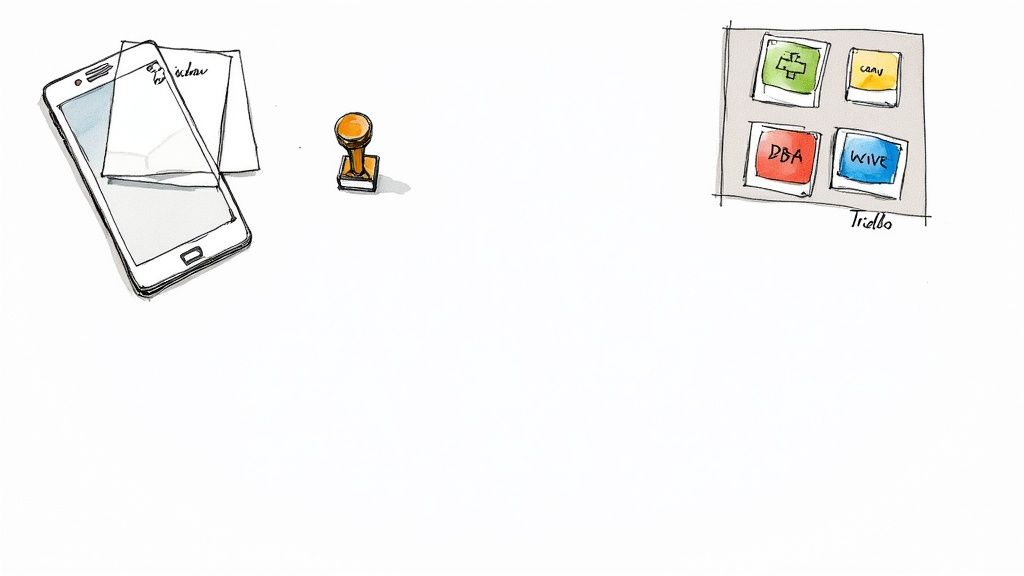
    Hand-drawn illustration of a smartphone, a stamp, and a grid of four app icons labeled 'Tridbo'.

    Claim Your Name and Digital Real Estate

    First things first: give your business a name. Make it memorable, easy to say, and relevant to what you do. Don’t overthink it for weeks; a good-enough name you actually use is infinitely better than a "perfect" name you never choose.

    Once you have a name, immediately secure your digital real estate. This part is non-negotiable and, luckily, costs nothing.

    • Social Media Handles: Jump on Instagram, TikTok, LinkedIn, or any other platform where your clients might hang out. Create accounts with your business name (like @YourBusinessName). Even if you don’t plan to use them right away, claim them before someone else does.
    • Email Address: Create a professional Gmail account like [email protected]. It’s free and looks so much better than sending client emails from [email protected].

    This simple act of claiming your name across a few key platforms makes your business feel real. It creates consistency and makes you easy to find.

    Making It Official: The Lean Chicago Way

    Once you’ve got some money coming in, you have to think about your legal structure. Don't get intimidated by this. Here in Illinois, the initial steps are pretty straightforward, and you have two primary, low-cost options to start.

    A DBA (Doing Business As) is the simplest path. It’s basically a registered nickname for you as a sole proprietor, letting you operate under a business name that isn't your own. It’s cheap and easy to file with the county clerk.

    The next step up is a single-member LLC (Limited Liability Company). This creates a separate legal entity for your business, and its main advantage is huge: it protects your personal assets (like your home and car) if the business ever faces debts or lawsuits. It costs a bit more to set up, but that peace of mind is invaluable.

    For your first few clients, operating as a sole proprietor is totally fine. But once you have consistent income, filing for an LLC is a bold, smart move. It protects you and signals to everyone that you're building something that lasts.

    Your Free Business Toolkit

    Running a business requires tools, but they don't have to drain your bank account. Your whole focus should be on creating a smooth, professional experience for your clients, and you can do that for free.

    Here is a curated list of essential, completely free tools to get you started:

    • Design: Canva is your best friend. Use it to create professional-looking proposals, invoices, social media graphics, and presentations. The free version is incredibly powerful.
    • Invoicing & Accounting: Wave offers free invoicing, accounting, and receipt scanning. You can send polished invoices and easily track payments, which is crucial for managing your money from the jump.
    • Project Management: Trello is a simple, visual way to manage your work. Create boards for each client, make to-do lists, and track progress so nothing falls through the cracks.
    • Business Phone: Grab a free Google Voice number. It keeps your business calls and texts separate from your personal life, adding a layer of professionalism while helping you maintain some sanity.

    Using these tools properly from day one is a survival tactic. After all, a staggering 82% of business failures stem from poor cash flow management. Starting with a free tool like Wave to track every single penny is one of the kindest things you can do for your future self. For more on this, check out these startup statistics and survival rates.

    These free resources are more than enough to build a solid foundation. We've compiled even more recommendations, which you can find on our list of free resources for Chicago founders. The goal here is to keep your overhead at absolute zero while you deliver a million-dollar experience.

    Marketing Your Business When Your Budget Is Zero

    So, you’ve landed a client and started to build a real foundation. Awesome. Now, how do you get the word out when your marketing budget is exactly $0?

    The answer isn't some complicated growth hack. It’s all about being scrappy, generous, and genuinely helpful. Marketing without money means proving your value before you ever ask for the sale. It's a slow burn, but it creates a rock-solid reputation that paid ads just can't buy.

    Think of it like being a great host at a party. You don’t walk around shouting about how great you are. You make introductions, share interesting stories, and make sure everyone feels welcome. People naturally gravitate toward that. Your marketing should do the same thing.

    Content That Gives More Than It Takes

    Your first move is to create one single piece of content that solves a real, nagging problem for your ideal customer. Don't try to launch a whole blog or YouTube channel. Just make one thing that is ridiculously useful.

    This could be a quick article, a simple checklist, or a short video. The format doesn't matter nearly as much as the value inside. Just ask yourself: What is one question my ideal client is Googling right now? Answer that question with clarity and kindness.

    • For a Graphic Designer: Create a simple PDF guide called "5 Free Canva Templates to Make Your Restaurant's Instagram Pop."
    • For a Virtual Assistant: Write a blog post on Medium titled "The 3-Step Process for Conquering Your Messy Inbox This Weekend."

    Once you've made your resource, share it where your people hang out. Post it on your LinkedIn profile. Drop it in a relevant Chicago-based Facebook group. Be a giver, first and foremost. This simple act of sharing what you know is what builds trust and attracts people who see your expertise.

    Marketing without a budget is a marathon, not a sprint. Every helpful article you write or connection you make is like laying another brick in the foundation of your reputation.

    The Power of Showing Up in Your Community

    Next, get out there and network—but with purpose. Forget stuffy corporate events. Your best opportunities are in local, niche communities where you can just be a real human.

    This is where being in Chicago is a massive advantage. We have a culture of support here. Your goal is to find your people and offer value long before you ever mention what you sell.

    • Join local online forums. Find your neighborhood's Chamber of Commerce group or a Slack community for local entrepreneurs. Listen in on the conversations. When someone asks a question you can answer, jump in with a helpful, detailed response. Don't sell. Just help.
    • Attend free meetups. Organizations like 1871 often host free events and workshops. Show up, be curious, and ask people what they're building. Make genuine connections, not sales pitches.
    • Engage with local businesses on social media. Follow a few local businesses in your target market. Leave thoughtful comments on their posts. Share their content when it's good. Be a good digital neighbor.

    This is all about playing the long game. When you consistently show up and provide value, people remember you. When they—or someone they know—need the service you offer, your name will be the first one that comes to mind. It's the Chicago way: earn respect through hard work and kindness.

    Making Connections Effortlessly

    As you meet people, you'll need a dead-simple way to share your contact info. A clean digital business card is a modern, no-cost tool that makes a great impression. You can share it with a link or a QR code, which is perfect for those random conversations at a coffee shop or meetup.

    For a straightforward guide on setting this up, learn how to generate a QR code with a contact card for free. It’s a small touch that shows you’re professional and on top of your game.

    Marketing with no money isn't a limitation; it's an opportunity. It forces you to be more creative, more authentic, and more plugged into your community. By focusing on giving value, you’ll build a brand that people not only trust but are genuinely excited to tell their friends about.

    Scaling from Service Gigs to a Real Company

    That first check from a client? That's your seed money. It might feel small, but it’s the most powerful capital you'll ever have. The real test is how you plant it to grow something much, much bigger. This is the moment you shift from freelancer to founder, turning early cash flow into an actual business.

    Think of that first bit of revenue like a small pile of kindling. You can use it to create a brief, warm fire, or you can use it to carefully ignite a much larger log that will burn for hours. Spending it on personal treats is the first option; reinvesting it smartly is the second. This is how you start building a real asset, moving beyond just trading your time for money.

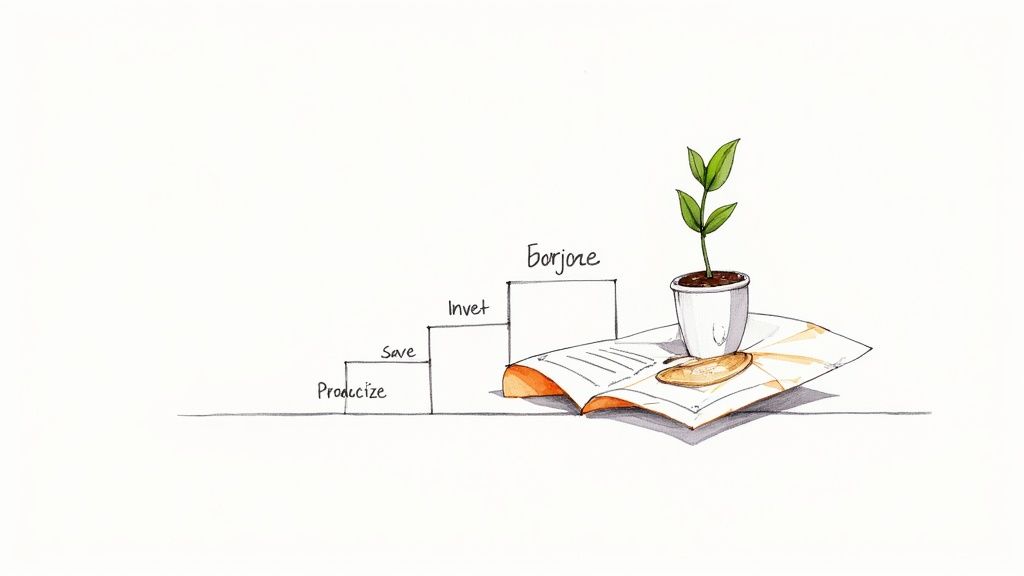
    A watercolor illustration depicting steps like Producize, Save, Invest, leading to a growing plant.

    Your First Smart Investments

    When you’re starting with zero cash, every single dollar you earn is precious. The goal isn’t to pay yourself a big salary right away. It's to put that money back to work, building systems that eventually make money for you.

    Your initial profits should go straight into assets that either save you time or boost your earning potential. We're not talking about flashy purchases; these are strategic, almost boring, moves that pay off big time.

    Here are a few wise first investments:

    • Key Software: Maybe it's finally upgrading from the free version of your accounting software. Or paying for a scheduling tool that kills the endless back-and-forth emails. A $20/month subscription that saves you five hours a month is an incredible return on your investment.
    • A Professional Website: A simple, clean one-pager on a platform like Squarespace or Carrd can be set up for a few hundred bucks. It acts as your digital storefront, building credibility and working for you 24/7.
    • Legal Formation: Like we talked about, saving up that LLC filing fee is a huge step. It protects your personal assets and sends a clear signal to clients that you are a serious, legitimate operation.

    This path of self-funding, or bootstrapping, is how most founders get their start. A staggering 78% of startups worldwide are self-funded. And the survival rates are pretty encouraging, too; nearly 80% of bootstrapped businesses make it past their first year. It’s solid proof that reinvesting your own revenue is a powerful way to grow. You can dig into more of these startup survival rates if you're curious.

    From Doing to Productizing

    The ultimate goal is to stop selling your time. You escape that trap by "productizing" your service. This just means turning your custom, one-off service into a standardized, repeatable package that you can sell over and over again.

    It’s the difference between being a custom tailor who measures every single client and a clothing brand that sells beautifully designed shirts in standard sizes. The brand can help way more people and scale much faster.

    Productizing your service is how you build a system that can run without you. It’s the first real step toward creating a company instead of just a job for yourself.

    To get started, just look at the work you’ve done for your first few clients. What were the common steps? What parts of the process were the same every single time? That process is what you need to package up.

    Real-World Example: A Graphic Designer's Journey

    1. The Service: A designer in Pilsen starts out creating custom logos for local cafes, charging $500 a pop. The work is great, but she's always starting from scratch, trading hours for dollars.
    2. The Analysis: After a few projects, she realizes every client needs the same core things: a primary logo, a social media profile icon, and a simple brand color palette.
    3. The Productized Offer: She creates the "Local Brand Starter Kit" for a flat fee of $1,200. It includes the logo, social assets, and a one-page style guide. She even builds a template for her process, which makes her faster and more efficient.

    Now, she’s not just selling "design time." She's selling a clear, valuable outcome. This lets her raise her prices, work more efficiently, and serve more of the kind, hard-working Chicago businesses she loves to support. That’s the essence of scaling.

    Got Questions? We've Got Answers.

    When you're starting a business with nothing but an idea and grit, a million questions pop into your head. Here are the real-deal answers to the ones we hear most from the bold, kind builders right here in Chicago.

    Do I Really Need to Register My Business Legally Right Away?

    Not on day one. But you should do it right after you land that first paying client.

    At the very beginning, you can just operate as a sole proprietor. This means you and your business are legally the same thing. It's the simplest way to start—no paperwork required.

    But once you've got real money coming in, it's time to make it official. You can file a DBA ("Doing Business As") to use a business name, or, even better, form a single-member LLC. An LLC is a game-changer because it builds a wall between your personal assets and your business debts.

    Here in Illinois, setting up an LLC is pretty straightforward. It also makes you look way more professional, which builds trust with clients. Think of it like putting on a uniform for work; it signals to everyone that you're serious.

    How Do I Set My Prices If I Have Zero Experience?

    This is the classic question that trips up so many new founders. First, do some digging to see what other people in your space are charging. But whatever you do, don't just copy them. Your price should reflect the value you deliver, not just the hours you put in.

    Stay away from hourly billing. It punishes you for being good and fast at what you do.

    Instead, create service packages. Think "Website Launch Package" or a "Monthly Social Media Content Package." This gets the client focused on the result they’re buying, not the time you're clocking.

    It's totally fine to offer a slightly lower "beta" rate for your first one or two clients in exchange for a killer testimonial. But don't undervalue yourself. The right clients will happily pay for the results and peace of mind you're providing.

    Your price is a signal. Setting it with confidence tells clients you believe in the value you're creating. Don't start your business journey by telling the world you're the cheap option.

    What’s the Single Most Important Thing to Focus On?

    Cash flow. Full stop.

    A staggering 82% of small businesses fail because they can't manage their cash flow. When you're starting with no money, every single dollar is critical.

    Your number one job is getting cash in the door. That means every ounce of your energy should go toward activities that lead directly to a sale: talking to potential customers, sending clear proposals, and following up. Forget about designing the perfect logo or wasting weeks on a business plan right now.

    Invoice your clients the second the work is done. Follow up on payments politely but firmly. Remember, a business without cash flow isn't a business—it's just a hobby.

    How Can I Possibly Compete with Established Businesses?

    You compete by being more human. Seriously. As a new founder, your superpower is personal connection.

    An established company can't offer the same level of direct attention and care from its founder. You can. That's your edge. Use it.

    • Build real relationships: Actually get to know your clients and what keeps them up at night.
    • Respond faster: Be the quickest, most responsive person they work with.
    • Add personal touches: A handwritten thank-you note or a quick check-in email makes a huge difference.
    • Be generous: Share what you know freely. Give away your expertise in your marketing.

    While they're blowing money on ads, you're building a loyal community, one person at a time. In the long run, genuine relationships built on trust and kindness will always beat a big marketing budget. It’s the Chicago way—grounded in hard work and a real desire to help other people win.


    At Chicago Brandstarters, we believe you have what it takes to build something incredible from scratch. We know how to turn people into millionaires, and we believe in helping the kind givers get there. If you’re a bold builder in Chicago, we invite you to learn more about our community. We’re here to help you skip the trial-and-error and build lasting relationships that move your business forward.

    Learn more and connect with us at https://www.chicagobrandstarters.com.