

Tag: venture capital

  • A Founder’s Guide on How to Find Investors for Small Business

    A Founder’s Guide on How to Find Investors for Small Business

    When you're starting out, trying to find investors can feel like shouting into a pillow. But let me give you the honest truth: the timing has never been better to go out and get that capital. The market is actively looking for founders like you with big ideas.

    Is Now the Right Time to Find Investors?

    A businessman looks out a window at a city skyline with an overlaid financial graph and "NOW'S THE TIME" text.

    It’s way too easy to get trapped in your own world, working nonstop on your product. You feel totally cut off from the financial markets. You see scary headlines and think nobody’s writing checks anymore.

    I'm here to tell you that’s wrong. They are.

    Let’s look at the big picture. The global small business market was worth a staggering $2.572 billion in 2023. That number is on track to nearly double to $4.985 billion by 2032.

    This isn't just some random number. It’s a tidal wave of opportunity flowing straight into the world you and I are building. You can dig deeper into these small business trends on the BizPlanr blog, but the takeaway is simple: a rising tide lifts all boats.

    Okay, But What Does This Mean for Me?

    For you, a founder grinding it out, it means investors are paying attention. The U.S. led this growth in 2023. With over 34.8 million small businesses making up 99.9% of all businesses in the country, we're not just part of the economy—we are the economy.

    Smart money goes where the growth is. Investors know that the next killer brand can come from a garage in Naperville just as easily as it can from Silicon Valley. They are actively hunting for these opportunities because the potential returns are massive.

    Here’s a quick gut-check for you to see if you're really ready. Be honest with yourself.

    Quick Guide to Investor Readiness

    Here's a quick checklist to see if you're truly ready to start your investor search.

    Readiness Check What You Need Why It Matters to Investors
    A Real Problem A clear, painful problem your customers face. They want to see a "hair on fire" problem, not a mild inconvenience.
    Early Traction Some proof people want what you're building (users, early sales, a waitlist). Ideas are cheap. Proof shows you can execute.
    Knowing Your Numbers A basic grasp of your market size and how you'll make money. They need a path to getting their money back, plus some.
    A Solid Story A simple, compelling pitch that explains what you do in under 30 seconds. If you can't explain it clearly, they can't get excited.

    Going through this isn't just for them; it's about building your own confidence before you walk into the room.

    Your job isn't to convince someone to believe in a fantasy. It's to show them how your business fits into a booming market. You’re providing a specific path to tap into that growth.

    This isn't blind optimism. It's about seeing the real economic winds at your back. You aren't just begging for money; you’re offering someone a partnership. That confidence, backed by data, changes everything.

    First Things First: Get Your House in Order

    Desk setup with laptop, calculator, business charts, pen, plant, and a 'GET PREPARED' sign.

    Before you draft that first email, stop. I know you're excited about the chase, but the most important part of finding investors has nothing to do with finding them. It’s about getting your business in order first.

    I’ve seen too many founders crash and burn because they skipped this step. They had a great idea, but their story was messy and their numbers were a disaster.

    Getting your materials together isn’t just about looking good for them; it’s about gaining clarity for yourself. When you’ve done the work, you can walk into any room knowing your business inside and out.

    The One-Page Executive Summary

    Your most powerful tool is a simple one-page executive summary. An investor gets hundreds of these a week. They spend just minutes on each one. Your only job is to get them to understand your business and want to know more. That’s it.

    Here’s what I always include in mine:

    • The Problem: What’s the "hair on fire" issue your customers face? Nail this in one or two sentences.
    • Your Solution: In plain English, how do you put out that fire? No buzzwords.
    • The Market: Who is your customer and how many of them exist? Is this market growing?
    • Why Now: Why is this the perfect moment for your solution?
    • Traction: Show me one or two numbers that prove you’re onto something. This could be revenue, user growth, or a big waitlist.
    • The Team: A quick line on why you and your co-founders are the only people who can pull this off.
    • The Ask: Be direct. How much are you raising and what will you do with it? (e.g., "We're raising $250,000 to expand production and hire a lead developer.")

    If you can’t tell your story on a single page, you don’t know your story well enough. It’s a harsh truth, but it forces you to be concise.

    An investor isn't funding your idea; they are funding your ability to execute. Your preparation is the first piece of evidence that you can.

    Your Pitch Deck Is a Story, Not a Novel

    Next is your pitch deck. Too many founders create a 40-slide monster packed with every detail. Please don’t do this. Your pitch deck is a visual story, not your life’s work.

    The best decks I’ve seen are built around 10 core slides. They tell a story that flows from the problem to how you’ll make money. The goal isn’t to answer every question—it’s to start a conversation. If they’re asking you questions, it means they’re leaning in.

    This kind of prep work also helps you build your company’s financial credibility. If you're curious about that, you can check out our guide on a simple way to build business credit for your company.

    Build a Financial Model You Actually Understand

    Okay, let's talk numbers. The term "financial model" makes a lot of founders sweat, but it’s not as scary as it sounds. You don’t need some 20-tab spreadsheet that only a Wall Street quant could love.

    Your financial model is just your business's story, but told with numbers. It’s your best, most honest guess about the future.

    Just start with these three things:

    1. Your Costs: List everything you spend money on. Be real. Salaries, marketing, software, rent—all of it.
    2. Your Revenue: How do you make money? How many customers do you need to hit your goals? Show your math.
    3. Your Runway: This is the big one. Based on your costs and revenue, how many months can your business survive before the bank account hits zero?

    Building this gives you an incredible sense of control. You’ll know exactly which levers to pull to stay alive. When you've done this homework, you're not just a founder with a cool idea. You're an operator with a plan.

    Alright, let's talk about finding money for your brand. This is a huge topic, and it’s easy to get lost.

    First thing's first: not all money is good money. I’ve seen it happen. Taking cash from the wrong person can torpedo your company faster than having no cash at all. You absolutely need to know what kind of capital you’re looking for before you start asking.

    Think of it this way. If you need a single, weirdly specific screw, you go to a local hardware store where the old-timer behind the counter knows every piece of inventory. If you're building a house, you go to a massive Home Depot. Both sell screws, but they solve completely different problems.

    Your job is to draw a map of this investor world so you stop wasting months pitching people who were never going to be the right fit.

    The First Stop: Friends and Family

    For most of us, this is where it begins. It’s your mom, your old college roommate, or that one uncle who's always believed in you. This is the "love money" that gets so many incredible brands off the ground.

    But be warned: mixing money and relationships is like juggling chainsaws. It can get messy, fast, if you don't set crystal-clear expectations from day one.

    My advice? Treat them like real investors. Because they are.

    • Put it in writing. Seriously. Don't do a handshake deal over Thanksgiving dinner. Get a simple, legally sound agreement.
    • Be brutally clear on the terms. Is this a loan they expect back with interest? Or are they getting a piece of the company (equity)?
    • Set the boundaries. Be upfront about their role. If you want their money but not their two cents on your new logo, you have to say that—kindly, but firmly.

    These are awkward conversations, I know. But they save you from catastrophic blow-ups down the road. You want them to feel respected, not used.

    The Smart Money: Angel Investors

    Okay, you've got a little traction and you need a bigger check. It's time to find angel investors. These are usually successful entrepreneurs or wealthy individuals who invest their own money into early-stage companies.

    I love a good angel investor. Why? The best ones bring more than a check. They bring their network, their hard-won experience, and real mentorship. They’ve been in your shoes. They know that gut-wrenching feeling of staring at the ceiling at 3 AM, wondering how you're going to make payroll.

    An angel might write a check for $25,000 to $100,000, maybe more. They’ll take equity, but unlike a VC, they usually aren't demanding a board seat right away. They just want to be kept in the loop.

    An angel investor is betting on you as much as your business. They need to see your passion, your grit, and that you understand the problem you're solving inside and out.

    A great angel becomes your first call when things go sideways—and your first call when you score a huge win. They are true partners. Here in the Midwest, many operate in groups like the Hyde Park Angels or IrishAngels, which lets them pool their money and expertise to make bigger, smarter bets.

    Moving Up to Venture Capital

    You’ve heard the term Venture Capital (VC). They get all the splashy headlines. But let's get a reality check: less than 0.5% of new businesses ever get VC funding. This is the big leagues, for companies with potential for massive, explosive growth.

    Here’s the difference: most of our businesses are like golden retrievers. They’re loyal, steady, and can grow into wonderful, profitable companies. VCs are only looking for cheetahs—businesses built for pure, blistering speed that can give them a 10x or 100x return.

    VCs invest other people's money (from pension funds, university endowments), so they are under immense pressure to find those rare home runs. They invest millions, and they will absolutely take a board seat and have a major say in how your company is run. If you aren't ready to give up that much control for rocket fuel, VC is not for you.

    Don't Overlook Alternative Funding

    There's a whole world of funding beyond these three paths. Obsessing over landing an angel or a VC can make you miss much better options hiding in plain sight.

    You can find grants for businesses with a specific social mission. There are Community Development Financial Institutions (CDFIs) that give loans to founders who might not get a yes from a traditional bank. We have some fantastic CDFIs right here in Chicago that just want to see local businesses succeed.

    It's all about knowing your numbers. While 65.3% of small businesses are profitable, a staggering 78% of solo founders make less than $50,000 a year. Knowing these benchmarks helps you target the right funding source for your actual stage. You can find more small business stats on Cake.com to help ground your financial story in reality.

    By mapping out all these players, you can finally stop shouting into the void and start having targeted conversations with the right people.

    Finding Your First Investors in the Real World

    Alright, you’ve polished your pitch deck and perfected your story. Now for the hard part: where do you actually find the people who write the checks?

    If your plan is to blast out a hundred LinkedIn connection requests, stop right now. That’s a fast track to burnout and a full inbox of rejections. Fundraising is a game of relationships, not a numbers game.

    We’re not building a list of 500 random names. We’re building a targeted list of maybe 50 people who are a genuine fit for you and your brand. It all starts with who you know.

    This whole process follows a pretty standard path. You almost always start with people you know and work your way out to the pros.
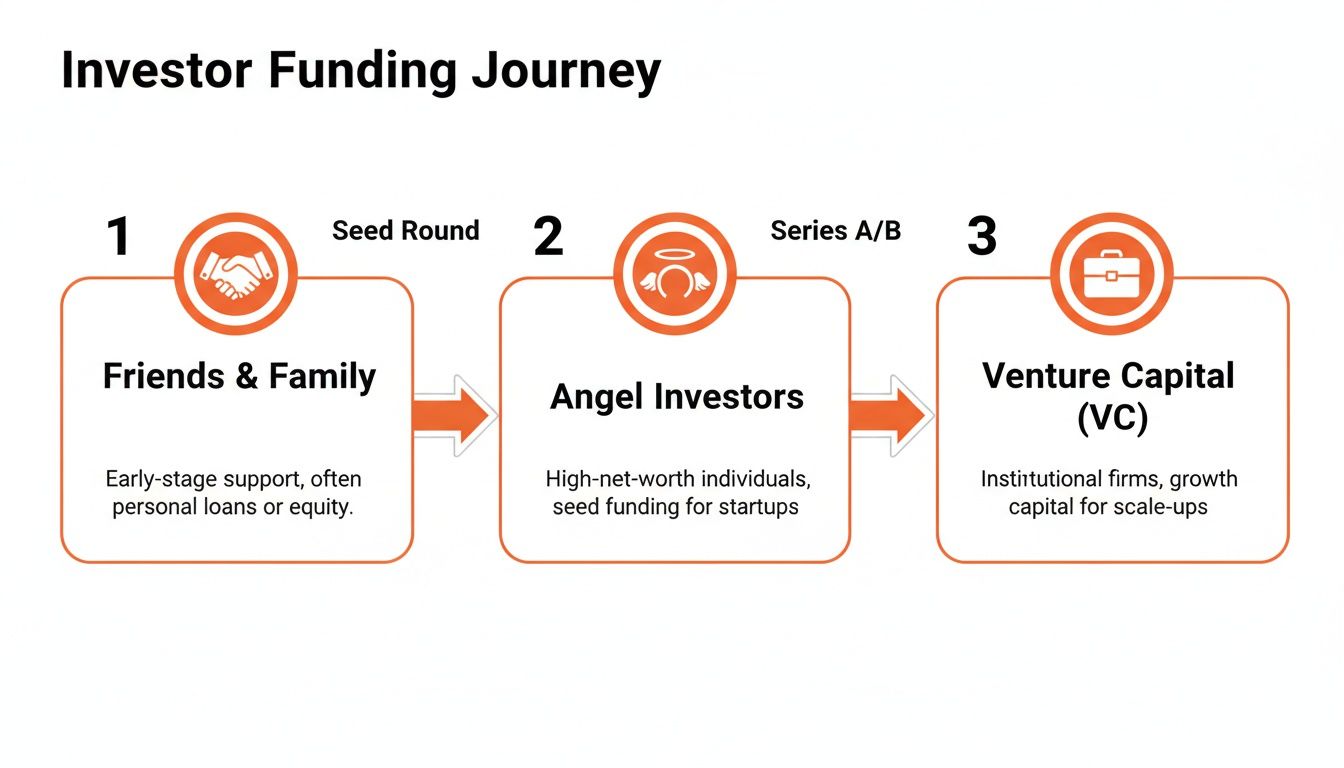
    Diagram illustrating the investor funding journey, from friends & family to angel investors and venture capital.

    As you can see, you don't just jump straight to VCs. You earn your way there.

    Start With Your Warm Network

    Before you chase down strangers, map out the connections you already have. This is your "warm" network—people you know, or people just one degree away.

    It's like making a friend. You’re way more likely to get a real conversation if a mutual connection can vouch for you.

    • Make a List: I’m serious. Open a spreadsheet. List everyone who might be an investor, know an investor, or is just incredibly well-connected. Think old bosses, trusted colleagues, professors, even that person you always click with at parties.
    • Never Ask for Money First: This is the golden rule. When you reach out to your warm network, your first ask isn’t for cash. It’s for advice.
    • Use the Magic Question: "I'm starting something new and I really respect your take. Do you have 15 minutes for me to run it by you and get your honest feedback?"

    This approach is genius. It’s flattering and takes the pressure off. And if they’re impressed, they will often volunteer to connect you with actual investors. That introduction is everything.

    A warm introduction from someone an investor trusts is the single best way to get their attention. It immediately puts you in a different category from the hundreds of cold emails they ignore every week.

    For our Chicago Brandstarters members, this community is your first warm network. We talk more about making these connections count in our guide on effective business networking strategies.

    Tap Into Local and Regional Resources

    Once you’ve worked through your immediate circle, go local. Every city has a startup scene—a small ecosystem trying to help founders win. Your job is to get in the room.

    Here in Chicago, that means showing up at places like 1871 or getting involved with P33. These hubs are magnets for entrepreneurs, mentors, and the investors who follow them. Go to their events, even the virtual ones.

    And don’t just go to “startup” events. If you’re building a food brand, you better be at every single local food and beverage trade show. That’s where you’ll meet angel investors who actually get your industry.

    Use Online Platforms the Smart Way

    Online platforms can work, but they aren't a magic wand. Think of them as research tools, not a place to just spam “connect.”

    • AngelList: This is still the main hub. You can build a company profile and search for investors. The key is to be surgical. Look for investors in your city or region who have put money into companies in your exact industry.
    • Gust: A lot of angel groups use Gust to manage their deal flow. Local groups like Hyde Park Angels or IrishAngels run their applications through this platform, so it's a good place to be.

    When you find a good fit, don't just hit a button. Do your homework. See who they've already invested in. Check them out on LinkedIn. Do you have any mutual connections? If you do, you just found your warm intro.

    That’s how you turn a cold online search into a real conversation.

    Alright, you've done the homework. Your story is sharp, you know your numbers, and you've got a list of potential investors.

    This is where most founders trip up. They get so wrapped up in their pitch they forget they're talking to another human being. It’s time to make contact.

    Two women having a business meeting at a small table, one writing notes in a notebook.

    The secret to a good first outreach? It’s not about you. It's about them.

    Your Cold Email Is a Warm Handshake

    Look, a cold email doesn't have to feel cold. Your only job with that first message isn’t to sell your whole company. It’s to get a conversation started.

    I’ve seen a ton of bad emails. The good ones, the ones that actually get a reply, usually do three things right:

    1. The Hook: Show them you did your homework. Mention a specific investment they made or something they wrote online. "I saw your investment in [Company X] and really resonated with your thinking on the future of consumer goods." This one sentence proves you’re not just spamming.
    2. The Bridge: Connect the dots for them. Super briefly. "We're building something with a similar spirit at [Your Company], tackling [Problem] for [Specific Customer]." One or two lines. That's it.
    3. The Ask: Make it ridiculously easy to say yes. Don't ask for an hour. Ask for "15 minutes to get your quick take" or if they're open to "a brief call to see what we're building."

    Honestly though, the best way to get a meeting is to avoid the cold email entirely.

    The most valuable currency in fundraising isn't your brilliant idea; it's a trusted introduction. A 'warm intro' from someone they know and respect cuts through the noise. It gets you taken seriously from minute one.

    Don't be shy about asking your network for these. People who believe in you will want to help. Just make it easy for them. Write a short, forwardable email they can just copy, paste, and send. Do the work for them.

    Owning the First Meeting

    Congrats, you got the meeting. Now forget everything you’ve seen on Shark Tank. This isn't a 90-second circus act. It's a conversation.

    Your job is to lead it.

    This is your story. Don't just click through your deck like a robot. Use it as a backdrop, but make a human connection. Look them in the eye. Tell them the why—the personal story that made you start this whole crazy thing. People invest in other people, not just in spreadsheets.

    The most underrated skill in these meetings? Listening. An investor’s questions are a treasure map. They are literally telling you what they need to believe to write a check. If they keep drilling down on your customer acquisition strategy, that's your cue to have a rock-solid, confident answer.

    The Art of the Follow-Up

    How you end the meeting is as crucial as how you start it. Never leave without clarifying the next steps. A simple, "What would be the best way to follow up with you on this?" works every time.

    Then, actually do it. Send a thank-you note within 24 hours. Keep it short. Thank them for their time, mention something specific from the chat, and restate the next steps you agreed on. It shows you’re organized, respectful, and on top of your game.

    This whole process can feel draining, I get it. But remember, founders who are building and growing are what investors look for. Nearly 40% of small business owners are planning to hire this year. And investors notice who's adapting—49% of owners are now more likely to hire for AI skills, according to the U.S. Chamber of Commerce. That kind of forward-thinking is exactly what smart money loves to see.

    Whether you walk out with a verbal "yes" or a polite "no for now," every meeting is a win. You practiced your pitch. You made a new connection. You learned what resonates and what doesn't. That’s how you build momentum, and that’s how you eventually get the funding you deserve.

    So you got a "yes" from an investor. It feels incredible, like you just crossed the finish line of a marathon.

    Take a breath. Celebrate. But know this: you're not at the finish line. You're starting a whole different race—a marathon of paperwork and invasive questions.

    This is where a handshake deal turns into money in your bank. It's also where a lot of promising deals go to die. Your job now is to be organized and transparent.

    First, The Term Sheet

    After the pitches and follow-ups, a serious investor will send a term sheet. Don't get freaked out by the jargon. A term sheet is like a prenup for your business. It's not the final contract, but it lays out the big, important rules before you sign anything binding.

    It’s a serious declaration of intent, covering the key items that will define your new relationship.

    You absolutely have to understand these three things:

    • Valuation: This is the number everyone gets hung up on. It's what the investor says your company is worth before their money comes in (the "pre-money" valuation).
    • Equity: This is the piece of the pie you're giving away for the cash, calculated from the valuation.
    • Vesting: This one is for you. Your own shares will probably be put on a vesting schedule, usually four years with a one-year cliff. This is the investor's insurance policy to make sure you don't take the money and bolt. You have to stick around to "earn" the shares you already own.

    Remember, these terms are a starting point. You can, and should, negotiate. This is your shot to make sure you're not giving away the farm. If you don't understand something, ask. Even better, get a startup lawyer to look it over. Don't cheap out on this part.

    Welcome to the Due Diligence Gauntlet

    Once you agree on the term sheet, the real fun begins: due diligence. It's a fancy term for the investor checking to make sure you aren't lying. They are doing their homework.

    Think of it like a home inspection. They're going to poke around in all the corners, looking for leaky pipes or a cracked foundation. This will feel invasive. It's supposed to. It’s a standard part of every single deal.

    An investor’s due diligence isn’t a personal attack. It's a risk-management process. The best way through it is with speed and organization. Give them what they ask for, clearly labeled and without drama.

    Here’s a pro tip: start building your "data room" now, before you have a term sheet. A data room is just a secure folder on Dropbox or Google Drive with all your important documents. For a full rundown, check out our startup due diligence checklist for founders.

    Having this ready shows you’re a pro. It builds trust and keeps the deal moving. I’ve seen it a hundred times: delays kill deals.

    Closing the Deal and Getting Back to Building

    Once due diligence is over and everyone is still smiling, the lawyers draft the final closing documents. This is the heavy, legally binding stuff. You'll sign a huge stack of paper, the investor wires the money, and… congrats. You've closed the round.

    Go celebrate. Have a nice dinner. Take one night off.

    Because the next morning, the clock starts ticking. You just traded a piece of your company for cash and a whole new set of expectations. Now you have to use that money to make good on your promises.

    The real work has just begun.

    Tough Questions About Finding Investors

    You’ve got questions. Good. It means you're taking this seriously. Let's get right into the straight-up answers to what I hear most from founders.

    How Much Equity Should I Give Up?

    Founders get hung up on this all the time. The textbook answer for a first seed round is 10% to 20%.

    But honestly, that number is a distraction. I’ve seen people get a "good deal" by giving up less equity, only to partner with an investor who adds zero value beyond the check. That’s a terrible trade.

    The right partner brings experience and a network that makes your entire business—your piece of the pie and theirs—worth a hell of a lot more.

    My advice? Stop obsessing over the percentage. Focus on the valuation and the person you're bringing on board. A great partner will make that equity far more valuable down the road.

    What's the Biggest Mistake Founders Make When Pitching?

    Easy. They fall in love with their product and forget to talk about the business. I see it constantly. They can talk for hours about features and design… but they stumble when the money questions come up.

    Investors aren't just buying a cool product. They're buying a machine that turns their one dollar into ten.

    You have to show them how that machine works. They need to see:

    • The Market: Who are your customers? How many of them are there?
    • How You'll Get Them: What’s your plan to reach those customers without burning through all their cash?
    • The Numbers: What do your financial projections look like? When do you start making money?

    Tell a great story, absolutely. But back it up with a business case that proves you know how to make them a massive return.

    Seriously, How Long Does This Take?

    Here's my rule: whatever you think, double it. At least.

    A typical fundraising process, from the first email to cash in your bank account, will take 3 to 6 months. And that's if things go smoothly. I’ve seen it take a lot longer.

    It’s a marathon, not a sprint. You'll spend an insane amount of time researching, chasing introductions, taking meetings, and then getting buried in due diligence.

    Start the process at least 6 months before you need the money. Fundraising is a full-time job on top of your other full-time job. Be ready for it.


    If you’re a kind, hard-working founder in Chicago building a brand, you don't have to do it alone. Chicago Brandstarters is a free, vetted community built on real support, not just transactional networking. Join us and find the people who will have your back.

  • The Ultimate 10-Point Startup Due Diligence Checklist for 2026

    The Ultimate 10-Point Startup Due Diligence Checklist for 2026

    I’ve seen too many promising startups stumble. They weren't ready for the tough questions that come with raising capital. Due diligence isn't just for investors; it's a mirror for you, the founder. It helps you spot cracks in your own foundation before they become business-ending holes.

    Think of it like building a skyscraper in Chicago. You wouldn't start without checking the blueprints, right? A good startup due diligence checklist is your blueprint. It’s how you prove you've built something solid, something an investor will trust, and most importantly, something that can actually last.

    I created this 10-point checklist from real operator experience—the kind of hard-won knowledge we share in communities like Chicago Brandstarters. I want to help you get your house in order before you show it to the world. It’s for you, the kind, hardworking builder who is tired of being taken advantage of.

    In this guide, you won't find generic advice. I'll walk you through everything, from your founding team's character to the hard numbers in your financial model. I'll use simple analogies to break down complex topics and give you actionable steps. This isn't about passing a test. It's about building a better, stronger company from the inside out. I want to help you stop guessing and start building with confidence. Let's get you ready for that next big meeting.

    1. Founder Background, Character, and Alignment with Values

    Before you look at a single spreadsheet, you must understand the founder. Think of it like this: you wouldn't build a house on a shaky foundation. In a startup, the founder is the foundation. Your integrity, resilience, and personal values will shape the company’s culture and its ability to survive a crisis far more than any business model.

    Two smiling men discussing business at a table with a 'Founder Integrity' banner.

    This philosophy is the cornerstone of communities like Chicago Brandstarters, which supports "kind givers." The idea, from thinkers like Paul Graham and Naval Ravikant, is that long-term success is built on character, not just charisma. You’re looking for evidence of grit, generosity, and an authentic mission that goes beyond a quick payday.

    How to Evaluate Founder Character

    Your goal is to see the person behind the pitch deck. I look for consistent patterns of behavior over time.

    • Observe Interactions: How do you treat your employees, a server at a restaurant, or even your competitors? Look for humility and respect.
    • Discuss Failures: Tell me about a time you failed professionally. Do you take ownership and share lessons, or do you blame others? I find that founders who openly discuss their mistakes show maturity and strength.
    • Check for Generosity: Do you have a history of mentoring others or contributing to your community? When you share credit with your team, you show a "we" versus "me" mentality, which is vital for building a great culture.

    Key Insight: As Kevin Tao, founder of Chicago Brandstarters, often says, "We're not just betting on an idea; we're betting on the person's ability to lead with kindness and courage when things get tough." I want to know if you'll do the right thing, even when no one is watching. It’s the single most important predictor of a successful partnership.

    2. Market Validation and Customer Demand

    After you've assessed the founder, you need to confirm a real market exists for the product. An incredible founder with a product nobody wants is a recipe for failure. You must ensure you're solving a problem real customers will pay to fix. You need to find proof of demand before you spend significant time and money.

    A top-down view of a desk with a tablet displaying 'Validate Demand' on an orange banner, a pen, a notebook, and a small plant.

    This is the core of the lean startup methodology. Instead of building in a vacuum, you test your assumptions with real people. If you're building an ecommerce brand, this might mean preselling a product before manufacturing. If you're a SaaS company, it's getting beta customers to pay a subscription fee, no matter how small. These early signals prove you're on the right track.

    How to Evaluate Market Demand

    Your mission is to find proof that customers want your solution, ideally with their time or money. I look for concrete evidence, not just optimistic projections.

    • Conduct Customer Interviews: Talk to 20-30 potential customers. Your goal isn't to sell but to listen. Do they recognize the problem you're solving? How are they currently dealing with it?
    • Track Willingness to Pay: During interviews, ask if they would pay for your solution. A "yes" is good, but a "Here's my credit card" is validation. Track how many people show real interest.
    • Test with an MVP: Create a Minimum Viable Product or even just a landing page with an email signup. A Kickstarter campaign that funds your first production run is powerful validation—it uses real money to confirm demand.

    Key Insight: Validation isn't a one-time event; it's a continuous process. Your goal is to de-risk your business by proving your core assumptions are correct. Are your early adopters just a small group, or do they represent a much larger market? Strong, early validation is one of the clearest signs you have a real shot at success.

    3. Business Model and Unit Economics

    After you understand the people, you must understand the math. A brilliant idea without a sustainable business model is just a hobby. You have to rigorously analyze how your company makes money, one customer at a time. This is about proving the core financial engine works before you pour fuel on the fire.

    A person calculates unit economics using a laptop and calculator, with charts on a desk.

    Pioneers like David Skok and Peter Thiel stress that you must grasp your business's fundamental arithmetic. Can you acquire a customer for less than the profit they generate? It doesn't matter if it's a subscription or a one-time sale; your unit economics must make sense. For example, a direct-to-consumer brand should aim for a Lifetime Value to Customer Acquisition Cost (LTV:CAC) ratio of at least 3:1. This ensures a healthy, scalable future.

    How to Evaluate the Business Model

    Your job is to model the financial reality of a single transaction and project it forward. Get into your spreadsheets and see if the numbers hold up under pressure.

    • Model the Unit: Create a detailed spreadsheet. Break down the revenue and costs for your primary customer. What is your Customer Acquisition Cost (CAC)? What is the Lifetime Value (LTV)?
    • Find the Break-Even Point: Calculate when your cumulative profits turn positive. How many sales does it take to recoup your initial investment and ongoing costs?
    • Stress-Test Assumptions: Model multiple scenarios: a conservative case, a base case, and an optimistic case. How do your economics change if customer acquisition costs double?
    • Track Real vs. Projected: As soon as you launch, start tracking your actual metrics against your projections. This shows me you understand how to operate a business, not just dream about one.

    Key Insight: A common mistake is focusing only on revenue while ignoring unit profitability. If your CAC payback period is over 24 months, your unit economics are likely broken. A strong business model shows you can make money on each customer. This creates a foundation for profitable scale, not just a cash-burning machine.

    4. Competitive Landscape and Defensibility

    Once you understand the team and market, you must analyze the competitive battlefield. A great idea means nothing if it can't survive in a crowded arena. You need to know who you’re up against and what makes your business defensible. Think of it as building a moat around your castle. It’s not about being the first to build the castle; it’s about having a moat so deep that others can’t easily cross it.

    This concept, from thinkers like Michael Porter and Peter Thiel, pushes you to find your sustainable advantage. You're not just looking for a temporary edge; you’re looking for a structural reason why you will win long-term. This is the difference between a fleeting success and a lasting enterprise.

    How to Evaluate Your Competitive Moat

    Your goal is to articulate why customers will choose you and keep choosing you, even when alternatives emerge.

    • Map the Territory: Don't just list direct competitors. I want to see a simple map that includes indirect competitors (solving the same problem differently) and substitutes (other ways customers can get the job done). This gives you a full picture of the forces at play.
    • Identify Your Unique Advantage: What is your "secret weapon"? For a DTC brand, it might be an authentic community that competitors can't replicate. For a SaaS business, it could be high switching costs. Be specific. "First-mover advantage" is not a moat; it's a head start that will quickly vanish.
    • Test Customer Loyalty: Don’t just assume customers prefer you. Talk to them. Ask why they chose you over others. Was it because you were the only option, or because you offer something genuinely better? The answer reveals the true strength of your position.

    Key Insight: As Peter Thiel wrote in “Zero to One,” your goal is to build a business so good it becomes a monopoly in its niche. Your defensibility isn't static; it should strengthen over time. A marketplace gains network effects with more users. A data-driven company gets smarter with every customer. This makes your moat wider and deeper as you grow.

    5. Product-Market Fit and MVP Viability

    After confirming your integrity, my focus shifts to the product. Product-Market Fit (PMF) is that magic moment when your solution perfectly meets a market's needs. Think of it as finding the one key that effortlessly unlocks a door. Before you get there, you have the Minimum Viable Product (MVP), a simple version of your product designed to test this fit with the least effort.

    This concept, from figures like Marc Andreessen and Sean Ellis, is the core of any successful startup. It’s the difference between pushing a product uphill and having customers pull it from your hands. You are looking for clear signs that the product solves a real, painful problem, leading to enthusiastic adoption, strong retention, and organic growth.

    How to Evaluate Product-Market Fit

    Your goal is to find objective evidence that people truly want and need this product. You must look past vanity metrics like total signups and dig into actual user behavior.

    • Track Retention Religiously: This is the truest indicator of PMF. For a SaaS tool, this could mean a net promoter score (NPS) above 50, showing users are active advocates. For a social app, I’d look for weekly active user retention above 40%.
    • Analyze Word-of-Mouth Growth: When your product is great, people talk. Are more than 30% of your new users coming from organic referrals? This is a powerful signal that the product is solving a real need.
    • Focus the MVP: A viable MVP solves one core problem exceptionally well, not ten problems poorly. For example, an e-commerce brand might prove PMF with a repeat purchase rate over 15% on a single hero product before expanding its catalog.

    Key Insight: As Rahul Vohra of Superhuman showed, you can systematically measure and improve your fit. Ask your users how they would feel if they could no longer use your product. If over 40% say "very disappointed," you're on the right track. This part of your startup due diligence checklist confirms your business isn't just an idea; it's a necessity for its customers.

    6. Founding Team Composition and Capability Gaps

    If you as a lone founder are the foundation, your founding team is the entire frame of the house. A brilliant idea with a dysfunctional or incomplete team will collapse under pressure. A core part of your startup due diligence checklist is assessing your team's combined skills, their chemistry, and your plan to fill any critical gaps. You're not just backing individuals; you're backing a unit that must execute together.

    This principle is a cornerstone of thinking from Y Combinator's Paul Graham to venture capitalist Brad Feld. They stress that the founding team is often a better predictor of success than the initial idea. An A+ team with a B- idea can pivot and win. A B- team with an A+ idea will likely fumble the execution. You are looking for a complementary blend of skills and a history of working well together.

    How to Evaluate Team Composition

    Your objective is to confirm your team has the right mix of expertise to build the product, find customers, and manage the business.

    • Identify Complementary Skills: Look for balance. A classic successful pairing is a technical founder who builds and a business co-founder who sells. A team of three engineers with no one to handle marketing presents a significant risk.
    • Assess Prior Relationships: Have you worked together before? Tell me about past projects, successes, and even conflicts. Teams with a proven ability to navigate disagreements are far more durable than a new group. If you're just starting, understanding how to find a co-founder with aligned values is a critical first step.
    • Map Future Needs: Identify your most critical skill gaps for the next 12-18 months. Do you lack financial expertise? Do you need a marketing lead? A great founder will not only recognize these gaps but will have a credible plan to attract talent to fill them.

    Key Insight: A strong founding team isn't about having all the answers. It's about having the self-awareness to know what you don't know and the magnetism to attract people who are smarter than you in those areas. My bet is on your ability to build a world-class team, not just a world-class product.

    7. Financial Projections and Realistic Path to Revenue

    A compelling story isn't enough; I need to see a credible map to financial success. This part of the startup due diligence checklist examines your financial model not as a crystal ball, but as a reflection of your strategic thinking. Your projections show how well you understand the levers of your business: what it costs to get a customer, how long they will stick around, and how you will eventually turn a profit.

    This is not about having perfectly accurate numbers for year five. It’s about building a logical, bottom-up forecast grounded in solid assumptions. Thinkers like David Skok have shown that for SaaS companies, understanding unit economics like LTV to CAC is more critical than a top-down market size guess. Your financial model is your business plan in numbers. It shows you’ve thought through the hard parts of building a sustainable company.

    How to Evaluate Financial Projections

    Your goal is to show a realistic path from where you are now to future profitability, even if you have zero revenue today.

    • Build from the Bottom Up: Instead of saying, "We will capture 1% of a billion-dollar market," start with your planned activities. For example, "We will run ads generating 1,000 leads per month at a 2% conversion rate, yielding 20 new customers."
    • Model Different Scenarios: Create conservative, base, and optimistic forecasts. This shows me you understand that plans change and have considered a range of outcomes.
    • Track Your Runway: Calculate your monthly cash burn and determine your runway—how many months you can operate before running out of money. For example, if you have $200,000 in the bank and burn $20,000 per month, your runway is 10 months. This is a vital metric.

    Key Insight: As venture capitalist Vinod Khosla says, the assumptions behind your numbers are more important than the numbers themselves. A founder who can clearly articulate and defend assumptions about customer acquisition cost and churn rate shows a deep command of their business and a credible plan for growth. Your projections are a test of your operational intelligence.

    8. Intellectual Property and Legal/Regulatory Compliance

    After understanding the people, you must secure the castle's walls. Your startup’s intellectual property (IP) and legal compliance are the moat and fortifications that protect your core value. Without clear ownership of your IP and a clean legal bill of health, you are building on contested ground, vulnerable to lawsuits or regulatory shutdowns.

    This part of your startup due diligence checklist is about proving you have a defensible, legal right to operate and own your creation. Pioneers in the venture space like Brad Feld and accelerators such as Y Combinator constantly stress this. They know that a single overlooked IP claim from a founder’s past employer or a failure to comply with data privacy laws can instantly sink an otherwise promising company.

    How to Evaluate IP and Compliance

    Your goal is to ensure you own your "secret sauce" free and clear, and that you aren't unknowingly breaking any rules.

    • Audit Your IP Assets: What are your key innovations? For a software company, this might be a unique algorithm. For a consumer brand, it's the name and logo. You must identify and protect these assets.
    • Trace IP Ownership: Confirm all IP created by founders, employees, and contractors has been legally assigned to your company. A common pitfall is a founder who started coding a project while still at a previous job, potentially giving that ex-employer a claim to the IP.
    • Review Regulatory Exposure: Does your business touch on regulated areas? A fintech app has financial compliance, a health tech product has HIPAA, and any company with user data must consider privacy laws like GDPR or CCPA. For example, a marketplace platform must be crystal clear on whether its providers are contractors or employees to avoid massive legal trouble.

    Key Insight: As many Techstars mentors advise, "Legal diligence isn't about finding problems; it's about preventing them." Clean IP documentation and proactive compliance aren't just legal busywork. They are foundational assets that create tangible value and de-risk the entire venture for you, your team, and future partners.

    9. Scalability and Path to Seven Figures Revenue

    An idea that works for your first ten customers must also work for your next ten thousand. A critical part of any startup due diligence checklist is assessing scalability—your business’s ability to grow exponentially without its structure collapsing. Can your model realistically get to seven figures in annual revenue, or will it break under pressure? You're looking for a strong engine, not just a car that looks good in the driveway.

    This focus on intentional growth is fundamental to thinkers like Peter Thiel, with his emphasis on 10x thinking, and Paul Graham, who provides countless growth tactics. The core principle is leverage: finding a business model where your inputs don't have to grow at the same rate as your outputs. For communities like Chicago Brandstarters, a key goal is helping founders build the systems needed for this journey, a topic explored in their guide to scaling your business.

    How to Evaluate Your Path to Scale

    Your objective is to map out a believable route from your current revenue to $1 million and beyond. This isn't just wishful thinking; it’s about identifying the real-world constraints.

    • Model the Math: Create a spreadsheet that models your path to seven figures. What are your key assumptions? For a SaaS business, this means tracking customer acquisition cost (CAC) and lifetime value (LTV). For an e-commerce brand, it's about average order value and repeat purchase rate. Do the numbers hold up at 100x your current volume?
    • Identify the Bottleneck: Every business has a primary scaling constraint. Is it your market size, customer acquisition, operational capacity, or access to capital? Pinpoint your biggest hurdle and make a plan to overcome it.
    • Stress-Test Your Operations: If your service business relies entirely on you, the founder, it can't scale. You must design a system where a team can deliver the same quality. For example, can you productize a service or build a training program that allows new hires to be effective quickly?

    Key Insight: The difference between a small business and a scalable startup is leverage. Ask yourself: "What is the one activity that, if I put in 10% more effort, will yield 10x the results?" Focusing on that single point of leverage is how you build a business that grows while you sleep, not one that requires you to be awake 24/7.

    10. Founder's Execution Ability and Track Record

    An incredible idea is just a starting point. Your ability to execute that idea is where real value is created. Many startups fail not because their vision was flawed, but because the team couldn't build, ship, and adapt fast enough. Evaluating your execution ability is a core part of any serious startup due diligence checklist. It reveals your capacity to turn plans into reality, especially when resources are scarce.

    This focus on doing over dreaming is championed by people like Paul Graham and Naval Ravikant, who stress that the best founders have a strong "bias toward action." You aren't just looking for someone who can create a perfect plan. You're looking for an operator who can navigate uncertainty, inspire a team with limited capital, and consistently deliver on commitments.

    How to Evaluate Execution Ability

    My goal here is to find concrete proof that you can get things done. I look for a history of accomplishment, not just ambition.

    • Review Past Projects: Show me specific examples of difficult projects you’ve completed. Did you ship multiple products, even if some failed? A founder who has built something, learned from feedback, and iterated shows a pattern of execution.
    • Assess Resourcefulness: How have you achieved big results with a small budget or team? I look for evidence that you can recruit talented people based on vision alone, a key skill in the early days.
    • Analyze Decision-Making: Tell me about a time you had to pivot based on new data. Do you stubbornly stick to your original plan, or are you flexible enough to adapt? The ability to change course is a sign of strength, not weakness.

    Key Insight: At events hosted by communities like Chicago Brandstarters, I can see this firsthand. A founder who follows up on every promise and consistently helps others is showing their execution DNA. It's about finding the person who not only dreams big but also rolls up their sleeves and makes it happen, day after day.

    10-Point Startup Due Diligence Comparison

    Criterion 🔄 Implementation Complexity ⚡ Resource Requirements 📊 Expected Outcomes 💡 Ideal Use Cases ⭐ Key Advantages
    Founder Background, Character, and Alignment with Values 🔄 High — subjective, requires multiple interactions ⚡ Moderate — time, references, background checks 📊 Strong cultural fit; lower trust/behavioral risk 💡 Community-driven programs; mission/alignment selection ⭐ Builds loyalty, attracts talent, reduces misconduct risk
    Market Validation and Customer Demand 🔄 Medium — structured interviews and tests ⚡ Low–Moderate — interviews, landing pages, presales 📊 Clear demand signals; reduced market risk 💡 Idea-stage to early MVP testing ⭐ Validates problem-market fit and early revenue signals
    Business Model and Unit Economics 🔄 Medium — financial modeling and benchmarking ⚡ Moderate — data, spreadsheets, competitor metrics 📊 Clarity on profitability path and scaling levers 💡 Pre-scale businesses preparing to raise or optimize pricing ⭐ Reveals sustainability and scalable margin drivers
    Competitive Landscape and Defensibility 🔄 Medium — market mapping and gap analysis ⚡ Low–Moderate — research, customer insights 📊 Understanding of moats and positioning risks 💡 Markets with many incumbents or fast innovation ⭐ Identifies durable advantages and differentiation points
    Product-Market Fit and MVP Viability 🔄 Medium — metric tracking and user feedback loops ⚡ Low — MVP, analytics, interviews 📊 Early retention and engagement signals; traction 💡 Early traction, launch validation, pivot decisions ⭐ Demonstrates real user value and repeatability
    Founding Team Composition and Capability Gaps 🔄 High — interpersonal assessment and role clarity ⚡ Moderate — interviews, references, network checks 📊 Execution readiness and uncovered skill gaps 💡 Team formation, hiring roadmap, co-founder searches ⭐ Reduces execution risk; complements founder strengths
    Financial Projections and Realistic Path to Revenue 🔄 Medium — scenario modeling and sensitivity analysis ⚡ Moderate — historical data, assumptions, finance tools 📊 Runway clarity and break-even timelines 💡 Fundraising prep and cash-flow planning ⭐ Highlights funding needs and milestone timelines
    Intellectual Property and Legal/Regulatory Compliance 🔄 Medium–High — legal review and filings ⚡ High — legal fees, filings, compliance processes 📊 Lower legal risk; protectable assets identified 💡 Tech, regulated industries, patentable products ⭐ Protects IP, enables partnerships, reduces legal surprises
    Scalability and Path to Seven Figures Revenue 🔄 Medium — growth modeling and systems review ⚡ High — marketing, operations, hiring, capital 📊 Feasibility of reaching $1M+ revenue and scaling limits 💡 Businesses aiming for rapid growth or investor scaling ⭐ Clarifies scaling constraints and leverable channels
    Founder's Execution Ability and Track Record 🔄 High — behavioral evidence and past performance review ⚡ Low–Moderate — references, project audits, peer feedback 📊 Predicts likelihood of delivery and resilience 💡 High-uncertainty ventures where execution matters most ⭐ Strong predictor of success; attracts talent and investors

    You're Ready. Now Go Build.

    We've walked through a mountain of information. Let's be honest, staring at a comprehensive startup due diligence checklist like this can feel overwhelming. It might seem like just another set of hurdles. But I want you to reframe that thought completely.

    This isn't about creating more work. This checklist is a map. It’s your strategic guide to moving faster and building with confidence. Think of it like a pilot's pre-flight check. You don't do it because you expect the plane to fall apart; you do it so you can fly with the certainty that every part is ready for the journey.

    Turning Knowledge into Action

    Your goal isn't to get a perfect score. You don't need a flawless answer for every item, especially if you're just starting. The true value is in the self-assessment.

    Where are your blind spots? Are you focused on product but not market validation? Do you have a killer team but a fuzzy understanding of your unit economics? This checklist gives you the power to be brutally honest with yourself, identify the weak links, and then get to work.

    The most successful founders I know aren't the ones who had all the answers from day one. They are the ones who were relentless about finding the right questions and then executing on the answers.

    Your next steps are clear. Don't just read this list; use it.

    1. Prioritize: Go back to the prioritization section. Identify the top 3-5 items most critical for you right now.
    2. Assess: Give yourself an honest grade. Where are you strong? Where are you genuinely weak? Write it down.
    3. Execute: For each weak point, define one or two concrete actions you can take this month to improve. Is it interviewing 10 more potential customers? Is it building a more detailed financial model? Is it filing for that provisional patent?

    This process transforms due diligence from a passive exercise performed on you into an active tool you use to build a stronger company. By preparing these documents and thinking through these areas, you are not just getting ready for a meeting; you are building a fundamentally better business. You are stress-testing your own assumptions before someone else does it for you in a high-stakes pitch.

    You Don't Have to Build Alone

    For those of you building in Chicago and the Midwest, remember that our region's strength is its spirit of genuine collaboration and grit. You are part of a community of builders who value kindness and hard work. The best founders I know are givers. They show up, they help, they share war stories, and they push each other to be better. They don't just talk; they ship.

    This startup due diligence checklist is your blueprint. Now, take it, find your starting point, and go build something that matters.


    Tired of going it alone? At Chicago Brandstarters, we are a community of kind, hardworking founders and builders who believe in supporting each other through every step of the journey, including navigating the complexities of due diligence. If you're looking for honest feedback and a supportive network to help you grow, we'd love for you to join us. Find your people and build with us at Chicago Brandstarters.