I'm going to be direct: a social impact strategy isn't about charity. You don't just write a check at the end of the year to feel good. I'm talking about weaving purpose into the very DNA of your business from day one.
This is how you build a brand that people will fight for and that the best talent will flock to. I've seen it firsthand. It's a secret weapon for building a smarter, tougher business that you and your customers genuinely want to see win.
Why Social Impact Is Your Startup’s Secret Weapon

As a founder, you're pouring everything you have into your startup. I get it. It's easy for you to look at social impact and file it under "nice to have," something you’ll get around to later when you're making real money.
I’m here to tell you that’s a huge mistake.
Thinking that way is like building a house and telling the contractor, "We'll figure out the plumbing later." You can't just cram it in after the fact. I believe it has to be part of your foundation from the very beginning.
A Mindset Shift From Giving Back To Building In
The old way of thinking about this stuff—Corporate Social Responsibility—often felt like an afterthought. It was a PR move. My new playbook is about building that purpose right into your operations. It’s a fundamental shift from “giving back” to “building in.”
This isn't just a feel-good platitude; I see it as a cold, hard business advantage. When your mission is authentic, it changes who you attract.
- You build a fiercely loyal customer base. People don’t just buy what you sell; they buy into why you sell it. They become your biggest fans.
- You become a magnet for top talent. The best people I know, especially younger generations, want their work to mean something more than just a paycheck. A strong mission is your recruiting superpower.
- You create a more resilient brand. When your business is anchored by a purpose beyond just making a profit, you build a level of trust that helps you weather any storm.
I see the real magic happen when your impact strategy is inseparable from your business strategy. It’s not a department; it’s part of your company’s soul. This is how you stop having transactional relationships with your customers and start building transformational ones.
The investment world has caught on, too. Social impact investing is expected to be a $1.5 trillion global market by 2026, with a huge focus on real-world wins like closing healthcare gaps and improving education. I've noticed investors at firms like Inrate aren't just looking for fuzzy feelings; they're funding measurable human progress.
For a founder like you, this proves that baking purpose into your model early doesn't just help you scale—it shows you're building a company that actively makes our communities better.
The core principle is simple: your business can be a force for good and be wildly successful. In my experience, one almost always fuels the other.
This guide is built on my own experiences and stories from real founders who learned that leading with a clear mission was the very thing that accelerated their growth. I want to help you build a smarter, more durable business. And when you build a business that people truly believe in, you also get much better at keeping those customers for the long haul.
Finding Your Authentic Mission And Cause

Okay, you get why social impact is important. Now we need to get personal and find your what. A generic, slapped-on cause just won't cut it. Your customers can smell inauthenticity a mile away.
Your mission has to come from somewhere real. It has to come from you.
Think of it this way: picking a random, popular cause is like sponsoring a local 5K. It’s a nice gesture, but it’s temporary. Building an authentic mission is like using your team’s unique skills to create a mentorship program for young entrepreneurs. One is about looking good; the other is about doing good in a way only you can.
To find that mission, you have to look inward. What genuinely gets you fired up? What problems in the world actually keep you up at night? The magic happens right at the intersection of your personal passion and your brand's unique skills.
Don't Get Caught "Cause-Washing"
Let's talk about "cause-washing." I see this happen when a brand jumps on a social issue for marketing points without actually making a real, tangible contribution. It’s a bad look, and it backfires.
To avoid this, you need to find an issue where your business can offer something special. Don't just pick the cause of the month.
Instead, ask yourself: Where can my business, with its specific skills, team, and resources, make a difference that no one else can?
An authentic social impact strategy isn't about looking good; it's about doing good in a way that is uniquely yours.
This isn’t about ego. It's about being effective. I've found that when your mission aligns with what you're already great at, you create way more value for the cause and your business. It becomes a powerful cycle of purpose and profit.
The Mission Alignment Worksheet
I want you to actually do this. Grab a piece of paper or open a doc. We're going to do a quick exercise to connect your personal passions, your brand mission, and a real-world problem you can help solve.
Answer these three questions. Be brutally honest. No filters.
What problem in the world breaks your heart?
List 3-5 issues you genuinely care about. This could be anything from animal welfare to youth homelessness in Chicago or mental health support for founders. Get specific.What is your business uniquely good at?
Think beyond just your product. Are you incredible at logistics? Building a tight-knit community? Creating educational content? List your company’s real superpowers. For example, if you run an e-commerce apparel brand, you’re skilled in supply chain management, design, and marketing directly to customers.Where do these two lists overlap?
This is where you connect the dots. How can your business’s superpowers be used to tackle one of the problems that breaks your heart?
Let's run through an example. Say you're a Chicago-based meal prep company (your superpower is food logistics) and you’re passionate about food insecurity in our city (the problem). Your authentic mission could be partnering with local shelters to deliver nutritious meals, using your existing supply chain to do it efficiently. You see? A perfect match.
This process requires a level of self-awareness that can feel a bit uncomfortable, but I believe it’s crucial for good leadership. If you want to dig deeper into this, you can learn more about how vulnerability in leadership is actually a massive strength.
Finding your cause is a deeply personal journey. I believe it’s about finding a mission so intertwined with your brand that one can’t exist without the other. Get this right, and everything else falls into place.
How To Choose Your Social Impact Model
Alright, you've figured out your "why"—the mission that gets you out of bed in the morning. That's the hard part. Now, we need to talk about the "how."
Choosing the right social impact model is a massive decision. This isn't just about how you'll donate money. It's the engine you're building to power your purpose, and it needs to be bolted directly to your business.
If you get this wrong, you're signing up for a world of operational headaches, a brand message that feels fake, and a ton of wasted energy. Let's walk through the three main ways I see founders do this right.
The Straightforward Pledge Model
This is the most direct path. You simply commit a percentage of your revenue, profit, or even product to a cause. The classic example is Patagonia's "1% for the Planet" commitment, where they give 1% of sales to environmental nonprofits.
The beauty here is its simplicity. It’s dead simple to explain to your customers and doesn't require a team of accountants to manage, which is a lifesaver when you're just starting out.
The only catch I've seen? It can feel a bit transactional if you don't wrap a real story around it. You have to make sure the pledge is big enough to matter and be totally transparent about where the money goes and what it actually accomplishes.
The Integrated Product Model
This is where your impact is baked right into what you sell. The "buy-one-give-one" model, made famous by TOMS Shoes, is the perfect example. A customer buys a pair of shoes, and the company gives a pair to someone who needs them.
I find this approach incredibly powerful. Your impact grows as your sales grow.
There's no tension between profit and purpose—they're two sides of the same coin. This kind of alignment is gold for your brand story.
The challenge is all on the backend. You’re not just managing one supply chain; you're managing two. Getting the "give" part right, from logistics to responsible distribution, is a heavy lift. It's a huge commitment, but when it works, it becomes your entire brand identity.
The Strategic Cause Partnership
This goes way beyond just writing a check. It’s about building a real, collaborative relationship with a nonprofit or a community group. You're not just a donor; you're a partner in the trenches with them.
I’ve seen this work wonders for Chicago startups. A local tech company I know partners with a youth center on the South Side, and their developers volunteer to teach kids how to code. This model uses your best asset—your team's talent—and creates a story that's impossible to fake.
The main thing for you to think about here is time. Real partnerships need real relationship management. It requires trust, constant communication, and a truly shared vision. I think of it less like a transaction and more like a long-term marriage.
Choosing Your Social Impact Model
I get it, looking at these options can feel like a lot. To make it a bit more concrete, I've broken them down in a simple table. Use this as a gut-check to see what really fits with your business, your resources, and your mission.
| Model Type | How It Works | Best For | Example |
|---|---|---|---|
| Pledge Model | You commit a percentage of revenue, profit, or product to a cause. | Early-stage startups needing a simple, clear, and easy-to-communicate model. | Patagonia's 1% for the Planet commitment. |
| Integrated Model | Your product or service itself directly generates social or environmental impact. | Product-based companies where a one-for-one or similar model is operationally feasible. | TOMS Shoes donating a pair for every pair sold. |
| Partnership Model | You build a deep, collaborative relationship with a nonprofit, often involving skills-based volunteering. | Startups wanting to create deep, localized impact and leverage your team's unique talents. | A local tech firm partnering with a school to teach coding. |
At the end of the day, there is no single "best" answer. The right model for you is the one that feels authentic to your brand, is sustainable for your company, and lets you make the biggest difference you can. I recommend you pick the one you can pour your heart into for the long haul.
Measuring The Impact That Actually Matters
This is the part where I see so many well-meaning founders completely drop the ball. It’s one thing for you to want to make an impact. It’s a whole different beast to actually prove it.
You can't get by on feel-good stories and vague promises. We have to talk about real, measurable results.
So, how do you measure ‘good’? I'll show you how I think about it. The key is to move past what I call vanity metrics—things like social media shares or even just the total dollars you donated. Instead, you need to lock onto concrete Key Performance Indicators (KPIs) that show you’re making a tangible difference in the real world.
Think about it like being a personal trainer. Your success isn't how many gym memberships you sell. It’s your clients' results—pounds lost, muscle gained, miles run. Your impact strategy needs that exact same level of accountability from you.
From Vague Goals To Concrete KPIs
You’ve got to get specific. Let's say your mission is to support animal shelters here in Chicago. Your main KPI shouldn't just be 'dollars donated.'
That’s an input, not an outcome. It’s what you give, not what happens because you gave it.
Instead, I want you to track the actual results on the ground.
- KPI: Number of animals fed for a month.
- KPI: Number of adoption fees sponsored.
- KPI: Pounds of pet food you provided to a local pantry like the Irving Park Community Food Pantry.
These are metrics that tell a story. They draw a straight line from your company’s contribution to a life you've changed. This isn't just for some dusty report; it’s rocket fuel for your team’s motivation and your brand’s storytelling.
Forgetting to measure your impact is like navigating a ship without a compass. You’re moving, but you have no idea if you’re actually getting closer to your destination.
This is where your chosen impact model—whether it's a pledge, integrated, or partnership model—really dictates what you can and should track.
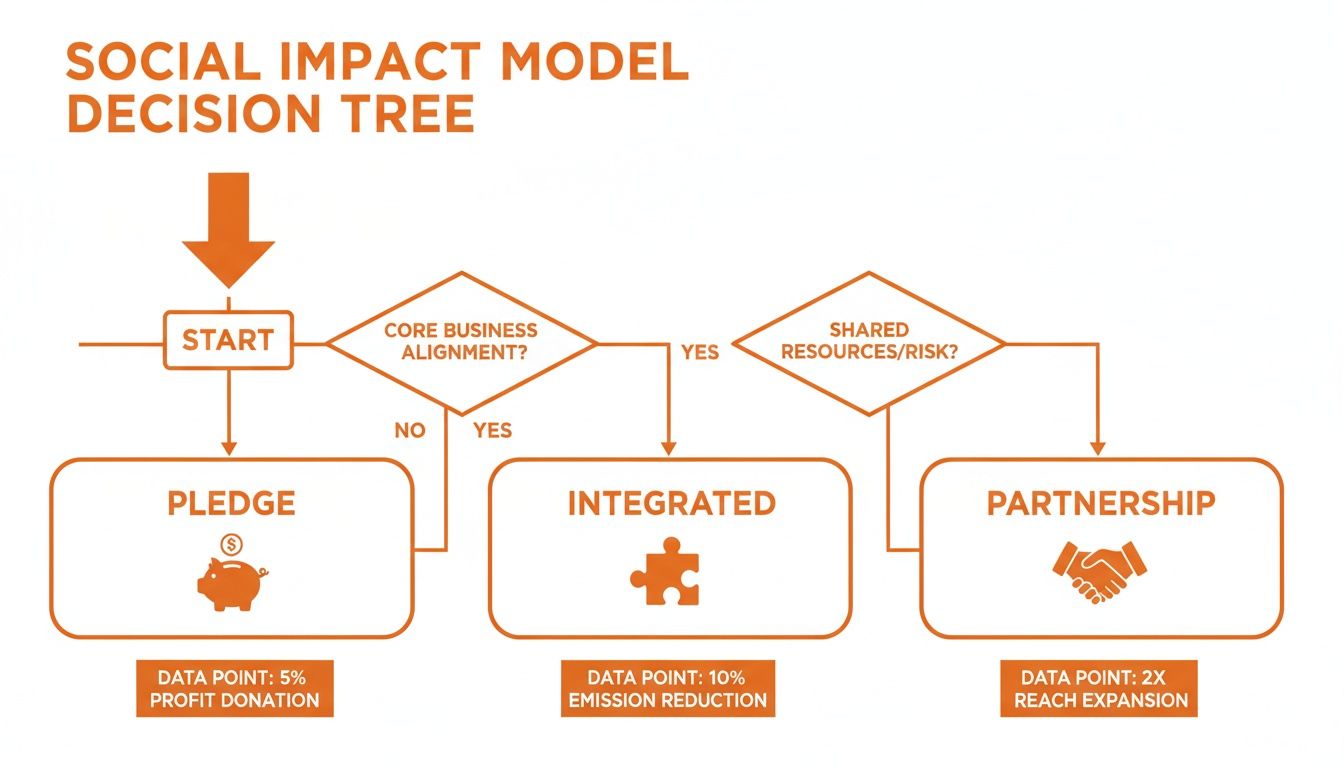
The big takeaway here is that each path demands a different kind of measurement. I've observed that a simple pledge model often focuses on financial inputs, while integrated and partnership models let you track direct outputs and even long-term outcomes.
Building Your Impact Dashboard
I tell every founder I work with to build a simple Impact Dashboard. Seriously, don't overcomplicate this. A basic spreadsheet is all you need to get started.
This simple tool will help you track the three crucial layers of your strategy.
- Inputs: This is your investment. It’s the time, money, and resources you’re putting in. Think $10,000 donated or 80 employee volunteer hours.
- Outputs: These are the direct, immediate results of your inputs. Think 400 meals served from your donation or 10 local parks cleaned up by your team. They’re the first ripple in the pond.
- Outcomes: This is the big one—the long-term, systemic change you’re trying to create. It's the hardest to measure, but it's your ultimate goal. An outcome might be a 15% increase in high school graduation rates in a community where you fund after-school tutoring.
Tracking these three things gives you the full picture. Inputs show your commitment, outputs show your action, and outcomes show your true impact.
And this isn't just some niche activity for a few do-gooder brands. Globally, there are 10 million social enterprises employing 200 million people and generating $2 trillion in revenue. This is a massive economic movement.
I see big organizations putting serious cash behind this, with recent pledges funneling $95 million into social procurement and $47 million in direct financial backing for these kinds of businesses. For founders like us, this is hard proof that you can build a business that is both profitable and purposeful. You can see more data on this trend in a full report from the World Economic Forum.
I urge you to start tracking from day one. Even if the numbers feel small, it builds a discipline of accountability that will be priceless as your business—and your impact—grows.
Telling Your Impact Story Authentically

You’re doing great work with your business, but if nobody knows about it, does the impact even register? I get it—talking about your social mission can feel weird. You don't want to come off as bragging or, even worse, like you’re using a good cause just to make a buck.
The secret? Just be real. Share your story like you would with a friend, not like you're shouting a press release from a megaphone.
Think about telling a close friend you finally finished that marathon you’ve been training for. You wouldn’t just send them a corporate memo with your finish time. You’d talk about the brutal early morning runs, the moment you wanted to quit, and the feeling of crossing that finish line. That’s the kind of energy you want here.
Show, Don’t Just Tell
My golden rule is simple: show, don't tell. It’s the difference between saying “we support local causes” and posting a video of your team laughing while packing boxes at a Chicago food bank. One is a forgettable line of copy; the other is a story people can feel.
Instead of just stating facts on your website, I suggest you try this:
- Weave your mission into your "About Us" page. This isn’t a footnote; it's part of your origin story. Why did you start this?
- Use your packaging as a tiny billboard. A quick note or a QR code on the box can turn a simple unboxing into a moment of real connection.
- Dedicate real estate on your social media to your cause. Feature your partners. Celebrate the milestones. Show the faces of the people you’re helping.
When you do this, your customers stop being just customers. They become part of your community, part of your journey.
Celebrate Your Partners, Not Just Yourself
One of the easiest ways I know to avoid that "braggy" feeling is to aim the spotlight somewhere else: your partners. They’re the heroes on the ground doing the hard work. Your job is to be their amplifier.
When you talk about your impact, frame it through their eyes.
Your story shouldn’t be, "Look how generous we are." It should be, "Look at the incredible work [Your Partner's Name] is doing, and we're just honored to help them." This simple shift from "me" to "we" changes everything.
This shows you're humble and that your work is about genuine collaboration, not just patting yourself on the back. You're a supporting character in their story, and honestly, that’s a pretty powerful place to be.
The whole corporate social impact world is getting a lot smarter about this. I've noticed companies are now tying their cause work directly to their main business goals, not just doing things for good PR. With budgets getting tighter, this kind of authentic alignment is more important than ever, and it's something you can really show off in your storytelling. If you want to go deeper, check out what the pros are saying about how these corporate social impact trends are shaping the future on ACCP.org.
Turning Impact Data Into Human Stories
We just talked about tracking your metrics. Now, it's time for you to give those numbers a soul. A stat like "400 meals served" is nice, but a story about one family who didn’t have to worry about dinner that night? That’s unforgettable.
Here’s how you can translate your data into content people actually want to see:
- Interview people. Talk to your nonprofit partners. If it’s appropriate, talk to the people they serve. Ask about their struggles and how your support actually made a difference.
- Use good visuals. I find that a single, powerful photo can say more than a wall of text. Short video clips are even better.
- Create an annual impact report. This doesn't need to be some stuffy, 50-page PDF. Make it a beautiful landing page on your site with stories, videos, and simple graphics that show the results.
Telling these stories is a massive part of your brand identity. For a closer look at building that identity from scratch, our guide on how to brand a product is a great place for you to start.
Authentic storytelling is what connects your mission to your audience. It’s how you turn casual followers into true believers who are proud to support what you're building.
Your Social Impact Strategy Questions Answered
You’ve got questions about social impact, and trust me, I’ve heard just about all of them. Let's cut through the noise and talk about the real hurdles that keep founders like you from making a difference.
This is all about quick, no-fluff answers to what's on your mind. My only goal is to give you the confidence to stop wondering and start doing.
When’s The Right Time To Start?
The right time to start is day one. I’m serious.
You don’t need to be donating a million dollars to get started. Far from it.
Beginning is as simple as defining your mission and values. Your first move might be as straightforward as your team volunteering for a few hours or pledging a tiny percentage of your very first sale. When you weave this into your brand early, it becomes part of your DNA—not some awkward add-on you tack on later when you're "big enough."
It’s like learning to cook with salt. You don't just dump a pile on at the end; you season as you go.
How Can I Give Back When I'm Barely Profitable?
I hear this one all the time. "How can I afford to give back when my startup is barely breaking even?" It's a fair question, but I think it's based on a flawed idea.
Impact is not just about writing checks.
Look at a model like "Pledge 1%," where you commit 1% of equity, 1% of product, and 1% of employee time. Donating your product or offering your team's skills pro bono can create a massive effect without touching your cash reserves.
Early on, my goal for you isn't to write the biggest check. My goal for you is to build an authentic commitment that can grow right alongside your revenue.
For example, a new design agency can offer a few hours of free branding work to a local food pantry. A software startup can give free licenses to a neighborhood after-school program. Your skills and your product are incredibly valuable assets—don't forget that.
Should I Partner With A Nonprofit Or Start My Own Foundation?
For 99% of startups, partnering with an existing, well-vetted nonprofit is the smartest move you can make. Hands down.
These organizations already have the boots-on-the-ground expertise, the community trust, and the infrastructure to turn your support into real action.
Starting your own foundation is like deciding to build your own car from scratch when you just need to get across town. It's a huge legal and financial headache, and frankly, a major distraction for you as an early-stage company. I see that as a move for massive corporations with dedicated teams, not for scrappy founders.
I urge you to find a fantastic partner whose mission truly syncs up with yours. You bring the resources and passion; they bring the experience. That's a winning combo.
How Do I Keep My Team Engaged In Our Mission?
A social mission isn’t just a line item in a budget; it's a living part of your culture. To keep it alive, you have to get your team involved directly.
Here are a few ways I've seen work to make it stick:
- Let them lead: Create chances for your employees to champion causes they care about. Maybe start an employee ambassador program. This builds real ownership.
- Share the stories: When your nonprofit partner sends an update, share it with the whole company. Show your team the tangible results of their collective effort.
- Make volunteering easy: Set aside paid time for your team to volunteer and use tools to organize it. It's proven that corporate volunteerism boosts morale and retention, but only when it’s genuinely supported by you and the company.
Think of it like a community garden. You can’t just plant the seeds and walk away. You have to water them, pull the weeds, and celebrate the harvest together.
Building a brand with purpose is a journey. It’s about making choices, big and small, that align with your values. If you're a founder in the Midwest who believes in building with both kindness and ambition, you don’t have to do it alone. Join us at Chicago Brandstarters, where we connect founders who are building something that matters. You can learn more and apply to join our community at https://www.chicagobrandstarters.com.