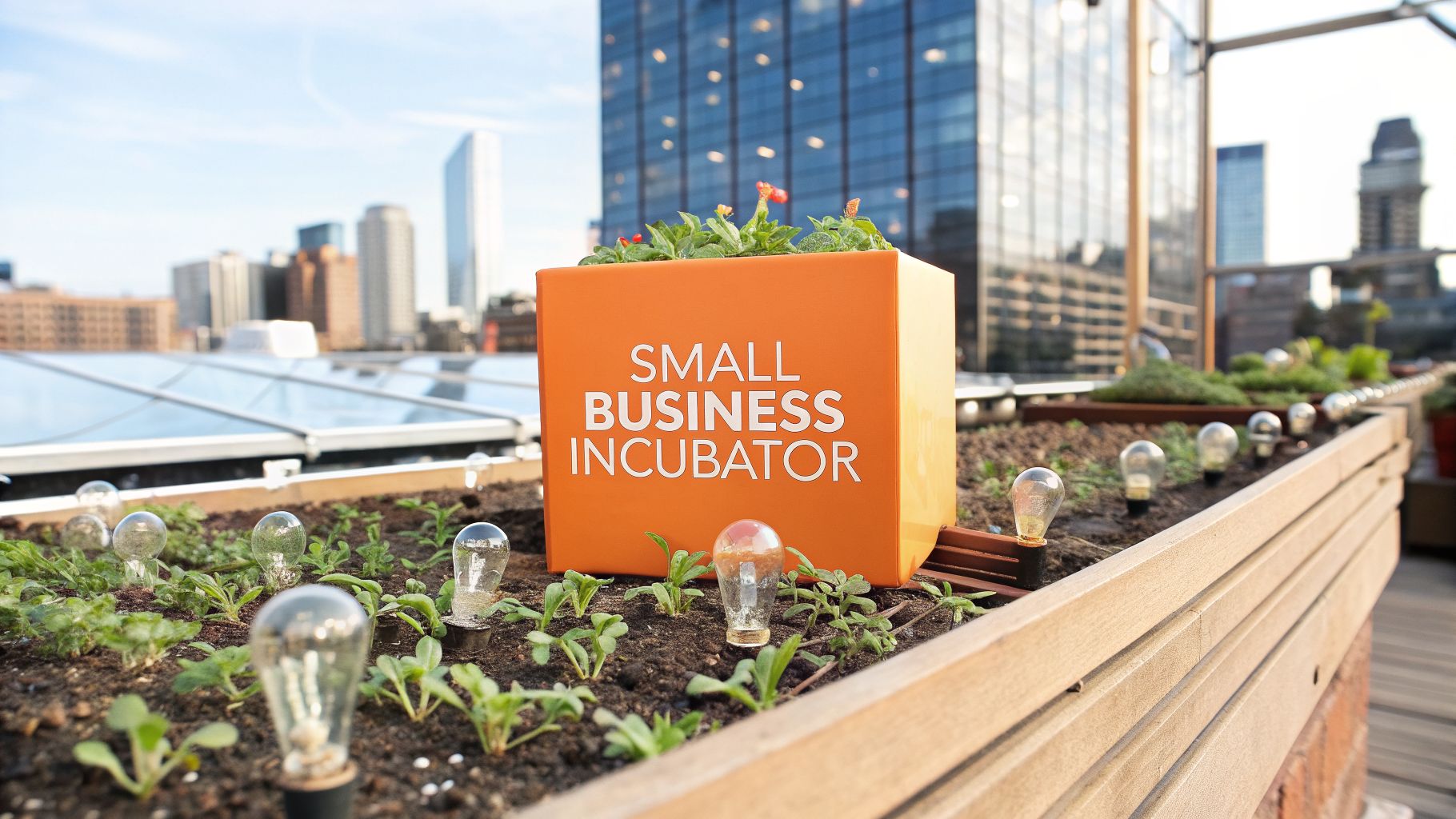
You've got an idea. The kind that wakes you up at 3 AM. But let's be real—turning that lightning in a bottle into an actual business is one of the hardest things you'll ever do. That's where small business incubators come in. Think of them as a greenhouse, shielding your fragile startup before it has to face the wild.
Is Your Idea a Business or Still a Dream?

I get it. You have a business idea so real you can almost taste it. It’s an electrifying feeling. But I've walked this path, and I know the road from a napkin sketch to your first real sale is a minefield.
I’m not here to scare you off. I’m here to keep your dream from getting stomped on. Most startups don't die from bad ideas; they die from isolation, empty pockets, and hitting roadblocks that were totally avoidable.
Bridging the Gap From Concept to Reality
This is why a support system isn't just nice—it’s vital. Passion alone won't pay the bills. You need practical advice from people who've already made the mistakes you're about to make. This is precisely what small business incubators deliver.
Imagine your startup is a tiny seedling. You wouldn't just toss it in a field and hope for rain, right? You'd put it in a greenhouse.
An incubator is your business's greenhouse. It creates a controlled environment—giving you structure, mentorship, and resources—so your company can grow deep roots before facing the storms of the real market.
These programs guide you through those brutal early days. They give you a direct line to:
- Mentors with Scars: People who've survived the trenches and can help you dodge bullets.
- Shared Resources: Things you can't afford yet, like office space, legal help, or pricey software.
- A Real Community: Other founders just as terrified and thrilled as you are.
Building a business from zero is tough, especially if you're trying to figure out how to start a business with no money. A solid support system doesn’t just make it easier—it might be the one thing that helps you survive.
What Small Business Incubators Really Do
So, what’s the real deal with small business incubators? Let's cut the jargon. Think of an incubator as a greenhouse for your new company—a sheltered place designed to help your fragile idea blossom into a business that can stand on its own two feet.
You get the right conditions to survive the vulnerable early days. You get the "sunlight" of mentorship, the "water" of shared resources, and the "good soil" of a strong peer network. It's all there to help you build solid roots before you face the wild, open market. This kind of support really works; incubated companies have an 87% higher survival rate after five years compared to those who go it alone.
The Core Services You Can Expect
Every program has its own personality, but most incubators offer core services to help you conquer the biggest hurdles you’ll face as a founder. These aren't just perks; they are survival tools.
You’re not just renting a desk; you’re buying a launchpad. You get to surround yourself with expertise and infrastructure you could never afford on your own at this stage.
Here's a breakdown of what that usually means for you:
- Business and Management Training: Hands-on workshops teaching you everything from building a business plan to actually understanding your financial forecasts.
- Affordable Office Space: Access to a professional workspace, meeting rooms, and office gear for far less than market rates.
- Critical Support Services: Real guidance on the tricky stuff—like legal structures, accounting, and protecting your intellectual property.
- Mentorship from Veterans: Direct access to experienced entrepreneurs who’ve walked your path and have the war stories to prove it.
An incubator's real job is to de-risk your startup journey. You get a framework and expert advice to help avoid the common, deadly mistakes most new founders make. It's a community that has your back.
This approach is more important than ever. The incubator market, valued at $6.27 billion in 2025, is projected to skyrocket to $20.39 billion by 2034. And it’s not just for city dwellers—over 45% of incubators now offer virtual or hybrid models, opening doors for founders everywhere. You can discover more insights about the business incubator market to see how vital these programs are becoming.
Different Incubator Models for Different Needs
Don't assume all incubators are the same. They come in different flavors, each with its own mission. Finding the right one for you depends on your industry and stage.
A university incubator might be perfect for a deep-tech company born from academic research. A for-profit model could be your best bet if you're chasing venture capital in Chicago.
Let’s break down the common types you'll encounter:
1. University-Affiliated Incubators
These are often tied to a university's research labs. They excel at turning academic discoveries into actual products, especially in fields like biotech, engineering, and software.
2. Non-Profit or Government-Funded Incubators
Their main goal is economic development—creating local jobs and sparking innovation. These programs are often easier to get into and usually don’t take a piece of your company.
3. For-Profit or Corporate Incubators
These are backed by private investors or big corporations hunting for the next home run. They offer intense mentorship and huge resources, but they do it for an equity stake in your business. Their goal is simple: a big financial return.
Incubators vs. Accelerators vs. Communities
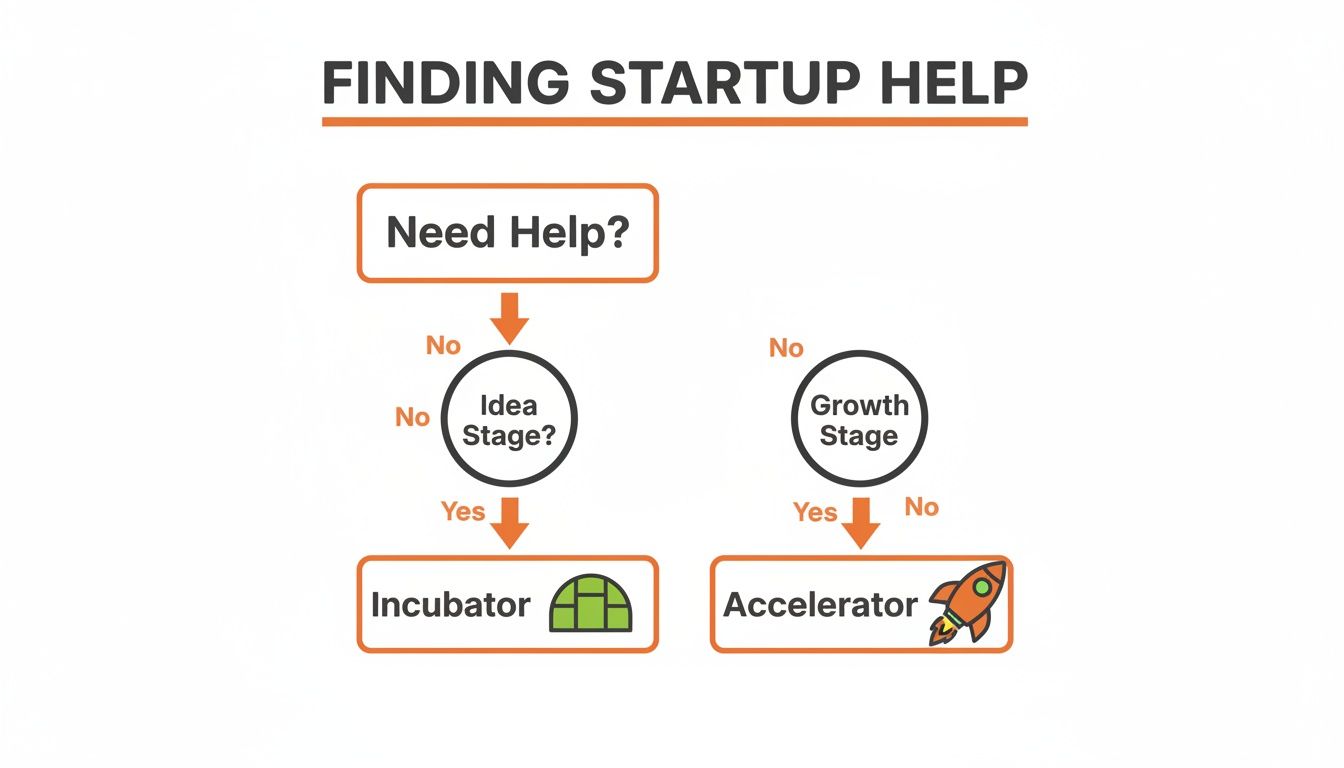
The startup world loves its jargon. You hear about small business incubators, accelerators, and peer communities, and it’s easy to get them all mixed up. Let me cut through the noise so you can figure out what’s what—and what’s right for you.
This decision tree gives you a quick visual. If you're still sketching on a napkin, an incubator is probably your best bet. If you have a product and early traction, an accelerator might be the rocket fuel you need.
Small Business Incubators
Think of an incubator as elementary school for your business. It's a nurturing space designed to help you turn a raw idea into a functioning company with a solid foundation.
You’re here to learn the fundamentals. Incubators focus on long-term development, often letting you stay for a year or more. The goal isn’t explosive growth; it’s survival, validating your concept, and building a sustainable business before you’re thrown to the wolves.
An incubator’s main job is to de-risk your earliest stages. I find they help you build your business model, validate your product, and find your first customers in a supportive environment.
This slow-and-steady approach is why many non-profit or university-backed incubators don't take equity. Their mission is to boost the local economy or foster innovation, not chase a quick payout. A great example is the Port of Seattle's SEA Sparks incubator, created to give local entrepreneurs a clear path to operate at the airport without demanding a piece of their business.
Startup Accelerators
If an incubator is elementary school, an accelerator is a hyper-intense college boot camp. You don’t go there to find your idea—you go when you have something that works and you're ready to hit the gas. Hard.
Accelerators are all about speed. They cram years of business growth into a few brutal months. In exchange for a small amount of seed funding and access to an incredible network, you typically give up an equity stake. The whole program sprints toward "Demo Day," where you pitch to a room of VCs for a large funding round.
It’s a high-pressure, high-stakes game. They expect you to show up with a product, some early customers, and a clear plan to take over the world. They aren't there to help you find your footing; they're there to help you run a marathon at a sprinter's pace.
Peer Communities
Then there’s a third path, one that I find is often more personal and authentic: a peer community. This isn’t a formal program with a rigid schedule. It’s a living network of founders who are right there in the trenches with you.
Think of it as your trusted neighborhood support group for entrepreneurs. You get together and share what’s really going on—the wins, the failures, the "I have no idea what to do" moments—and help each other figure it out. No curriculum, no Demo Day, and you don't give up equity.
This is the whole philosophy behind what I'm building at Chicago Brandstarters. I create small, private dinners and run an active chat group where founders can share war stories and tactics without any BS. It's built on trust and mutual support, not transactions. For many of us, having a group of peers who genuinely have your back is worth more than any formal program.
So, how do you choose? This table breaks it down for you.
Incubator vs. Accelerator vs. Peer Community
| Feature | Small Business Incubator | Startup Accelerator | Peer Community (e.g., Chicago Brandstarters) |
|---|---|---|---|
| Best For | Idea-stage or very early startups | Startups with a product & early traction | Founders at any stage seeking authentic connection |
| Timeline | Long-term (6 months to 2+ years) | Short-term & intense (3-6 months) | Ongoing, no end date |
| Focus | Nurturing ideas, building a business model, survival | Rapid growth, scaling, fundraising | Mutual support, shared learning, real relationships |
| Cost / Equity | Often free or low-cost, usually no equity taken | Seed funding provided in exchange for equity (typically 5-10%) | Usually free or a small membership fee, no equity taken |
| Structure | Less structured, more self-directed | Highly structured curriculum, mentorship-driven | Informal, member-led, built on trust |
| Vibe | Collaborative, supportive, educational | High-pressure, competitive, fast-paced | Authentic, vulnerable, community-focused |
Ultimately, there's no single "best" option—only what's best for you right now. An incubator builds your foundation, an accelerator launches your rocket, and a peer community is the support crew that keeps you sane through it all.
How to Find the Right Incubator for Your Startup
Picking an incubator is a lot like picking a co-founder. Get it wrong, and your startup could sink before it ever really sets sail. You'll burn precious time, money, and momentum in a program that just doesn't get you.
So how do you find the right one? It’s not about chasing the biggest name. It's about finding the right fit for what your business actually needs. I'll walk you through how I think about it so you can find a program that will genuinely help you grow.
First, Figure Out What You Actually Need
Before you even start Googling, get brutally honest with yourself. What do you really need right now?
Is it deep tech mentorship? Connections to retail buyers? Or just a room full of other founders who understand the chaos you're living in? Don't get distracted by a fancy name. Your real needs will point you to the right place.
I always tell founders to start with these questions:
- What's my industry? A program focused on consumer goods won't have the right contacts for your fintech startup. Be specific.
- What stage am I at? Are you an idea on a napkin, or do you have a working prototype? This determines if you need validation (incubator) or rocket fuel (accelerator).
- Where are my biggest gaps? Are you terrible at marketing? Do your financials look like a mess? Find a program that fills the holes in your own skill set.
Look at the Program’s Focus and Structure
Once you know what you’re looking for, you can start digging into specific programs. Every incubator has its own personality. You’re trying to find one that clicks with your business and how you work.
Think of it this way: a marathon runner and a powerlifter are both athletes, but their training is completely different. You need the program designed for your specific event.
The right incubator feels less like a classroom and more like a dedicated training facility for your specific business. The wrong one will have you doing exercises that won't help you win your race.
The incubator world is huge, especially in North America which holds over 42% of the market share. With giants like Y Combinator and Techstars in the U.S. nurturing almost half the world's incubated startups, you've got options. And it works—around 80% of startups in these programs get follow-on funding within a year.
But here's a catch: only about 20% of incubators really focus on access to capital. So if fundraising is your main goal, you need to find one with a strong network. You can discover more insights about the business incubator market to see how these hubs really operate.
Vet the Mentors and Find the Real Story
A program is only as good as its people, especially the mentors. Don’t just be impressed by a list of fancy titles. You need to know if these people are actually involved and if their experience is relevant to you.
The best way I've found to get the real story? Talk to founders from the last couple of cohorts. Find them on LinkedIn and reach out.
Ask them direct questions. No fluff.
- "Who was the most helpful mentor for you, and why?"
- "How much time did you actually get with the lead mentors?"
- "What was the single biggest thing the program helped you with?"
- "What do you wish the program did better?"
Their answers will tell you everything. If a program is great, its alumni will be its biggest fans. Their stories will be specific, enthusiastic, and honest. That's the signal you're looking for.
The Power of a Supportive Community

Look, formal programs like small business incubators have their place. They give you a curriculum and resources, which is great.
But let’s be honest. Sometimes the most powerful thing you can have isn’t a syllabus—it’s a handful of people who actually have your back. This is the whole idea behind what I’m building with Chicago Brandstarters.
I’ve seen the alternative too many times. You go to some "networking" event, pocket a bunch of business cards, and go home feeling more alone than when you arrived. It’s all so transactional and, frankly, exhausting. That’s not real support.
This is my take on why a small, trusted group of peers can be more important than any formal program. It’s for founders who crave real connections and believe we’re all in this together.
The Problem with Transactional Networking
Think about the last networking event you went to. It probably felt like a series of bad first dates where everyone was just trying to sell you something. You slap on a smile, give your pitch a dozen times, and listen to a dozen more in return.
You’re in a room full of people, but you feel totally isolated. That’s the exact opposite of what you need when you're building something from scratch. This journey is lonely enough without having to pretend everything is perfect all the time.
A formal program can teach you how to build a financial model, but it can’t sit with you at 10 PM when a critical shipment is lost and you need to figure out a solution, fast. That's where a real community comes in.
You need people you can be brutally honest with. A place where you can talk about your struggles without getting a sales pitch or a blank stare. You need people who just get it.
Real Stories from a Real Community
I’m not just making this up. I see this magic happen all the time with our members at Chicago Brandstarters. These aren't just feel-good stories; they're real breakthroughs that happen because people trust each other enough to be vulnerable.
Here are a few examples that I’ve seen:
- The Logistics Nightmare: One of our members was days from launching when their co-packer completely fumbled the ball. They were panicking. They posted in our group chat, and within minutes, another member who'd been through the same thing made a direct intro to a local logistics partner they trusted. Problem solved.
- The Critical Introduction: During one of our small group dinners, a founder mentioned they were struggling to get a meeting with a key retail buyer. Someone else at the table happened to know them personally. A quick text was sent. A week later, that founder had the meeting that led to their first major retail order.
- The Honest Feedback: A founder was burning cash on Facebook ads with terrible results. Instead of guessing, they shared their campaign in our private chat. Three other members who had built seven-figure e-commerce brands jumped in and shared their exact ad strategies. It saved the founder thousands and months of painful trial-and-error.
These things don't happen in a classroom or at a conference. They happen in a space built on trust.
Why Trust and Vulnerability Are Non-Negotiable
You can’t have this kind of support without two things: trust and vulnerability. Everyone has to be willing to drop the tough-guy act and share what’s actually going on—the good, the bad, and the ugly.
That’s why I am so protective of our community. I vet every single person to make sure they’re a kind, hardworking founder, not a service provider trying to drum up business. Our number one rule is simple: no sales pitches. Ever.
This creates a sanctuary. When you know for a fact that everyone in the room has your back, you’re not afraid to ask the "stupid" questions or admit you don't have all the answers. That’s where the real growth happens. If you're looking for this kind of tight-knit group, you might be interested in how mastermind groups for entrepreneurs provide a similar level of deep, confidential support.
A great community is like having your own personal board of advisors. It’s a group of people who are just as invested in your success as you are in theirs. While small business incubators offer a fantastic, structured launchpad, you should never underestimate the power of a few trusted peers you can call anytime.
Answering Your Top Incubator Questions
Okay, so you've learned what incubators are and why the people around you matter so much. But now for the real talk.
These are the questions I get all the time from founders like you. Getting this stuff right is a big deal, so let's get into it.
Do I Give Up Equity to Join a Small Business Incubator?
This is the big one. The answer: it depends. You have to know the difference.
Many incubators, especially those run by universities, non-profits, or the city, don't take any equity. Their goal isn't to make a buck off you; it's to create jobs and cool new things in their area. Think of the Port of Seattle's SEA Sparks incubator—they just want to help local brands get into the airport, not own a piece of them.
But for-profit incubators, and pretty much every accelerator, will ask for equity. It's how they make money. You can expect to give up anywhere from 2% to 10% of your company for their help and maybe some seed cash. You must get this clear before you even start the application.
Here's a simple way to think about it: A public library gives you books for free because its mission is to educate the public. A bookstore sells you books to stay in business. Both get you what you need, but their models are totally different.
This is exactly why a community like Chicago Brandstarters is different. We don't take any equity. Our goal isn't a financial payout; it's to build a real community where founders have each other's backs.
What Stage Is Right for an Incubator?
Small business incubators are all about the very beginning of your journey. They're perfect if you're:
- Still messing around with an idea.
- Haven't built a product or made any money yet.
- Just launched and have a few early customers.
The whole point is to help you figure out if your idea is any good, who your customer is, and how to build a business that won't fall apart.
If you already have a product, you're making consistent sales, and you want to pour gasoline on the fire to grow like crazy, you need an accelerator, not an incubator.
An incubator is there to help you hatch the egg. An accelerator is for launching the rocket.
Are There Good Incubators in Chicago and the Midwest?
Yes! You don't have to move to the coast to find great support. The startup scene here in Chicago and across the Midwest is seriously underrated.
We've got incredible programs right here in our backyard. For tech, you have 1871. For healthcare, there's MATTER. And the big universities have amazing resources, like the Polsky Center at the University of Chicago and The Garage at Northwestern.
The key is finding a program that gets your industry and shares your values. Honestly, that's what I'm building with Chicago Brandstarters. I’m tapping into that classic Midwestern vibe—all about real support and hard work. It's a community-first option for founders who get it.
What Is the Biggest Mistake When Choosing a Program?
I see this all the time: founders get blinded by a big, flashy name and forget to ask if the program is actually the right fit for them.
They chase some prestigious program in a big tech city without thinking about whether the culture or the network will actually help their business.
If you're building an e-commerce brand selling physical products out of your garage in Illinois, you'll probably get way more value from a local group of CPG founders than a fancy SaaS accelerator on the West Coast. You have to be brutally honest about what you need right now.
Do you need tech mentors? Introductions to retail buyers? Or just a few other founders you can text at 11 PM when you're freaking out? Don't pick a program because of its logo. Pick it for the people.
If you're a founder in Chicago or the Midwest who believes in hard work and real relationships over just swapping business cards, I invite you to check out Chicago Brandstarters. We're building a community where kind, bold founders help each other win. Learn more about our private dinners and peer support group at https://www.chicagobrandstarters.com.