

So, you're thinking about scaling. It's the big dream, right? But what does that actually mean?
Simply put, scaling is about making more money without pouring in the same amount of effort and cash. It’s about building a business that can grow without you, the founder, being the bottleneck for every single thing. The first, most crucial step isn't hiring or marketing—it's taking a hard, honest look in the mirror to see if you're even ready for the race.
Is Your Business Truly Ready to Scale?

Before you slam the gas pedal, let’s get real for a minute. I’ve seen way too many founders dive headfirst into scaling because they felt this intense pressure to "go big or go home." That’s a recipe for disaster. Scaling at the wrong time will kill your business faster than anything else.
Think of your business like an engine. Right now, it might be running great, getting you where you need to go. But scaling is like deciding to enter that engine in the Indy 500. If the core components aren’t absolutely solid, pushing it that hard will just make it blow up on the first lap.
This isn’t about some generic checklist you download. It’s about a deep, brutally honest look at your operations. Are your processes repeatable, or are they held together by digital duct tape and your sheer force of will? This is your pre-flight check, and you can't skip it.
The Real Signals of Readiness
How do you know it's the right time? I always look for a few undeniable green lights.
The first is consistent profitability. Are you actually making money, month after month, without wild swings? If your cash flow is a rollercoaster, adding the complexity of scaling will only make those stomach-churning dips deeper and more terrifying. You need a stable financial foundation before you can build a skyscraper on it.
Another massive signal is overwhelming demand. Are you struggling to keep up? Are potential customers waiting in line? If you’re constantly turning business away because you just don’t have the capacity, that's the market screaming that it wants more of what you have. The demand should be pulling you forward, not you pushing a boulder uphill.
And finally, check your customer loyalty. Do your customers keep coming back? Better yet, do they tell their friends about you without you even asking? A strong core of repeat business is the bedrock of any scalable venture. It’s proof you’ve built something people genuinely love, not just a one-off product.
Red Flags That Scream 'Wait'
Just as important are the red flags that tell you to hit the brakes. The biggest one? If you are the business.
If you can't take a two-week vacation without everything grinding to a halt, you're not ready. If every decision, sale, or customer service issue has to run through you, you haven’t built a business—you’ve built a high-stress job for yourself. You need to build systems before you can scale them.
"The biggest trap I see founders fall into is confusing growth with scaling. Growth is adding resources at the same rate you're adding revenue. Scaling is adding revenue exponentially faster than costs. If you haven't solved this, you're just buying yourself a bigger, more expensive job."
Shaky unit economics are another huge warning sign. If you don't know exactly what it costs you to get a new customer (CAC) and how much they're worth to you over time (LTV), you're flying completely blind. Pouring money into marketing at that point will just burn cash faster. If you're fuzzy on the basics, take some time to understand what business scaling really means.
Scaling Readiness Scorecard
Use this scorecard to honestly check if your business is ready for the next growth stage. This isn't a test; it's about spotting your strengths and weaknesses before you invest time and money into scaling.
| Growth Signal | What It Looks Like (Green Light) | What It Looks Like (Yellow Light) |
|---|---|---|
| Profitability | You have 3-6+ months of consistent, predictable profit. Cash flow is healthy and manageable. | Profit is inconsistent. You have good months and bad months; cash flow is tight. |
| Market Demand | You're struggling to keep up with inbound leads/orders. You're at or near full capacity. | Demand is steady but not overwhelming. You have the capacity to take on more work easily. |
| Operations | Key processes are documented and can be run by your team without your constant oversight. | The business relies heavily on your personal involvement for day-to-day tasks and decisions. |
| Team | You have a core team in place that understands their roles and can handle more responsibility. | You're a solopreneur or have a very small team that is already stretched thin. |
| Customer Base | You have a high rate of repeat customers and strong word-of-mouth referrals. | Most of your customers are one-time purchasers. You have to fight for every new sale. |
This scorecard should give you a gut check. Be honest with yourself. It's far better to wait six months and build a solid foundation than to jump in now and watch the whole thing crumble.
The opportunity here is massive. The global small business market was valued at an insane $2,572 billion in 2023 and is projected to hit nearly $4,985 billion by 2032. With small businesses making up 99.9% of all U.S. firms, they are the engine of our economy.
Timing is everything. Get this part right, and you'll be building on a foundation of stone, not sand.
Mastering Your Unit Economics Before You Grow
Alright, let's talk about the math that actually matters when you want to scale. Forget vanity metrics like social media followers or website traffic for a second. If you don't have a rock-solid grip on your unit economics, trying to grow is like building a skyscraper on a foundation of mud. You're just setting yourself up to go broke, fast.
I've seen it happen. A founder gets a rush from their first few sales, dumps money into ads, and watches the orders flood in. The problem? They were losing a few bucks on every single sale. Scaling just made them lose money much, much faster.
Think of it this way: your "unit" is one customer. Unit economics is the simple math behind that single customer. How much does it cost you to get them in the door, and how much are they worth once they're there? If each customer is profitable, you can build an empire. If not, you’re just building a bigger pile of debt.
What Is Customer Acquisition Cost (CAC)
Your Customer Acquisition Cost (CAC) is simply what you spend on sales and marketing to land one new paying customer. It’s that straightforward. If you spent $1,000 on a marketing campaign last month and it brought you 20 new customers, your CAC is $50.
To figure this out for your own business, you'll need to add up all your sales and marketing expenses over a set period. Make sure to include everything:
- Ad Spend: The cash you put into platforms like Google, Facebook, or LinkedIn.
- Salaries: A portion of your marketing or sales team's paychecks.
- Tools & Software: Costs for your CRM, email marketing service, SEO tools, you name it.
- Content Creation: Money spent on designers, writers, or video production.
Once you have that total, just divide it by the number of new customers you brought in during that same period. That number is your CAC. Knowing it is the first real step toward making smart growth decisions.
What Is Lifetime Value (LTV)
Now for the other side of the coin: Lifetime Value (LTV). This number tells you the total revenue you can reasonably expect from a single customer over their entire relationship with you. It’s not just their first purchase; it’s everything they might buy from you, ever.
Let's use a coffee shop as an analogy. Your CAC might be the cost of a "Free Coffee" sign that gets me in the door. My LTV, though, is the value of the latte I buy every single morning for the next five years. Big difference.
Calculating a precise LTV can get tricky, but a simple version is a great place to start:
(Average Purchase Value) x (Average Purchase Frequency) x (Average Customer Lifespan)
For a service business, it might just be the average monthly fee multiplied by the number of months a client typically sticks around. This number tells you what a customer is truly worth. Getting your numbers straight is crucial; for more on the financial nuts and bolts, you can check out our guide on the calculation of gross margin percentage.
The Golden Ratio for Scaling
Here’s where it all comes together. The relationship between your LTV and CAC is probably the most important indicator of a scalable business. You’re looking for a healthy ratio.
A strong LTV to CAC ratio is generally considered to be 3:1 or higher. This means for every dollar you spend to get a customer, you make at least three dollars back over their lifetime. If your ratio is 1:1, you’re actually losing money once you factor in the cost of your products or services.
This isn't just theory; it's survival. Business failure rates climb from 20% in year one to 50% by year five, often because of cash shortages (38%) or simply not having a market (35%).
This is why communities like Chicago Brandstarters focus so heavily on operator-led tactics. We help growing firms nail their unit economics before pointing them to next-stage programs like Goldman Sachs 10KSB or EcomFuel.
Once you know this ratio, you have a powerful tool. You know exactly how much you can afford to spend to get a new customer and still build a healthy, profitable business. Don't take another step toward growth until you have this clarity.
Building Your Team and Systems for Growth

I learned the hard way that you can't scale a business by yourself. For way too long, I was the bottleneck. Every decision, every email, every problem landed on my desk. If you want to really grow, you have to get out of your own way, and that starts with two things: building a team and creating systems that don’t need you.
This is exactly where so many founders stumble. The second they get a taste of growth, they hire a bunch of people. But they do it too fast or for all the wrong reasons. Even worse, they bring people on but fail to build the processes needed to actually handle more business, creating total chaos instead of momentum.
The goal isn't just to hire bodies to fill seats. It's about intentionally building an operational engine—the right people plus the right processes—that makes your growth predictable and something you can actually sustain.
Making Your First Critical Hires
Your first few hires are less about filling a job description and more about finding people who can wear a dozen hats with a great attitude. You’re not hiring a specialist; you’re looking for a versatile problem-solver who genuinely believes in what you’re building.
Forget about finding someone with ten years of experience at a Fortune 500 company. Instead, I focus on a few core qualities that are so much more valuable when you’re just starting to scale.
- Scrappiness: Can they figure things out without a manual? When they hit a wall, do they wait for instructions, or do they immediately start looking for a way around it? You need resourceful people who don't need constant hand-holding.
- Customer Empathy: Your first team members are your front line. They absolutely have to care about your customers and see the world through their eyes. This is something you can't teach, but it’s the foundation of every great customer experience.
- High Ownership: Look for people who say "we" when things go well and "I" when they screw up. They take personal responsibility for their work and are driven to see the company succeed, not just check off a to-do list.
Making these first hires can feel overwhelming. If you want a deeper dive, check out our guide on how to hire your first employee. It breaks the whole process down into simple, practical steps.
Creating Your Operations Playbook
Once you have someone to hand tasks off to, you need something to hand them from. This is where your operations playbook comes in. It sounds fancy, but it’s really just a simple instruction manual for your business.
Think of it like a recipe book. You've perfected the recipe for your product or service. Now, you need to write it down so someone else can make it exactly the same way, every single time. This is how you guarantee that whether you have 10 customers or 1,000, the experience is consistently great.
Your playbook isn't a static document; it's a living guide to how your business runs. Start small by documenting one core process a week. By the end of the month, you’ll have a foundation you can actually use to train new hires and delegate with confidence.
Start with the tasks you do most often or the ones that cause the most headaches. This could be anything from "How we onboard a new client" to "The checklist for packing and shipping an order." Use simple tools like Google Docs or Notion. The goal here is clarity, not complexity.
Ultimately, building your team and systems is about buying back your own time so you can focus on the big picture. It’s the critical shift from working in your business to working on it. Get this right, and you'll have a company that can truly grow beyond you.
Finding Your Unfair Marketing Advantage
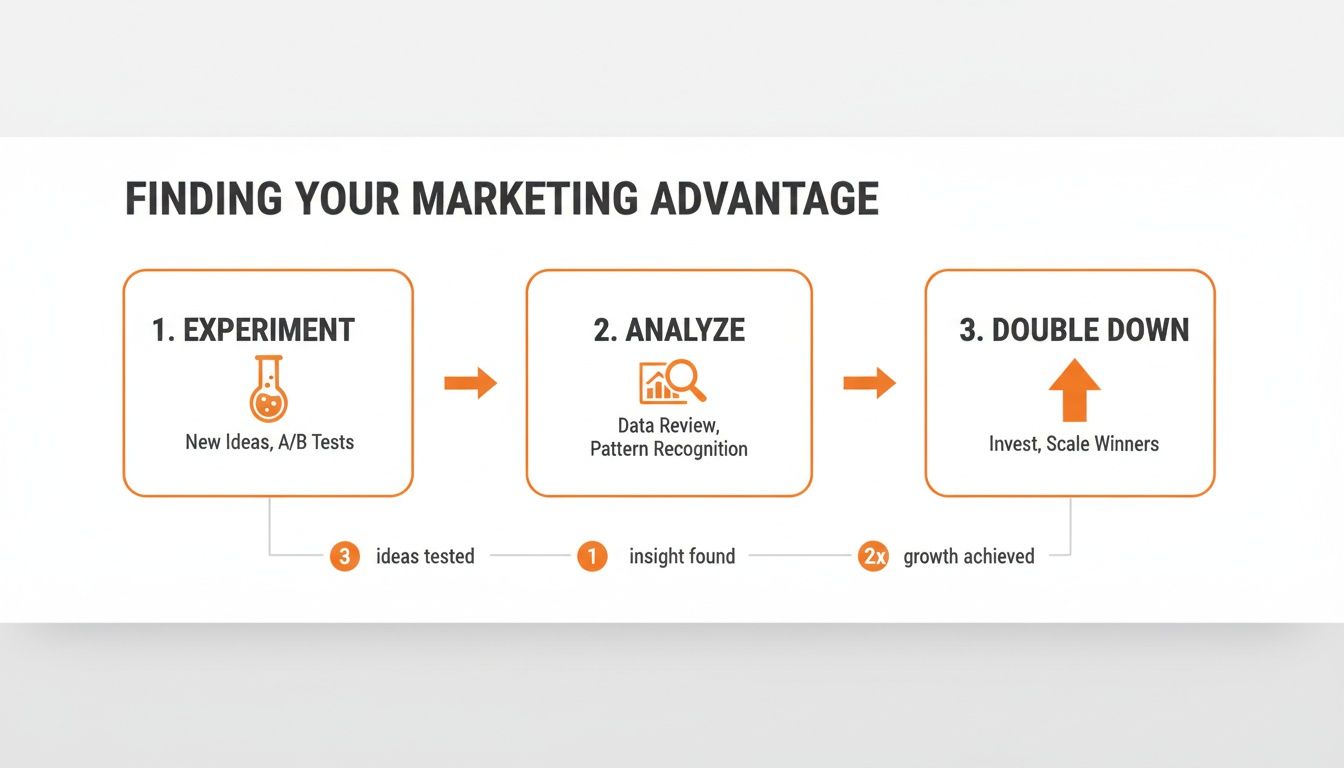
Let’s talk marketing. I see so many founders get completely paralyzed by this. They feel the pressure to be everywhere at once—TikTok, Google Ads, a podcast, a newsletter. That's not a growth strategy; it's a direct flight to burnout.
You absolutely do not need a massive budget to scale your business. What you do need is a ridiculously smart strategy.
The secret isn’t about being everywhere. It’s about finding the one or two channels that click for your business and pouring everything you have into them. I call this finding your "unfair advantage." It’s the one thing you can do better or differently than anyone else that consistently brings in the right customers.
Maybe your unfair advantage is creating unbelievably helpful content that answers every possible question your customers have. Or maybe it's building a referral engine that runs on pure customer delight. For some, it’s mastering local SEO so your name is the first thing people see when they search. Forget the noise. Your only job is to find what works for you.
Discover Your Channel Through Cheap Experiments
The only way to find your unfair advantage is to experiment. I’m talking about small, cheap, fast tests. This isn't about betting the farm on some huge ad campaign; it’s about putting on a lab coat and being a scientist in your own business. You form a hypothesis ("I bet my customers are on LinkedIn"), run a tiny test to see if you're right, and look at the data.
Think of it like dating. You don’t propose on the first date. You grab coffee, see if there's a spark, and then maybe plan a second date. Marketing channels work the same way. A little time, a little money, and see what happens before you commit.
Here are a few ways you can run these experiments without emptying your wallet:
- Content Marketing: Don't launch a whole blog. Just write one killer article that solves a common customer problem. Send it to your email list. Do people share it? Do they reply with more questions? That’s your signal.
- Social Media: Pick one platform where your ideal customer actually lives. For one week, just show up. Post, engage, have real conversations. Don't just broadcast your sales pitch. Are you getting any traction? Any leads at all?
- Referral Program: No fancy software needed. Just email your ten best customers. Offer them something simple—say, a 20% discount on their next purchase—for sending a new customer your way. Does anyone bite?
The goal here isn't to get a thousand new customers overnight. The goal is to get a signal. You’re just looking for that one channel that shows a spark of life. Something you can pour some fuel on.
Pouring Fuel on the Fire
Once you find a channel with some promise, it's time to go all in. This is where focus becomes your secret weapon. You stop messing around with the five other channels that went nowhere and plow 80% of your marketing energy into the one that’s actually working.
Let’s play this out. Say you ran a little experiment with your Google Business Profile. You updated your info, added some fresh photos, and made a point to ask your last few customers for a review. A week later, your phone is ringing a bit more, and a couple of people mention they "found you on Google Maps."
Bingo. That’s your signal.
Now you pour fuel on that fire. You build a simple system to ask every single customer for a review. You start posting weekly updates to your profile with photos of your work. You build out specific pages on your website targeting local search terms.
See the difference? You're not just "doing marketing" anymore. You’re building a repeatable, predictable system for getting customers. That’s how you scale a small business without a Fortune 500 budget. It's about being focused, not just being busy.
Your 90/180/365 Day Scaling Action Plan
All the theory in the world doesn't matter without action. So let's create a practical, no-fluff roadmap for the next three months. Scaling a business can feel like climbing a mountain, but we’re going to tackle it one manageable step at a time.
I’ve broken this down into a tangible 90-day plan. Think of it less as a to-do list and more as a blueprint designed to build real momentum. You'll see how each phase builds on the last, creating a solid foundation for growth that actually lasts. Let's get to work.
Your First 90 Days of Scaling
Here’s a clear, actionable plan to guide your focus and efforts as you begin to scale your business. Each phase builds on the last, creating sustainable momentum.
| Phase | Key Focus | Actionable Goals | Chicago/Midwest Resource Spotlight |
|---|---|---|---|
| Days 1-30: Solidify Your Foundation | Clarity and Process Documentation | 1. Calculate Unit Economics (CAC & LTV) 2. Document one core operational process 3. Set up a simple financial dashboard |
Check out a workshop at The Polsky Center at UChicago. They have incredible (often free) resources on business fundamentals. |
| Days 31-60: Test & Delegate | Experimentation and Team Building | 1. Run two low-budget marketing tests 2. Delegate the documented process to someone 3. Interview three potential hires/freelancers |
Connect with mentors through SCORE Chicago. Getting an outside perspective during the testing phase is invaluable. |
| Days 61-90: Ramp Up & Systematize | Focused Execution and Optimization | 1. Triple the budget on the winning channel 2. Formalize your hiring process (job descriptions, etc.) 3. Plan your next 90-day sprint |
For brands with physical products, mHub Chicago is a game-changer for prototyping and scaling production. |
This table is your north star. It's about building habits: measure, document, test, delegate, and repeat. Nail this rhythm, and you're well on your way.
Days 1-30: Solidify Your Foundation
The first month isn't about flashy growth hacks. It’s about getting your house in order. We're going to nail down your numbers and document your core processes so you have a stable platform to launch from.
Think of it as sharpening the axe before chopping down the tree. A little prep here saves a ton of headaches later. If you skip this, you’re just scaling chaos. Trust me.
Here’s what you need to lock down this month:
- Calculate Your Unit Economics: Get absolute clarity on your Customer Acquisition Cost (CAC) and Lifetime Value (LTV). Don’t just guess. Dig into the real numbers from the last 3-6 months. This is your single source of truth for every decision you’ll make.
- Document One Core Process: Start small. Pick one critical task—like how you onboard a new client or fulfill an order—and write down every single step in a simple Google Doc. The goal is to create a recipe someone else could follow perfectly without asking you a single question.
- Set Up Basic Financial Tracking: Make sure you have a simple dashboard or spreadsheet where you can see your key numbers (revenue, profit, cash on hand) at a glance. You need to know the score to win the game.
Days 31-60: Test And Delegate
With a stronger foundation, your second month is all about controlled experiments. This is where we start testing our assumptions and bringing others into the fold. It's about taking small, calculated risks to see what works.
This is also where you start shifting from being a solo operator to a true leader. It starts by trusting your systems and your people.
Your focus for the next 30 days:
- Run Two Small Marketing Experiments: Based on what you learned about finding your unfair advantage, pick two channels and run a small, cheap test. I'm talking no more than a few hundred dollars. You're hunting for a signal, not a home run.
- Make Your First Key Delegation: Using that process you documented last month, hand it off. Completely. Give it to a team member or a freelancer. Your job is to train them and then get out of the way. This will feel uncomfortable, but it’s a non-negotiable step.
- Interview Three Potential Hires/Freelancers: Even if you think you aren't ready to hire, start the conversation. Talk to people who could fill a key role (e.g., customer service, marketing assistant). This builds your network and forces you to clarify what you actually need.
This simple loop is how you find your marketing edge: experiment, check the data, and then hammer down on what’s working.
Days 61-90: Ramp Up What Works
In the final month of this plan, we take the winners from your experiments and pour some fuel on the fire. This is where you’ll start to see and feel real, scalable growth. It’s all about focus and execution.
By now, you should have data, not just ideas. You have a process, not just effort. This is the moment you stop being busy and start being effective.
Now you can confidently ramp things up:
- Double Down on the Winning Channel: Take the marketing experiment that showed the most promise and triple the budget. Analyze the results obsessively. Is the CAC holding steady? This focused investment is how you build a predictable customer acquisition machine.
- Systematize Your Hiring Process: Turn your interview notes into a formal job description and a simple hiring process. Knowing how you'll find and vet people before you're desperate is a total game-changer.
- Plan Your Next 90 Days: Look back at everything you accomplished. What worked? What bombed? Use this knowledge to map out your next action plan, setting slightly more ambitious goals. This continuous cycle of planning, executing, and learning is the real engine of scaling.
The Tough Questions About Scaling a Business
As you get closer to hitting the accelerator, the questions start getting more specific and, let's be honest, a little more stressful. I get it. I've been there. Here are some of the most common questions I hear from founders teetering on the edge of growth. My answers are direct, based on what I've seen work—and what I've seen go horribly wrong.
How Much Money Do I Really Need to Scale?
This is the big one, and the answer almost always catches people off guard: it's less about the size of your bank account and more about how your business machine actually works. Believing you need a giant pile of cash before you can make a move is a trap.
The real answer is buried in your unit economics. If you know, without a shadow of a doubt, that every $1 you feed into marketing spits out $3 in profit, then scaling becomes a simple math problem. The money is just fuel for a system you've already proven.
Scaling isn't about starting with a massive war chest. It's about building a profitable, repeatable process that you can pour money into with total confidence.
My advice is always the same: Prove you can grow efficiently on your own dime before you even think about chasing outside funding. Once your LTV is at least 3x your CAC, you have a model that works. Only then should you think about adding external capital to the fire.
Chasing venture capital too early is like strapping a rocket engine to a go-kart. The frame can't handle the force, and the whole thing just disintegrates.
What's the Biggest Mistake Founders Make When Trying to Scale?
The single biggest mistake I see, time and time again, is premature scaling. It’s such an easy and intoxicating trap to fall into.
You get some early wins, revenue starts to climb, and the excitement is real. So you start acting like a "big" company. You hire people you don't truly need yet, sign a lease on a cool office space, and dump money into ad campaigns you haven't fully tested. You're doing all this without confirming that your initial success is actually a repeatable, scalable model.
You're just doing more of what you were doing before. That's not the same as scaling.
Remember, scaling amplifies whatever you already have.
- If your foundation is solid, it amplifies success and profit.
- If you have cracks in that foundation—messy operations, fuzzy numbers—it amplifies the chaos and burns through your cash at a terrifying speed.
Be brutally honest with yourself before you pull the trigger. The pressure to grow is immense, but the discipline to wait for the right moment is what separates the businesses that thrive from the ones that nosedive.
Should I Find New Customers or Sell More to My Existing Ones?
In the early days, the answer is almost always the same: sell more to the customers you already have. This isn't just a sales tactic; it's the ultimate stress test for your business's health.
Think about it. Your existing customers have already voted with their wallets. They've raised their hands and said, "I trust you, and I like what you're selling." Trying to convince a total stranger to take that same leap of faith is infinitely harder and more expensive.
The data doesn't lie. It's 5 to 25 times more expensive to acquire a brand-new customer than it is to keep a current one happy.
Before you spend a fortune trying to reach new people, ask yourself: Can you increase your average order value? Can you introduce a new product or an add-on service they would actually want? Nailing this proves your business has real depth, not just a flashy storefront.
Once you’ve done everything you can to serve your current base and they're sticking around, then you've earned the right to go hunting for new customers. It's a clear signal that your business is built on real value, not just a revolving door of one-time buyers.
If you’re a founder in the Midwest who values hard work and kindness, you don't have to figure all this out alone. Chicago Brandstarters is a free, vetted community where you can share the real story with other operators who get it. We skip the transactional networking and build real relationships that help you move forward. Join us at https://www.chicagobrandstarters.com.