
Are you getting that late-night email ping? That weekend "emergency"? That knot in your stomach is your internal alarm sounding off. Something's wrong.
Setting boundaries at work isn’t about building walls or being difficult. It’s about teaching people how to treat you so you can do your best work without burning out. I've learned it boils down to three simple actions: define your limits, tell people what they are, and stick to them.
Your Guide to Setting Clear Work Boundaries
I see you. You're the kind, hardworking founder or side-hustler who’s sick of being the go-to for every "quick question" and weekend fire drill. You're driven, you care deeply, but being perpetually "on" is a direct flight to burnout. It feels like you're pouring all your energy into building everyone else's dream while yours sits on the back burner.
Think of it like this: your business has a financial budget to stay healthy. Your life needs the same thing for your time and energy. Learning how to set boundaries at work is how you create that budget and stop the slow leak of your most precious resources.
The Foundation of Effective Boundaries
You can’t just wake up one day and decide you have boundaries. They don't work that way. This is an active, ongoing practice, not a one-and-done announcement. It’s all about reclaiming control over your focus so you can shut your laptop at the end of the day without a shred of guilt.
I've found this whole process can be broken down into a simple, repeatable cycle.
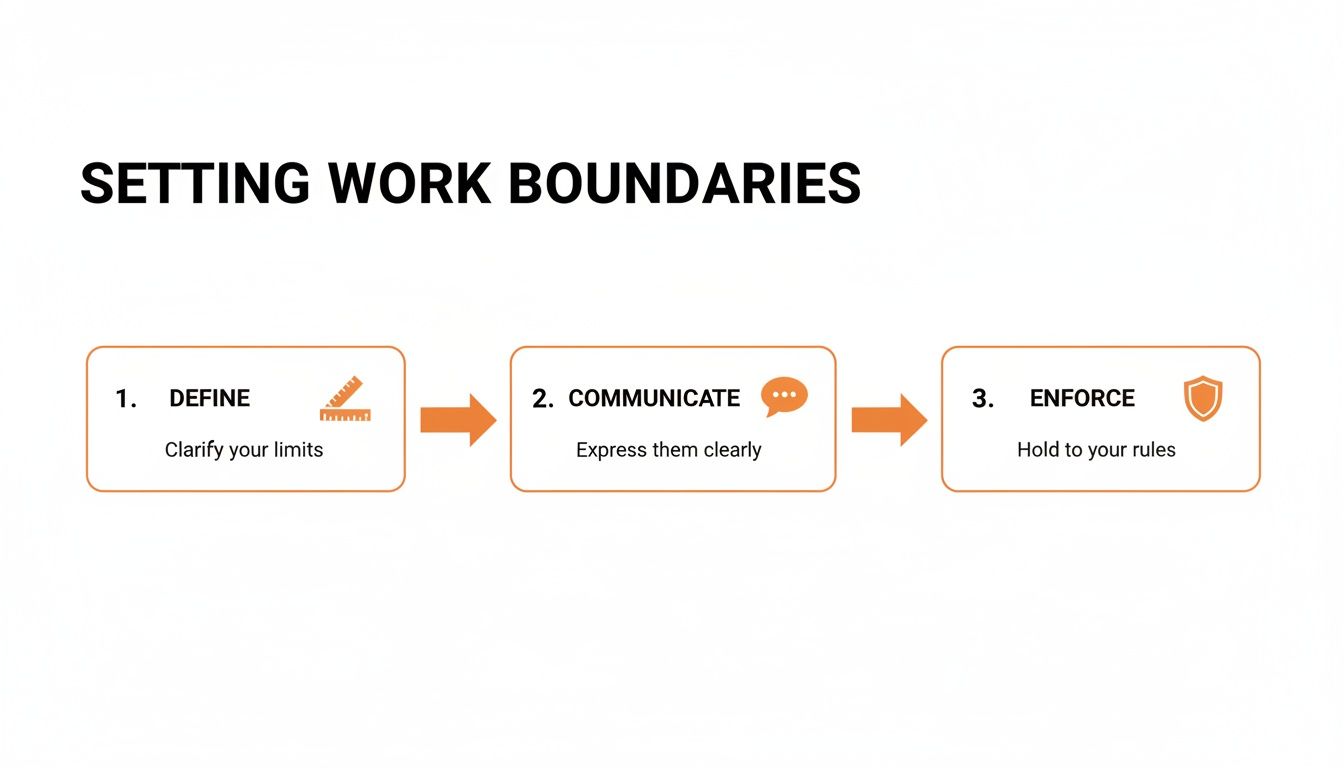
These three pillars—Define, Communicate, and Enforce—are what will move you from constantly reacting to being in the driver's seat of your professional life.
And this isn't some airy theory; it gets real results. Look at the whole 'quiet quitting' trend—it's really just people pushing back to do the job they were hired for. A LendingTree study found that 57% of these so-called "quiet quitters" saw their work-life balance improve once they started protecting their time.
For the kind givers and aspiring Midwest founders I know, that’s proof you can be bold in your business without setting yourself on fire. You can see more on how powerful this shift is for work-life balance and learn from others who have done it.
To help you get started right now, here’s a simple way I think about it.
Your Quick-Start Boundary Setting Framework
This table breaks down the core ideas into immediate, actionable steps. This is your first move toward a healthier relationship with your work.
| Boundary Pillar | What It Means for You | First Action Step |
|---|---|---|
| Define | Getting brutally honest about your limits—what drains you and what you need to thrive. | List 3 non-negotiables for your workday (e.g., no meetings after 5 PM, a full lunch break away from your desk). |
| Communicate | Clearly and calmly telling others what your boundaries are before they're crossed. | Draft a one-sentence script for your most common boundary issue (e.g., "I'll be able to review this first thing tomorrow morning."). |
| Enforce | Taking action to protect your boundaries when someone pushes against them. | Block off your non-negotiable times in your calendar as "busy" or "unavailable"—make it a visible barrier. |
This isn't just about saying "no" more often; it's about creating a structure that allows you to say "yes" to the things that truly matter.
Your boundaries are not selfish. They are the clear instructions that teach others how to respect your time, energy, and focus—and they give you the space to do your most impactful work.
I wrote this guide to be your game plan. It’s here to help you stop feeling overworked and start being the respected owner of your own time. I'm going to walk you through exactly how to build and hold these lines with confidence.
If you want to dive deeper, you can also check out our other articles on setting boundaries.
Identify Your Personal and Professional Lines
You can't defend a property line you haven't drawn. Before you can even think about enforcing boundaries, you have to get brutally honest about where your lines are in the first place.
This isn't some fuzzy, feel-good exercise. It's a practical self-audit to figure out what you actually need to protect your time and energy. You wouldn't build a fence without knowing your property lines, right? Same thing here.
Think about it. Is it getting through dinner with your family without Slack blowing up your phone? Is it finally carving out a morning for deep work, no interruptions allowed? You have to map out your non-negotiables.
Start Your Boundary Audit
Let's get real. My goal here is to help you pinpoint exactly what—and who—is draining you. Where are the leaks in your time, your focus, and your energy? Grab a notebook and think about the last month.
Ask yourself these questions, and don't hold back:
- When did you feel that creeping sense of resentment at work? What was the specific trigger? A last-minute request? A particular person?
- What tasks or meetings consistently leave you feeling completely spent, even if they don't seem like a big deal?
- What do you wish you had more time and headspace for, both in your business and in your life?
Your answers are the breadcrumbs. Resentment is a giant flashing neon sign pointing directly at a boundary that’s been crossed. This isn't about blaming anyone; it's about collecting data. You're gathering the evidence you need to build a better system for yourself.
That feeling of resentment? It's your internal alarm system. It's telling you that you’ve said "yes" when you should have said "no," or that one of your unspoken rules has just been bulldozed.
This audit is your first step to stop being reactive and start designing your days on your own terms.
The Three Core Boundary Types
Once you know your stressors, you can start putting them into buckets. I've found that most of the boundary issues you'll face at work fall into one of three main categories. Thinking about it this way makes it much easier to figure out what to do next.
Time Boundaries: This is about protecting your clock and your focus. It’s deciding when you’re on and when you’re off. Plain and simple. This could be a hard rule like no emails after 6 PM, or blocking off Monday mornings for focus work, no meetings allowed.
Role Boundaries: This is about knowing what’s your job and what isn't. It’s your best defense against scope creep. A solid role boundary sounds like, "That's an interesting idea, but it’s outside of what I'm handling. Let's loop in the right person to take the lead on it."
Energy Boundaries: These are about protecting your mental and emotional fuel tank. This means limiting your exposure to colleagues who drain you or flat-out declining meetings that could have been an email. You have to save your best energy for your most important work.
Getting clear on your lines in these three areas is a game-changer. It’s how you stop the time-sucking, soul-crushing requests before they even derail your day. Once you know your non-negotiables, you can start building the scripts and strategies to protect them.
Crafting Your Scripts for Difficult Conversations

Knowing you need to say "no" is one thing. Actually saying it is another.
This is where most of us get that knot in our stomach. You worry about coming off as rude, unhelpful, or worse, not a team player. I've been there.
But here's the thing: communicating a boundary isn’t a declaration of war. It's a negotiation. The goal isn't to win; it's for everyone to walk away feeling respected. You just need the right words—language that’s both kind and completely firm.
I'm opening up my playbook for you. These are field-tested phrases for those exact moments. Don't treat them like rigid scripts. Think of them as a starting point you can tweak to sound like you. The goal is to feel prepared, not like a robot.
How To Frame Your "No"
Your "no" doesn't have to just be the word "no." In fact, a flat "no" often invites more questions and pushback.
A good "no" is all about redirecting. You're not just closing a door; you're pointing them toward the right one, whether that’s a different timeline, a different person, or a different approach.
A boundary isn’t a wall to keep people out. It’s a filter to ensure your best energy goes to your most important work. Your words are the settings on that filter.
Here’s how you can frame your responses in different situations.
For Email: When a request lands in your inbox that you can’t take on, I tie my response to a shared goal. Try this: "Thanks for thinking of me for this. To make sure Project X gets the focus it needs to hit our deadline, my plate is full this week. I can circle back next Tuesday to see how I can help."
For Slack/Teams: These tools create a false sense of urgency. I've learned to slow the conversation down. A great go-to is: "Good question. I'm deep in the quarterly report right now, but I've added this to my list to look at tomorrow morning."
For Face-to-Face: When you're put on the spot, buy yourself some time and put the ownership back on them. You can say, "That sounds important. Right now, my top priorities are A and B. Can you help me understand where this new task fits in with those?" This turns it from a personal favor into a strategy discussion.
Making It a Team Effort
Setting boundaries is a lot easier when it's a team culture, not just your personal battle. It's about building mutual respect for everyone's time and focus.
For example, a study on global teams found that the most successful ones didn't just wait for a manager to tell them to stop pinging each other after hours. They all agreed on "no-reply" rules together. When leaders framed this as a positive move for well-being, everyone felt they could unplug without guilt. You can read more about how teams build these supportive communication habits and see the impact it has.
These conversations are a skill. Like any skill, you get better with practice. You might find our guide on how to give and receive feedback helpful as you start building these new communication muscles.
Remember, every time you use one of these phrases, you're not just protecting your own time—you're teaching others how to work with you more effectively.
How to Make Your Boundaries Stick (Consistently)

Okay, you've figured out your limits and had the tough conversation. That's the first half of the equation. The real test is the daily grind of making those boundaries stick. Anyone can set a boundary once; the hard part is defending it over and over.
This is where your new rules go from being an idea to a habit. Trust me, the first few times you hold the line on a "quick five-minute chat," it's going to feel awkward. Maybe even a little confrontational. But every time you do it, you're not just protecting your own focus—you're teaching people how to work with you.
Turn Your Calendar into a Fortress
Your calendar is your best friend here. Seriously. If you don't treat your calendar like a fortress guarding your time, someone else will see it as open land to build their projects on.
Here are a few tactics I live by every single week:
- Book Deep Work Blocks: I put 90-minute to 2-hour "Focus Time" blocks on my calendar for the work that actually moves the needle. I treat these blocks like a meeting with my most important client. Because that's what it is—a meeting with my own progress.
- Use "Out of Office" for Focus: You don't have to be on a beach to use the OOO auto-responder. If you've blocked off a morning, set a simple reply: "Heads up, I'm in a focused work session until noon and will get back to you then. Thanks for your patience." It instantly manages expectations for you.
- Buffer Your Meetings: Stop stacking meetings back-to-back. It's a recipe for burnout. Go into your calendar settings and automatically add a 15-minute buffer after every event. This gives you a moment to breathe, grab water, and actually prepare for the next conversation.
This isn't about being rigid for the sake of it. It's about being intentional. When you take command of your schedule, you send a powerful signal that your time is a finite resource. This is actually a core part of building vulnerability in leadership—it shows your team you're a human who needs focus, just like them.
Handling the Inevitable Pushback
People will test your new boundaries. It's not usually malicious; it's just human nature and old habits. Someone will hit you with the "got a sec?" or try to guilt you into an "urgent" last-minute request. How you respond in these moments is everything.
I've learned the key is to be calm but firm. Repeat your boundary without feeling like you need to apologize for it. Think of it less as a confrontation and more as a simple, gentle reminder of how you work now.
A boundary without enforcement is just a suggestion. Your consistency is what gives it power and turns it into a respected line that people learn not to cross.
Remember, giving people control over their own boundaries is a massive win for everyone. An incredible experiment gave grocery store workers more control over their shifts, even letting them use their phones for family needs. The result? No drop in productivity. In fact, employees felt more trusted and even used their phones to better help customers. Empowering people is just good business. You can discover more insights about how boundary control benefits everyone and see the proof for yourself.
Your 30-Day Action Plan for Lasting Change

Alright, you’ve read the theory. You get the "why." Now it's time to actually do the thing. This is where you and I turn these ideas into real, lasting change over the next 30 days.
This isn't about flipping a switch and becoming a totally different person overnight. Learning how to set boundaries at work is a skill. Think of it like going to the gym for the first time—you don't walk in and immediately deadlift 400 pounds. You start small, build your strength, and stack small, consistent wins. That’s exactly what we're going to do here.
I designed this plan for you—the ambitious but completely overloaded professional who's ready for a career that energizes, not drains you.
Week 1: Observe and Pick Your First Fight
Your first week is all about reconnaissance. Seriously, don't change a thing yet. Just become a detective of your own workday. Pay attention to the moments you feel that spark of resentment or that wave of exhaustion. Where are the energy leaks?
After a few days, I want you to pick one small, "low-stakes" boundary to practice. This is your training ground.
- For example: Maybe you decide to stop checking email during your actual lunch break.
- Or maybe: You stop answering Slack messages after 6 PM, even if you’re still at your desk finishing something up.
The goal is to pick a battle you know you can win. This first step is just for you. You don't even have to announce it. Just practice holding that one tiny line for yourself.
Week 2: Go Public With Your Line
You've held your small boundary for a week. Feels good, right? Now it's time to communicate it, using those kind-but-firm scripts we talked about. This isn't a dramatic proclamation; it's just a calm, simple statement.
Your boundary isn't a demand; it's a piece of information. You're just letting people know how you work best.
Let’s say you’re protecting your lunch break. You could update your Slack status to "Grabbing lunch." If a colleague pings you for something "quick," you respond after your break is over with something like: "Just saw this as I'm back from lunch. Taking a look now." No apology needed. You're just calmly reinforcing your boundary.
Week 3: Enforce and Handle the Pushback
This is where the real work happens. In week three, someone is going to test your new boundary. I promise. It's totally normal. Your only job is to stay consistent and handle that first bit of pushback with grace.
Remember, you don't need to get defensive. Just state your boundary again as a simple fact.
- The scene: A coworker asks for "just five minutes" during your protected focus block.
- Your reply: "I'm deep in a focus block until 11 AM, but I can definitely connect with you right after. Does 11:15 work?"
You aren't rejecting them; you're just managing the timing. Every single time you do this, the boundary gets stronger and becomes way easier to hold the next time.
Week 4: Level Up to a Bigger Boundary
You've got some momentum now. You’ve proved to yourself that you can actually do this. In this final week, you're ready to set a bigger, more impactful boundary. Look back at your notes from Week 1 to find a more significant pain point.
Maybe it's finally declining a meeting that has no clear agenda. Or pushing back on a project with a timeline that’s completely unrealistic. You now have the practice, the scripts, and the confidence to hold a more challenging line. This is it. This is how you build a sustainable career, one boundary at a time.
Frequently Asked Questions About Setting Work Boundaries
Okay, so you're starting to set boundaries. That's awesome. But I bet your mind is racing with a thousand "what if" scenarios. Don't worry, you're not the only one. These are the real-talk questions I get all the time from people just learning to take back their time.
What if My Boss Ignores My Boundaries and Keeps Contacting Me After Hours?
This is the one everyone worries about, and yeah, it’s tough. The first time it happens, you don’t need to pick a fight. Just gently and firmly remind them.
So, an email lands in your inbox at 8 PM. Don't touch it. The next morning, reply with something like: "Got it, I'll jump on this first thing today. Just a reminder, I'm fully offline after 6 PM so I can be recharged and focused for the next day." You’re being helpful, but you’re also drawing the line again.
If it keeps happening, it’s time for a quick, direct chat. The key is to frame it around your performance, because that's a language every manager speaks. I'd say something like, "I've noticed I produce my best work when I can completely disconnect in the evenings. Can we lock in a better way to handle truly urgent, after-hours messages?"
A boundary isn't a wall; it's a guide that teaches others how to work with you effectively. If that guide is ignored repeatedly, it’s no longer about the boundary itself—it’s about a lack of respect that you need to address directly.
If they still don't get it and it’s affecting your health, start a paper trail. Document every time it happens. From there, you can think about a formal talk with HR, especially if you can point to company policies on work-life balance.
How Do I Say No to Extra Work Without Seeming Lazy or Uncooperative?
This is all about how you frame it. You need to stop thinking in terms of "yes" or "no" and start thinking about priorities. A flat "no" makes you look unhelpful. Instead, I make it a conversation.
I call this my "Help Me Prioritize" script. It’s a game-changer.
The next time someone dumps a new project on you, try this: "I can absolutely take that on. Right now my main focus is on Project A and Project B. Could you help me figure out where this new task fits in with those priorities?" This move makes you a strategic partner, not just a pair of hands. It forces them to actually think about what's important.
I'm a Founder Who Has to Be "Always On" for Clients. How Can I Set Boundaries?
I hear this constantly from founders. You think you need to be available 24/7 to show you're dedicated. That's a trap, and it's a fast track to complete burnout. The answer isn't to work more—it's to manage expectations from the very beginning.
You have to train your clients how to work with you.
- Put it in writing. Your onboarding docs and kickoff calls should clearly state your business hours and response times. I use something like, "Our team is here to help from 9 AM to 5 PM, and we promise to get back to you within 24 business hours."
- Use an email autoresponder. Seriously. Setting one up for after-hours messages doesn't make you look weak; it makes you look like a professional who runs a real business.
Look, if you answer emails at 10 PM, you're teaching your clients that you're always on call. You can't sustain that. Protect your own time, and you'll have way more energy to deliver amazing work for your clients when it actually counts.
At Chicago Brandstarters, we know the founder's journey is a marathon, not a sprint. Setting boundaries is just one of the many real-world challenges we help each other solve in our free, vetted community. If you're a kind, bold builder in the Midwest tired of going it alone, join our community and find your people.