

You're pouring everything into your brand—late nights, weekends, all of it. Let's talk about something most founders push to the back of their minds: your business exit strategy.
This isn't about giving up. I'm telling you this is about making sure all that hard work actually pays off in the end. Thinking about your exit from day one is one of the smartest things you can do.
Why Your Business Exit Strategy Starts Now

I've seen it happen way too many times. You're deep in the trenches, building an incredible community around a product you love. Then, years down the road, you decide it’s time to sell and get a nasty surprise: your amazing business isn't actually "sellable."
Think about it like building a house. You wouldn't just start nailing boards together without a blueprint. You need a plan for the foundation, the frame, the plumbing—everything. Your exit strategy is your blueprint. It forces you to build a valuable, transferable company today, not just a job for yourself.
The Brutal Market Reality
The numbers are grim. A shocking 75% of U.S. business owners like you want to sell their companies in the next ten years. But here’s the reality check: of the 250,000 mid-sized businesses looking for an exit by 2030, only a tiny fraction will make it.
Data from firms like Fragasso Advisors shows only about 30,000 will successfully sell, and a mere 14,000 will get the price they were hoping for.
That massive gap between what you want and what you get isn't bad luck. It’s what happens when you wait too long to plan. It’s the result of building a business that can't run without you, has messy books, or doesn’t have a clear competitive edge.
This is exactly why you and I need to be talking about this now.
I often see founders get stuck on myths about selling their business. You might assume your hard work automatically translates to a high valuation, but the market is a different beast. I put together this table to contrast some typical founder assumptions with what data and my experience show us is the market reality.
Exit Readiness Common Myths vs Market Reality
| Your Assumption | Market Reality (Based on Data) | What This Means for You |
|---|---|---|
| "My business is my life's work, a buyer will see its potential." | Buyers purchase future cash flow and proven systems, not your personal story. Only 20% of businesses listed for sale actually sell. | You need to build a business that runs on systems, not on your personal heroics. I mean start documenting everything. |
| "I'll just sell when I'm ready to retire in a few years." | The average sale process takes 9-12 months, and that's after years of preparation. If you rush the process, you will almost always get a lower price. | You should begin your exit prep 3-5 years before you even think about listing. This gives you time to clean up your financials and operations. |
| "All my revenue growth will get me a top-dollar valuation." | Profitability, recurring revenue, and low customer concentration are far more attractive. A business with flat revenue but high profit margins can be worth more than a fast-growing, cash-burning one. | You must shift focus from just top-line growth to building sustainable profitability. A buyer is buying profits, not just revenue. |
| "I'll find a buyer easily; my industry is hot." | Most potential buyers (over 80%) are strategic acquirers within your industry who already know you or your competitors. Cold outreach has a very low success rate. | You have to start building relationships with potential strategic partners or buyers years in advance. Make your brand known in the right circles. |
This isn't meant to discourage you, but to get you to act. Understanding these realities now is your biggest advantage. It allows you to build a company that defies the odds because you designed it from the start to be valuable to someone else.
Shifting Your Mindset From 'Baby' to Asset
I get it, your business is your baby. You’ve lost sleep over it. You've sacrificed a ton to watch it grow. That emotional connection is real, but honestly, it can be your single biggest roadblock to a successful exit.
A buyer isn't buying your sleepless nights or your passion. They're buying an asset—a machine that's going to make them money. To get ready for an exit, you have to start making a mental shift.
- Stop being the hero. Start writing down how everything gets done. Your goal is to build a company that runs smoothly even if you take a month-long vacation.
- Focus on what buyers want. They care about things like recurring revenue, profit margins, and customer acquisition costs. You should track them like a hawk.
- See the business as your legacy. It's a vehicle that can carry on its mission long after you've moved on to your next adventure.
This doesn't mean you have to become a cold, detached robot. It means you have to be strategic. You’re building with the end in mind, which ensures the value you’re creating is real and transferable. This takes a clear mental model for making choices. If you want to go deeper on this, check out our guide on building a framework for making business decisions.
By thinking like a future seller today, you’re not just planning an exit—you’re building a better, stronger business right now. That's the real secret.
Choosing Your Exit Path: The Main Options
Thinking about your exit is something you should do from day one. I know, it sounds crazy. You're just trying to get your first sale, and I'm talking about selling the whole company?
Trust me. Knowing where you could go makes the journey a hell of a lot clearer. Each exit path is a completely different road. They lead to very different places for you, your team, and the brand you’re bleeding for.
Let me walk you through the most common ways out, and what they really mean for a brand builder like you.
Strategic Sale or Acquisition
This is the one everyone dreams about. A huge company in your space—think of a CPG giant or a major competitor—swoops in and buys you. They aren't just buying your sales numbers; they're after your customer list, your secret sauce, your cool branding, or just a way to get into a market they can't crack on their own.
- The upside? This is usually where you'll see the biggest valuation. A strategic buyer will pay a premium because you solve a major problem for them.
- The downside? You kiss control goodbye. Your brand's culture will get swallowed whole by the corporate machine. Your baby might become something you don’t even recognize.
I advised a founder who built an incredible niche food brand. A massive corporation acquired them for a life-changing number. The deal was fast, the money was insane. But within two years, they'd changed his original recipe to shave a few cents off the cost. He was set for life, but he still talks about that loss.
Sale to a Financial Buyer
This means you sell to a private equity (PE) firm or a similar group of professional investors. These guys aren't in your industry. They're basically expert house flippers for businesses.
They buy companies with good bones, spend a few years optimizing everything to squeeze out more profit, and then sell it again for a nice return. They are buying your future cash flow, plain and simple.
A financial buyer is a great path if you have a profitable business with solid, repeatable systems. But I warn you: they will put your finances under a microscope. Clean books are not optional.
Internal Transfer: Family or Employees
This path is less about the biggest check and more about your legacy. It’s about selling the company to a family member, a key manager, or even your entire team. This is for founders like you who want to see the mission and the culture live on.
It’s way more common than you’d think. The media loves a massive buyout story, but the truth is different. Research shows that around 70% of business owners would rather pass the torch internally to protect what they’ve built. Only 17% are dead-set on an external sale above all else.
This stat from an employee ownership report shows a deep desire for the business to land in the right hands.
An Employee Stock Ownership Plan (ESOP) is a formal way for you to sell to your team. You essentially sell your shares to a trust that holds them for your employees. It's a powerful way to reward the people who helped you get there.
- The upside? Your legacy is safe, and you reward your loyal team. You can also step back gradually instead of all at once.
- The downside? You will almost certainly get a lower price than from an outside buyer. These deals are also a headache to structure and finance.
Initial Public Offering (IPO)
Ah, the IPO. This is the unicorn of exits—ringing the bell on the stock exchange. It's the big dream, but for most of us, it’s just that: a dream.
Going public is unbelievably expensive, brutally demanding, and incredibly rare for the kinds of brands we build. It’s like turning your scrappy startup into a massive public company with thousands of shareholders you have to answer to every quarter.
Honestly, unless you're on a rocket ship to hundreds of millions in revenue, don't waste your time thinking about it. You should focus on the other, more realistic options.
The 36-Month Plan to Get Your House in Order
You’d never try to sell a house with a leaky roof and closets overflowing with junk. The exact same logic applies to your business. This is where you roll up your sleeves and turn a good business into a great, sellable asset. It’s all about getting your house in order long before a buyer ever comes knocking.
Most founders wait until they're completely burned out or get a surprise offer before they even think about this. That’s a huge mistake. The hard truth is a shocking 80% of businesses put up for sale never actually find a buyer, usually because of messy books and operational chaos. You can see more stats on this from places like Spring-Green.
Getting ready for an exit isn’t a weekend project. It’s a marathon that you must start 24 to 36 months before you even want to think about selling. Here’s my playbook for you.
This timeline shows how different exit strategies, like a strategic sale or family transfer, require different amounts of prep time and lead to different results.
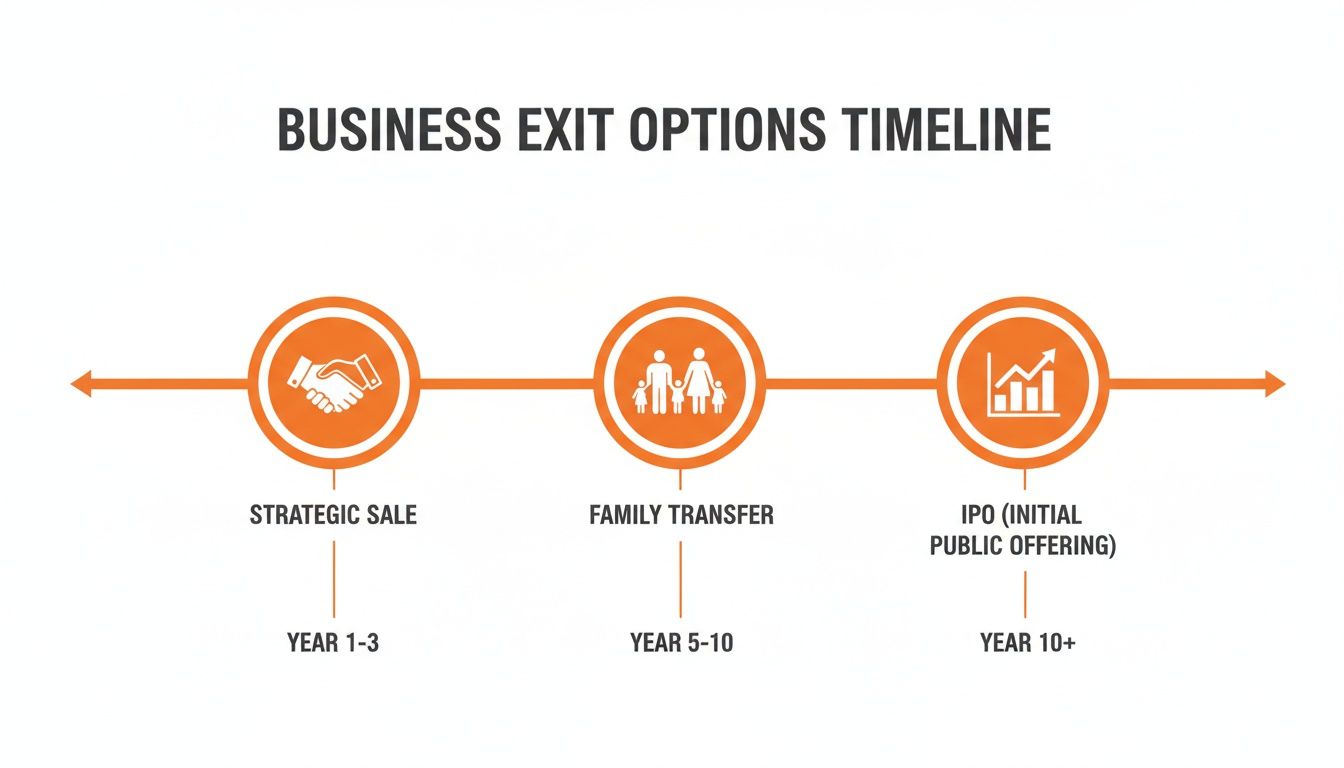
As you can see, the path you choose changes the timeline, but every successful exit has one thing in common: a ton of preparation.
Phase 1: Financial Cleanup (Months 1–12)
Think of your financials as the foundation of the house you're selling. If there are any cracks, a buyer's inspector—their due diligence team—will find them. Your mission here is to go from messy spreadsheets to clean, auditable financials.
I’ve personally seen deals completely fall apart because the founder was expensing personal dinners and family vacations through the business. This isn’t about judging; it’s about you presenting a clean financial story. A buyer needs to see exactly how the business makes and spends its money, without your personal life tangled up in it.
Your first year should be all about three things:
- Hire a Fractional CFO or a Good Accountant: You must ditch the cheap bookkeeper. Seriously. You need someone who lives and breathes GAAP (Generally Accepted Accounting Principles). This is the language buyers speak.
- Separate Everything: You have to get a dedicated business bank account and credit card. Stop mixing personal and business funds. It sounds so basic, but you’d be shocked how many founders get this wrong.
- Produce Monthly Financial Statements: You need a clear Profit & Loss (P&L), Balance Sheet, and Cash Flow Statement every single month. This proves you have a history of stability and predictability.
A buyer isn't just buying your past performance; they're buying its predictability. Clean, consistent monthly financials are the ultimate proof that your business is a well-oiled machine, not a chaotic hobby.
Phase 2: Operational Streamlining (Months 13–24)
Now that the financial foundation is solid, it's time to work on the house itself. This phase is all about one critical goal: making the business run without you. A business that depends entirely on its founder isn't a sellable asset—it's just a job.
I worked with a founder once who was the only person who knew how to manage their most important supplier relationship. When a potential buyer asked what would happen if he got hit by a bus, he didn't have a good answer. The deal fell apart right there.
Your job for this year is to document everything. Create a "business playbook" that a stranger could use to run the company.
- Document Key Processes: How do you get customers? Fulfill orders? Handle support tickets? You must write it all down in Standard Operating Procedures (SOPs).
- Delegate and Empower Your Team: Start handing off your key responsibilities. A buyer wants to see a strong management layer that isn't just you.
- Solidify Your Agreements: Get long-term contracts in place with key suppliers and clients where possible. This shows stability and reduces the risk for a new owner.
This isn’t just for a sale, by the way. This whole process will force you to run a better business and will free up your time right now.
Phase 3: Legal Fortification (Months 25–36)
This is the final inspection. You’re making sure all the legal paperwork is completely buttoned up so there are no ugly, last-minute surprises that could kill your deal.
A friend of mine was two weeks from closing a seven-figure sale of her e-commerce brand when the buyer’s lawyer found out she had never properly registered her trademark. The deal almost died. They had to frantically spend tens of thousands on legal fees to fix it, which came directly out of her pocket at closing.
Don't let that happen to you. Use this final year to audit and strengthen your legal standing.
- Protect Your IP: You must make sure your trademarks are registered and your patents (if you have them) are secure. Your brand is one of your most valuable assets.
- Review All Contracts: Have an M&A attorney review your employee agreements, client contracts, and vendor agreements. You’re hunting for any clauses that could be a problem in a sale, especially "change of control" provisions.
- Clean Up Your Cap Table: Your ownership structure must be crystal clear. If you have partners or early investors, make sure every piece of documentation is clean and signed.
This 36-month plan might feel like a lot, but you're not just preparing for an exit. You're building a stronger, more resilient, and more valuable company every step of the way. That’s how you design a business exit strategy that actually works.
How to Know What Your Business Is Really Worth

Let me get one thing straight with you right away: your business is worth exactly what someone is willing to pay for it. Period. It's not about how much you've sacrificed or how much you love it.
So, how do you figure out that number? It can feel like a dark art, but there’s more science to it than you might think. A buyer isn't buying your past; they're buying your future. They're making a bet on the profits your business will generate down the road.
The most common way buyers value a modern brand like yours is with a simple formula: SDE or EBITDA x Multiple. I’ll break down what that means for you in plain English.
Decoding the Valuation Lingo
Don’t let the acronyms scare you. For most small to mid-sized brands like yours, we often start with SDE, which stands for Seller’s Discretionary Earnings. Think of it as your total net profit plus your own salary, any personal perks you run through the business (like your car payment), and one-time expenses that won't happen again. It’s the total cash benefit you, the owner, get from the business.
For slightly larger businesses, buyers use EBITDA—Earnings Before Interest, Taxes, Depreciation, and Amortization. It’s a more formal measure of profitability that’s standard for bigger deals. The core idea is the same: it’s a snapshot of the company’s raw earning power. Understanding how to manage and present your earnings is key; strong cash flow management for your small business is a great place for you to start.
The second part of the equation is the Multiple. This number is where the magic happens. A buyer takes your SDE or EBITDA and multiplies it by a number—say, 3x, 5x, or even 8x—to arrive at your company's value. Your job, as a founder planning your business exit strategy, is to do everything you can to increase that multiple.
What Drives a Higher Multiple
A higher multiple means a buyer sees less risk and more opportunity in your future. They’re willing to pay a premium. The good news for you is that you have a ton of control over the factors that increase this number.
These are the "value drivers" that I know buyers absolutely love to see:
- Recurring Revenue: Is your income predictable? Subscription models, long-term contracts, and high customer repeat rates are gold. They prove your revenue isn't a fluke.
- Strong, Defensible Brand: Do you have a real brand with a loyal following, or are you just selling a commodity? A powerful brand with protected intellectual property is much harder for competitors to copy.
- Diversified Customer Acquisition: Are you totally dependent on Facebook ads? That’s risky. Buyers want to see you getting customers from multiple channels like SEO, email, social media, and retail.
- A Business That Runs Without You: Can you take a month off and the business still grows? A strong team and well-documented processes prove the business is an asset, not just your job.
I worked with a founder whose entire business relied on one key employee. When that employee left, the company's value was slashed in half overnight. Building a system that doesn't depend on any single person is one of the most valuable things you can do.
The Power of Small Improvements
You don't need to double your revenue to dramatically change your valuation. Small, strategic tweaks can have an outsized impact.
Consider your gross margin—the percentage of revenue left after you pay for the cost of goods sold. Let's say your business has $500,000 in profit and is valued at a 4x multiple, making it worth $2 million.
If you can improve your gross margin by just 5%, that could add $100,000 to your annual profit. Now your profit is $600,000. At that same 4x multiple, your business is suddenly worth $2.4 million. That's a $400,000 increase in value from one small change.
This is why you have to start thinking like a buyer now. Every decision you make—from negotiating with suppliers to documenting a new process—either adds to or subtracts from your final valuation. Start building the company a buyer can't resist.
Negotiating and Closing the Deal Without Losing Your Mind
So you did it. You built something incredible, prepped it for sale, and now you’re staring at a Letter of Intent (LOI). This is the big moment. But let me be completely real with you: the final sprint from this point to the closing table is a brutal mental marathon.
This is where so many deals fall apart. It's rarely about the numbers. It’s about emotions, ego, and sheer exhaustion. I’ve been in the trenches on this, both for my own exits and for founders I’ve coached. You should prepare yourself for a rollercoaster where every tiny decision you've ever made gets picked apart. Your patience will be tested. Daily.
Build Your Deal Team
You cannot do this alone. I repeat: you cannot do this alone. Trying to save a few bucks by DIY-ing this part of the process is the single most expensive mistake you can possibly make. The very first thing you need to do is get your personal deal team in place—these are the experts who will go to war for you while you do the most important job: keeping the business from falling off a cliff.
A performance dip during due diligence is a classic deal-killer. Your job is to keep steering the ship. Let your team manage the sale.
Here’s who you absolutely need in your corner:
- An M&A Attorney: Not your general business lawyer who drafts your employment contracts. You need a specialist who lives and breathes acquisitions. They know what's "market," can spot a poison pill in a contract from 50 paces, and will shield you from liabilities that can haunt you for years.
- An M&A-Savvy Accountant: This is the person who will defend your financials when the buyer's team tries to tear them apart. They’ll guide you through the brutal Quality of Earnings (QoE) process and make sure your numbers can withstand the heat.
- An M&A Advisor or Broker: This is your quarterback. They run the process, handle the back-and-forth negotiations, and serve as a critical buffer between you and the buyer. That emotional distance is what will keep you sane and prevent you from making bad, rash decisions.
Think of your deal team as your personal bodyguards and translators. They speak the language of acquisitions fluently and will protect you from getting emotionally tangled in the negotiations—which is a surefire way to blow up your own deal.
Surviving the Due Diligence Gauntlet
Once you sign the LOI, the real fun begins: due diligence. This is where the buyer puts every square inch of your business under a microscope. It feels incredibly invasive and personal, because it is. They will question everything. Every hire, every expense, every marketing claim.
My best advice to you? Detach. Emotionally. This isn’t an attack on your baby; it’s just business. They’re verifying the asset they plan to buy. You should get ready for a firehose of requests for documents, data, and endless explanations.
Organization is your only defense here. Set up a virtual data room (a secure folder system like Dropbox or DealRoom works) and have everything ready before they ask. The faster and more professionally you respond, the more confidence you instill in the buyer. If you want a preview of what’s coming, think about all the questions to ask when buying a business—they’ll be asking you every single one.
Negotiating Without Burning Bridges
Negotiation isn’t a one-time event. It’s a constant dialogue that starts with the LOI and doesn’t end until the money is in your bank. And remember, the price is just one piece of the puzzle. The terms—the reps and warranties, the escrow, the transition plan—are just as, if not more, important.
Here are a few hard-won principles for you at the negotiation table:
- Know Your Walk-Away Point: Before any talk begins, you must know your absolute bottom line on price and key terms. Write it down. This is your anchor in the storm.
- Focus on "What," Not "Why": The buyer doesn’t care why you think you deserve a certain price. They care about data. You have to use your growth, your margins, and your market position to justify your stance. Keep it objective.
- Give to Get: You won’t win on every point. It's a negotiation, not a surrender. Be ready to concede on smaller things to secure the wins that actually matter to you. This signals you’re a reasonable partner, not a roadblock.
- Let Your Advisor Play Bad Cop: When you need to hold a firm line on a tough point, have your M&A advisor deliver the message. This keeps your personal relationship with the buyer positive, which is crucial for a smooth transition after the deal closes.
The last few days before closing are a pressure cooker. I’ve seen deals die hours before the wire was supposed to hit. Stay calm, lean hard on your team, and keep your eyes on the finish line. This is the final chapter of your exit strategy, and getting across it is a victory that makes every bit of the struggle worthwhile.
Your Top Business Exit Questions, Answered
When you're deep in the trenches building your brand, thinking about the end can feel strange. But trust me, you have to. You'll suddenly find yourself needing to be an expert in M&A, finance, and law.
It’s overwhelming. I get it. Here are some of the most common questions I hear from fellow founders like you, with the kind of direct, no-fluff answers I wish I’d had.
When Is the Absolute Best Time to Sell My Business?
The short answer? Sell when you don't have to.
The best deals happen when you're negotiating from a place of strength, not desperation. This means you should sell when your business is firing on all cylinders and has a clear runway for more growth.
Buyers aren't just buying what you've done; they're paying for what they believe you're going to do.
Don't wait for a new competitor to pop up, the market to get shaky, or for you to be completely burned out. The sweet spot is often 12 to 24 months into a solid growth spurt. That gives you an incredible story to tell and the numbers to back it up. I tell everyone: start the prep work when business is booming. That’s when you have the energy and cash to clean house and get the best possible price.
How Much Does It Really Cost to Sell a Business?
Selling your business costs money. Period. And trying to cheap out here is one of the most expensive mistakes you can possibly make. You should think of these fees as an investment, not an expense. A killer team can add millions to your final price, easily paying for themselves.
Here’s a realistic look at what you’ll be spending:
- M&A Advisor or Broker: This is usually the big one. You can expect to pay a success fee between 5% and 10% of the final sale price.
- Legal Fees: You need a real M&A lawyer for this, not the person who set up your LLC. You should budget $25,000 to over $100,000, depending on how messy the deal gets.
- Accounting and Financial Prep: Your books have to be spotless. An accountant will help you prepare and defend your numbers during due diligence. This can run from $10,000 to $50,000+, especially if you need a formal Quality of Earnings (QoE) report (and you probably will).
I've personally seen founders lose out on millions because they tried to save a few thousand dollars on advice. Don't be that person. You must invest in your exit.
What's the Biggest Mistake Founders Make During an Exit?
Hands down, the biggest mistake is letting your emotions hijack your business sense.
I’ve seen it happen again and again. You’ve poured your blood, sweat, and tears into this company. It's your baby. To a buyer, though, it’s an asset. A line on a spreadsheet.
This emotional attachment causes two massive errors:
- Killing a great deal over small things: You get a fantastic offer but walk away because a minor detail "feels" wrong or you feel personally slighted. Your feelings are real, but they shouldn't be driving the bus.
- Trying to do it all yourself: This is a close second. You're a founder, not an M&A pro. Trying to run the sale on your own to save on fees is a recipe for disaster. Your only job during the sale process is to keep the business growing. A dip in performance while you're distracted is a classic deal-killer.
Hire the best people you can afford. Trust them. And you? You keep your head down and run your company until the day you hand over the keys. That's how you protect your legacy—and your bank account.
Building a business is hard, but you don't have to do it alone. If you're a kind, hardworking brand builder in the Midwest, Chicago Brandstarters is a free, vetted community designed to help you connect with peers who get it. We skip the transactional networking for real conversations and durable friendships. Learn more and see if it's right for you at https://www.chicagobrandstarters.com.