
Let's be honest. "Networking" probably makes you want to crawl under your desk. You picture a chaotic room, a sea of unfamiliar faces, and the crushing pressure to make endless small talk. It feels like a stage where you’re forced to perform, and it’s exhausting.
I get it. But I want you to completely reframe that picture. The old model of handing out business cards like they're candy is dead. Today, your real success comes from authentic relationships.
It’s time you stop trying to "perform" and start focusing on genuine connection. Forget those loud, crowded rooms. I’m talking about quality over quantity—seeking the small, meaningful interactions that actually energize you, not drain your social battery.
This is a game you're already built to win.
Your Introvert Networking Advantage

What if your introversion wasn't a liability, but your greatest strength? Your natural inclinations are exactly what modern networking demands. These aren't your weaknesses; they're your superpowers in a world full of noise.
The Power of Deep Connection
As an introvert, you probably prefer deep, one-on-one conversations over superficial chatter. You’re also likely a fantastic listener. You absorb what others are truly saying instead of just waiting for your turn to speak.
Think of it like this: an extrovert might be a radio tower, broadcasting a signal to a wide area and hoping someone tunes in. You, on the other hand, are an expert at creating a secure, direct line. It’s a focused, high-quality connection that builds real trust. And it lasts.
You don't need to change who you are to build an amazing network. The problem isn’t you—it's that most networking advice is for extroverts. You've been playing a game with rules that drain your energy.
To see how we differ, let's compare our networking superpowers. Neither is better; we just operate differently. Your key is to lean into what you do best.
Introvert Strengths vs Extrovert Strengths in Networking
| Networking Trait | My Introvert Superpower | Their Extrovert Superpower |
|---|---|---|
| Conversation Style | Meaningful one-on-one dialogues | Engaging multiple people at once |
| Listening Skills | Active listening, absorbing details | Quickly grasping the "big picture" of a room |
| Energy Source | I gain energy from deep, focused talks | They gain energy from social stimulation |
| Relationship Building | I build strong, long-term bonds | They cast a wide net for many contacts |
| Follow-up | Thoughtful, personalized outreach | Quick, high-volume follow-ups |
Once you understand this, you can stop trying to be the person who works the whole room. Instead, you become the person who has the most memorable conversation of the night.
A Game You Are Built to Win
The idea that you have to be a social butterfly to build a powerful network is a myth. In fact, many of the world's most successful leaders are introverts like you and me.
Did you know that while we make up 25% to 40% of the population, a striking 30% to 70% of business leaders and CEOs share our trait? This isn't a coincidence. As some research from Escalon.services highlights, your natural ability to think deeply and form genuine bonds is a massive asset.
This should give you a ton of confidence. You don’t need to fake it or become someone you're not.
You just need to find the right environments and strategies that let your strengths shine. Forget the pressure to "work the room." Your goal is to have one or two meaningful conversations.
I'll show you exactly how to do that. You'll learn how to find events you'll actually enjoy, master quiet conversation, and build a network that feels less like a chore and more like a community of allies. It’s time for you to play the networking game by your own rules.
Finding Networking Events You'll Actually Enjoy
The biggest mistake you can make is forcing yourself into situations that feel awful. Let me get one thing straight: you don't have to.
My secret isn't to become an extrovert. It's to find the right rooms. Forget the giant conference hall packed with thousands of people. That’s only one type of networking, and honestly, it’s usually the least effective for me.
Your goal isn't to suddenly love chaotic rooms. It’s about finding environments that fit your natural energy, where your strengths—like being a great listener and asking thoughtful questions—can actually shine. You just have to be picky.
Think of it like picking a restaurant. You wouldn't go to an all-you-can-eat buffet when you really want a quiet, intimate meal. Same logic. You’re looking for the networking equivalent of that cozy, six-table spot where the conversation is just as good as the food.
Ditch the Chaos for Curated Connection
For introverts like us, the best events are almost always small and focused. These are the places where you can be a real person, not just another face in a sea of name tags.
I always look for these kinds of meetups:
- Intimate Dinners: This is my absolute favorite. A small group of 6-8 people around a dinner table is the perfect setup. The conversation flows naturally, and you actually have time to get past the small talk.
- Specialized Workshops: When you go to a workshop on a topic you genuinely care about, you instantly have something in common with everyone there. It’s a super low-pressure way for you to connect with your peers.
- Roundtable Discussions: These are great because they're structured. Everyone gets a chance to speak, so you don't have to fight for airtime. You can just listen, think, and share something meaningful when it's your turn.
This is exactly why I built Chicago Brandstarters the way I did. We host small, private dinners for just 6-8 founders at a time. The format itself attracts people who value depth, creating the kind of space where you can build real friendships, not just transactional contacts.
Powerful networking happens in environments of trust, not transaction. Your first job is to find or create spaces where you can build trust. You have to be intentional with your energy.
This isn’t about hiding from people. It's about being strategic. You choose to engage on your own terms, in settings that won’t burn you out before you’ve even had your first conversation.
How to Vet a Networking Group
Once you spot a promising event or group, you need to do a little homework. Not all groups are worth your time. Some are just full of "takers"—people who only show up to see what they can get from you. You want a room full of "givers."
Before you commit, do a quick vibe check.
- Check Their Vibe: Look at their website and social media. Does the language sound real and community-focused, or is it all corporate-speak about "closing deals"? Look at the pictures. Are people actually talking to each other, or does it just look like a business card exchange party?
- Look for a Mission: The best communities have a clear purpose beyond just "networking." My mission, for example, is to help kind, hardworking founders succeed. A strong mission attracts the right kind of people and keeps the wrong ones away.
- Find Out Who Attends: If you can, check out past attendees or look for member profiles on LinkedIn. Are these the people you want to build relationships with? Do they seem to be in a similar field or at a similar stage as you?
If you're looking for a new community, learning how to find the right business network group is a skill you must have. It'll save you from wasting so much time and energy in rooms that just aren't a fit for you.
Ultimately, networking as an introvert is a mindset shift. You’re not just attending events; you’re building relationships. That all starts with being strategic about where you show up. When you aim for small, curated, and mission-driven gatherings, you put yourself in a position to win without faking it. You get to have the deep, meaningful conversations you actually enjoy—and those are the ones that lead to real opportunities.
Mastering the Art of Quiet Conversation
Okay, you did the hard part. You found a good event—one of those small, curated dinners I talked about. You're there. But now you’re standing by the door, and that familiar feeling creeps in. What on earth do you say to these people?
That fear of awkward small talk is real. It feels like you need a perfect, witty script. I’m telling you to throw that idea out the window. Your goal isn't to impress anyone with a slick pitch. It's just to start a real conversation.
Think of it like building a campfire. You don't just toss a giant log on and hope for the best. You start with small kindling that catches fire easily. Conversations work the exact same way.
Simple Starters for Genuine Connection
The easiest way I break the ice is to use what we already have in common: the event itself. Forget trying to be clever. Just be curious.
Here are a few of my go-to "kindling" questions. They're low-pressure and get the other person talking:
- "What brought you to this event tonight?" (This opens the door to their goals or passions).
- "I thought the speaker's point about [topic] was really interesting. What did you think?" (This grounds the conversation in a shared experience).
- "First time at one of these dinners for me. Have you been before?" (A simple, easy question about the context you're both in).
Notice a pattern? These questions aren't about you. They’re about them. That’s your secret weapon.
The Art of Actually Listening
Extroverts might fill the air with words, but you and I often hear more. And I mean really hear. Active listening isn't just nodding while you wait for your turn to talk. It’s like being a detective searching for clues. You absorb what someone is saying.
When you truly listen, you’ll pick up on their passions, their pain points, and what makes them tick. Those are the little threads you can gently pull to go from small talk to a real discussion.
Your real job at a networking event isn’t to talk; it's to listen. Your curiosity is far more compelling than your elevator pitch. People don’t remember what you said as much as they remember how you made them feel—and feeling heard is powerful.
When you make someone feel seen and understood, you build a connection that a stack of business cards never will.
This whole process—from finding the right event to having these quiet conversations—is a deliberate flow.
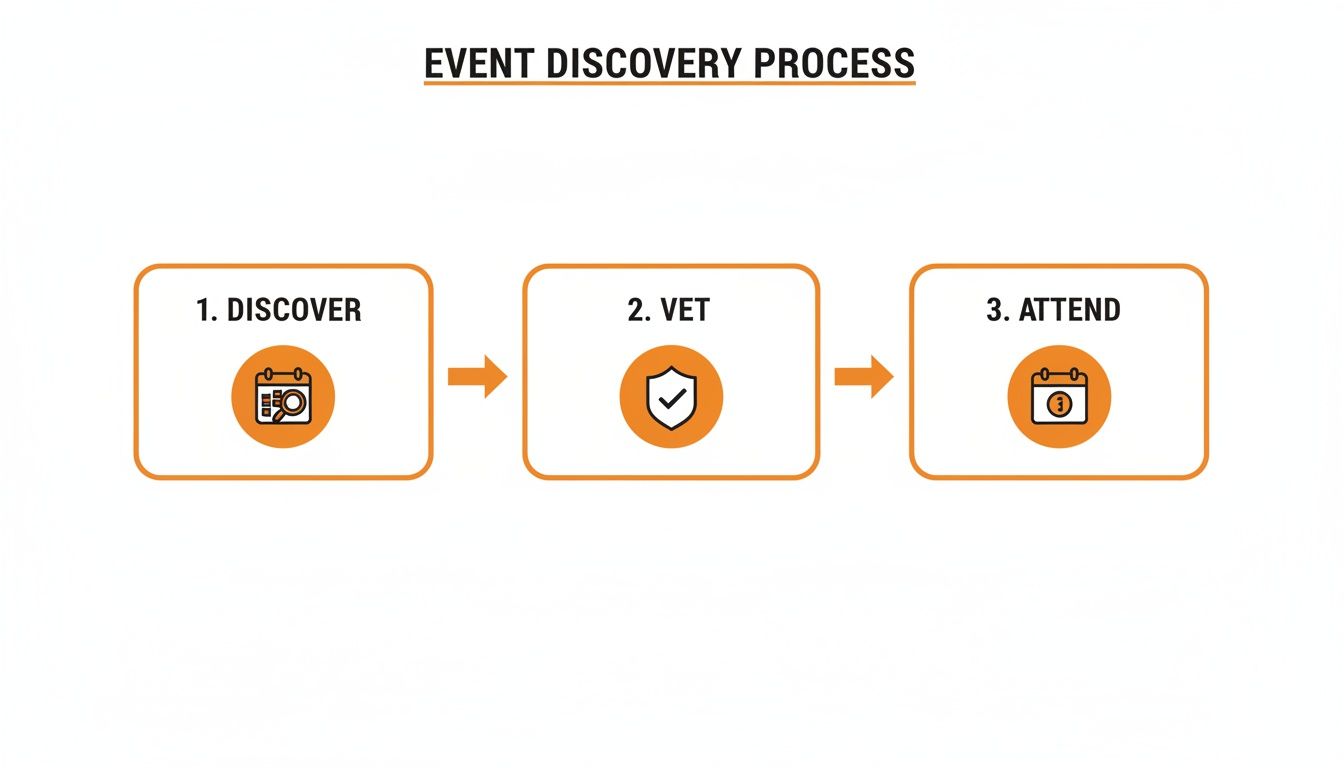
When you’re thoughtful before you even walk in the door, the conversation part becomes so much less scary.
Escaping the Awkward Trap
So what happens when the conversation stalls? Or you feel your social battery hitting zero? It happens to me, too. Having a simple, polite exit strategy is a total game-changer. It removes that trapped feeling.
You don't need a crazy excuse. Just be direct and honest.
- "It was great chatting with you about [topic]. I'm going to grab a drink, but I hope you enjoy the rest of the night."
- "I really enjoyed our conversation. I'm going to try and mingle a bit more, but it was a pleasure meeting you."
This isn't rude, it's just good self-management. It’s about you leaving the event feeling like you accomplished something, not like you just survived a battle. A bit of prep work turns my dread into confidence.
A career guide from the University of Florida confirms this, showing that simple tactics—like researching who's attending and focusing on listening for stories—can completely change your experience. You can read more about these practical networking strategies for introverts and see for yourself.
By aiming for one or two quality conversations, listening more than you talk, and knowing how to make a graceful exit, you’ll master this whole quiet conversation thing. You'll walk away with real connections, not just a pocketful of names.
Using Digital Tools for Comfortable Connection
For a lot of us, the screen is a welcome buffer. It gives you the space to be thoughtful without the on-the-spot pressure of a face-to-face chat. This is your moment to turn your comfort zone into a networking powerhouse.
Think of digital networking less like sprinting and more like gardening. You don’t just toss seeds on concrete and hope for the best. You have to prepare the soil, plant with intention, and nurture those seeds over time.
Sending a blast of generic LinkedIn requests is like scattering seeds on pavement. It just doesn’t work. Instead, you can use these tools to thoughtfully build relationships from your own home, turning a source of anxiety into a genuine asset for you.
Mastering Asynchronous Outreach
The real magic of digital connection is that it's asynchronous. You don't have to respond in a split second. This gives you a massive advantage. You get to take your time and craft the perfect, personalized message.
Platforms like LinkedIn, targeted emails, and niche online communities are your best friends here. But my secret isn’t just clicking "connect." It's all about making it personal.
Your goal online isn't to be seen by everyone; it's to be remembered by the right people. One thoughtful message that shows you've done your homework is worth a hundred generic connection requests.
This approach builds trust right from the jump. When you prove you’ve invested a little time to understand who they are, you immediately stand out. You signal that you value their time and want a real conversation, not just a transaction.
How to Craft a Message That Actually Gets a Reply
So, how do you write one of these messages? My formula is simple: be specific, be genuine, and be generous. Ditch the robotic templates. Focus on a human-to-human connection.
Here’s a simple framework I swear by:
- A Specific Compliment: Kick things off by mentioning something specific you admire about their work. This proves you've paid attention. "I really enjoyed your recent article on supply chain management…"
- A Personal Connection: Briefly tie it back to your own world. "…it resonated with me because I’m currently trying to solve a similar challenge with my own product."
- A No-Pressure Ask (or No Ask at All): End with something light. Honestly, the best move you can make is to simply offer value or appreciation. "I just wanted to reach out and say thank you for sharing your insights. I'm looking forward to following your work."
Notice there’s no big, needy ask. You’re not demanding a 30-minute call. You're just planting a seed and opening a door. This simple, generous approach is how you network as an introvert without feeling gross or salesy.
Speaking of digital connections, sometimes the most valuable tools bridge the gap between online and in-person. If you meet someone, having a quick way to share your details is a lifesaver. You can check out my simple guide on how to generate a free QR code with your contact card to make that exchange seamless.
Share Your Story to Build Trust
Your digital presence is also a place to share your own story. You don’t need to broadcast every win. In fact, being vulnerable and sharing the real challenges you're working through is often way more powerful.
This might look like you:
- Posting a thoughtful question on LinkedIn: Share a problem you're trying to solve and ask for advice. This invites collaboration.
- Participating in a niche community: If you're in a Slack group for founders, actually contribute. Answer questions and share your own experiences.
- Writing a short article or post: Document a lesson you learned from a recent failure or a small win you finally achieved.
When you consistently offer value before you ever ask for anything, you build a reputation as a giver. This is the foundation of a strong, authentic network built on your terms. This method lets you recharge your social battery while still making real progress, creating durable connections one thoughtful interaction at a time.
Building Friendships Instead of Just Contacts
Let's be real: the whole point of this isn’t to rack up LinkedIn connections. A long list of contacts is useless if it's just a list. What you're actually after is a support system—a crew of people who will have your back when things get tough.
This is where I ditch the word "networking" and start talking about "community building." It’s a huge shift from being transactional to being relational. Those first few connections you made are just the starting line. Now it's about nurturing them into something that lasts.
From First Contact to Lasting Friendship
The follow-up is where almost everyone drops the ball. But for you, this is another secret weapon. You aren’t going to spam everyone with a generic “Nice to meet you!” email. You’re going to follow up with the same genuine thought you put into the first conversation.
Think of it like bringing a new plant home. You don't just drown it with water once and walk away. You give it consistent, thoughtful care. Your solid follow-up is simple, personal, and adds value without asking for anything in return.
I once met a founder who was pulling her hair out trying to find a specific type of fabric. A week later, I stumbled on an article about a new textile supplier. I shot it over to her with a quick note: "Hey, remembered our chat about fabric sourcing and thought of you. Hope this helps!"
That tiny act builds a bridge. It proves I was actually listening and that I care. That's how a contact starts to become a real connection.
The most powerful move you can make is to give without any expectation of getting something back. It flips the entire dynamic from a transaction to a relationship. This is the core of how you network as an introvert effectively.
This approach just feels better. And honestly, it works. It’s how my friends at Chicago Brandstarters get a personal factory tour or find the one person who can solve a stubborn packaging problem. That stuff comes from friendships, not from swapping business cards.
The Superpower of Giving Back
The bedrock of any strong community, like the one I've built, is a simple idea: be a giver. You’ve been in rooms full of takers—people who are only there to see what they can get. It’s draining and feels totally hollow.
A community of givers is the polar opposite. It’s a space where everyone is actively looking for ways to help each other out. And you don’t have to be a millionaire or a seasoned pro to be a giver.
You can give by:
- Sharing your own struggles: Being vulnerable is a gift. When you open up about a problem, you give someone else the chance to step in and help. It builds trust faster than anything.
- Making a thoughtful introduction: Connecting two people who you genuinely think can help each other is one of the most valuable things you can do.
- Offering your ear: Sometimes the best thing you can offer is to just listen while someone else talks through a hard decision.
This give-first mindset creates a bond that shallow, transactional networking can never touch. In my group, we have a strict confidentiality rule for this exact reason. What’s shared in the group stays in the group, which allows you to be brutally honest about your "war stories" without fear. You can read more about my philosophy in this breakdown of the right strategies for business networking.
Why This Is Your Advantage Now
This whole approach—focusing on depth, trust, and giving back—isn’t just some "nice-to-have" for introverts anymore. It’s quickly becoming the winning strategy for everybody. We live in a world where automation can handle the small talk. Your ability to build real, genuine bonds is what actually makes you stand out.
Research from Harvard shows that while introverts are often seen as less effective networkers, our talent for building deep, trusting relationships actually makes us superior in the long run. Savvy introverts lean into these strengths by going for smaller, more meaningful interactions. Your natural tendencies are becoming a massive business advantage for you.
Entrepreneurship is a lonely road. Building a network of true friends and allies doesn’t just help your business; it makes the entire journey feel less solitary. It’s how you build a professional life that not only succeeds but sustains you.
Answering Your Toughest Introvert Networking Questions
Even with a solid game plan, I know you still have questions. That’s a good thing. I’ve spent years helping founders work through this stuff, and I’ve noticed the same fears pop up again and again.
Let's get straight to it. No fluff, just real talk and advice you can actually use.
How Do I Start a Conversation Without It Being Awkward?
First, drop the pressure to say something brilliant. Seriously. Your only job is to be curious. The easiest way in is to use the context you both share—the event itself.
Try something simple, like, "What brought you to this event?" or if you just listened to a speaker, "That point about supply chains was interesting, what did you think?"
These questions invite a story, which is way better than a yes or no. And look, not every conversation will be a home run. If it’s not clicking, a simple, "Well, it was great to meet you. I'm going to grab another drink," is a perfect, low-stress exit. No big deal.
But What if I Have Nothing Interesting to Say?
This is probably the #1 fear I hear from you. I promise you, it's completely wrong. You don’t need a perfect elevator pitch. Forget perfection. People connect with real problems, not a polished PR script.
Just talk about what's actually on your mind. What problem are you wrestling with right now? Try something like, "Honestly, I'm trying to figure out the best way to source sustainable packaging, and it's been a real puzzle."
Your authentic struggles are far more interesting than some slick success story. Being real and even a little vulnerable invites people to help. They want to connect with a person, not a walking LinkedIn profile.
This approach immediately opens the door for someone to offer you advice or share their own war stories. That’s how real relationships start.
I Get Drained Easily. How Many Events Should I Go To?
This is so important: quality over quantity, always. Your social energy is a finite resource, so you must invest it wisely.
Going to one great, small-group event a month and having two or three deep conversations is infinitely better than burning yourself out at four massive mixers.
Listen to your body. My goal here for you is sustainable connection, not speed-networking until you crash. One meaningful chat that leads to a real follow-up is worth more than a stack of 100 business cards you collected just to feel productive.
How Do I Follow Up Without Being Annoying?
My secret to a great follow-up is to be specific and to give, not take. A generic "Nice to meet you" email is forgettable and, frankly, lazy. I delete them.
Instead, reference something specific from your conversation.
For example: "Hi [Name], it was great talking with you about [specific topic] on Tuesday. You mentioned you were looking for [a good book/podcast/contact], and I thought you might find this article useful."
When you offer something of value without asking for anything in return, you're not being annoying—you're being helpful. You're a resource. It proves you were actually listening, and that alone makes you stand out from everyone else.
Building a network as an introvert isn't about faking it. It’s about you finding the right environments and the right people who get your genuine, thoughtful approach.
At Chicago Brandstarters, I built our entire community around that idea—connecting kind, hardworking founders through small dinners and honest conversations, not transactional cattle calls. If you're ready to build real friendships that also happen to move your business forward, I'd love for you to learn more about us.