

As an entrepreneur, you hear that time management is the key to success. But let's be real—most of that advice is generic garbage that doesn't fit the chaos of building a company from the ground up. It’s not about finding more hours in the day; it's about making the hours you do have actually count.
Why Your Time Is Your Most Valuable Asset

I’ve been there. Most days as a founder feel like a blur. You're just putting out fires and answering endless emails. By the end, you have no idea where the day went.
I learned the hard way that if I didn't tell my time where to go, it would just disappear. This guide isn't filled with the usual tips that fail in the wild, unpredictable life of an entrepreneur. This is what actually works.
The Real Cost of Being "Busy"
Can we agree that "busy" isn't a badge of honor? It usually just means you're reacting instead of leading. Your time is like a bank account. If you don't track where your money goes, you’ll end up broke. Your time works exactly the same way.
The secret isn't to find more time—it's to fiercely protect the time you have. This shift from scarcity to stewardship is your first step toward reclaiming your schedule and your sanity.
Real time management for you means getting in the driver's seat. You intentionally put your focus—your most precious asset—on the things that actually grow your business. It’s the difference between running on a treadmill and actually running a race.
Energy Management Is the New Time Management
Your time and energy are completely linked. And not all hours are created equal. You have moments of peak focus where you can crush anything, and you have times when writing a simple email feels like lifting a car.
Trying to force creative work into your low-energy periods is a recipe for disaster. It only leads to frustration and crappy results.
I've learned to match my tasks to my energy levels, and it's been a game-changer for me:
- High-Energy Hours: I save these for the tough stuff—strategy, deep problem-solving, or make-or-break sales calls.
- Low-Energy Hours: This is for easy admin work, like organizing files, cleaning up my inbox, or catching up on industry news.
This isn't about being lazy; it's about being smart with your resources. I have a whole article on this, which you can check out here: how to protect your energy.
This guide will show you exactly how to find where your time and energy are leaking. It's the first step to building a system that serves you, not the other way around.
You can’t fix what you don’t see. Before you can handle your time, you must get brutally honest about where your hours actually go. Your first move is a simple but eye-opening one: a time audit.
Don’t worry, I’m not asking you to download some complicated app or create another chore. For just one week, keep a simple log of what you're doing. A notebook works. A basic spreadsheet is fine. The point isn't to beat yourself up; it's to get crystal-clear on the facts.
The Brutal Truth About Your Time
Most founders I work with are stunned by what they find. The small stuff kills you. The constant inbox refreshing, the "quick" social media checks, and the endless switching between tiny, unrelated jobs silently eat your day alive.
The reality is that for many of us, a huge chunk of the workweek gets lost to stuff that doesn't move the needle. I've read studies that found business owners spend an average of 7 hours each week on tasks you could easily delegate or just eliminate. That adds up to 364 hours over a year—or nine full workweeks you could have spent actually growing your business. If you want to go down that rabbit hole, you can explore more time tracking stats from the research.
Sort Your Tasks for Clarity
After you track your time for a week, it's time to make sense of it. Don't just stare at the raw data. Sort every single activity into one of four buckets.
- High-Impact Growth: These activities directly drive your business forward. Think sales calls, product development, or building key partnerships. This is your gold.
- Essential Operations: Necessary stuff that keeps the lights on but doesn't really spur growth. This includes your payroll, bookkeeping, and team management.
- Delegate or Delete: This bucket is for low-skill, repetitive tasks someone else could (and should) be doing. Think scheduling meetings, managing your inbox, or data entry.
- Distractions & Time Wasters: Everything else. Mindless scrolling, meetings that go nowhere, and any activity that adds zero value to your business or your well-being.
A time audit isn’t about judging your past choices. It's about gathering the intelligence you need to make better decisions tomorrow. This is your map for plugging the leaks in your schedule.
When you categorize, patterns jump out. You might find that "Essential Operations" are eating your peak creative hours. Or you might realize the "Delegate or Delete" list is way longer than you thought—which is a huge opportunity. As you build this awareness, you'll get better at protecting your time. My guide on how to stop being taken advantage of is a great next step for that.
I see the same time drains with founders over and over. Here’s a quick breakdown of the low-value junk you need to stop doing, and where that time should go instead.
Common Time Drains for Founders
| Low-Value Time Drain (Eliminate or Delegate) | High-Value Focus Area (Protect This Time) |
|---|---|
| Constantly checking and replying to emails | Building strategic partnerships with other brands |
| Manually scheduling meetings back and forth | Conducting deep customer interviews for feedback |
| Attending meetings with no clear agenda or goal | Working on your core product or service offering |
| Handling minor administrative or data entry tasks | Developing a long-term marketing or sales strategy |
| Scrolling through social media feeds for "research" | Mentoring and developing your key team members |
Getting this audit done gives you a solid foundation. From here, you can finally start creating a schedule that reflects your biggest priorities, not the tyranny of your inbox.
The Founder's Focus System for Prioritization
So, you did the time audit. Painful, right? You’ve seen exactly where your day goes, and it's probably not pretty. Now what? How do you decide what actually matters when everything feels like a five-alarm fire?
Here’s the thing: your to-do list is a monster that never stops growing. You can't outwork it. The only way you win is by getting ruthless about what gets your attention. I’m not talking about some fluffy corporate system that takes a week to learn. I'm going to show you the simple, battle-tested frameworks I use to cut through the noise and make the tough calls. This is about building a focus system that actually works in the chaos of a startup.
The Impact/Effort Matrix for Quick Wins
Let's start with the easiest tool in the box, one I use almost every day. It's a simple mental model called the Impact/Effort Matrix. Think of it as a quick sorting machine for your brain. You just ask two questions for every task on your plate:
- How much impact will this have on my goals? (High or Low)
- How much effort will this take to pull off? (High or Low)
This simple exercise sorts your tasks into four buckets and gives you instant clarity. Your job is to live in the High-Impact, Low-Effort box. These are your quick wins—the things that give you the most momentum for the least pain. I always try to knock these out first.
On the flip side, you need to develop an allergy to Low-Impact, High-Effort tasks. These are the soul-crushing time-wasters that make you feel busy but get you nowhere. They are your enemy. Eliminate them, delegate them—do whatever you have to do to get them off your plate.
Prioritization isn't about finding the perfect plan. It's about making the best decision with the information you have right now, over and over again. It’s a continuous action, not a one-time event.
This matrix is perfect for daily triage. But when you're dealing with bigger, more complex decisions, your gut can sometimes lead you astray. For a deeper look at making better choices, you can learn more about a framework for making decisions we use.
Use RICE Scoring for Objective Decisions
What happens when you have a dozen great ideas for a new feature or marketing campaign? They all feel important. This is where your gut can get you into trouble. You need a way to step back and be objective. That’s where the RICE scoring method comes in. It’s your best friend for taking emotion out of the equation.
RICE makes you score each idea against four simple factors:
- Reach: How many people will this actually touch in a set time period? (e.g., 5,000 users per month)
- Impact: How much will this really move the needle on our main goal? (I use a simple scale: 3 for massive, 2 for high, 1 for medium, 0.5 for low, 0.25 for minimal)
- Confidence: Let’s be honest. How sure are you about your estimates for reach and impact? (Score it: 100% for high confidence, 80% for medium, 50% for low)
- Effort: How much time and resources will this take from your team? (I use "person-months" to estimate this.)
Then you just plug it into a formula: (Reach x Impact x Confidence) / Effort. The idea with the highest RICE score wins. It’s a data-driven way to kill your darlings and make sure you’re betting on the right horse.
Set Your North Star with OKRs
RICE is great for prioritizing individual projects, but what's the bigger picture? If you don't have a North Star, you're just running in circles, even if you're running efficiently. This is why you need Objectives and Key Results (OKRs) to set your direction each quarter.
An Objective is your big, ambitious goal. It's the "where are we going?"
Example: Nail our product launch and get some real traction.
Key Results are the hard numbers that prove you got there. There’s no ambiguity.
- KR1: Get 1,000 new sign-ups in the first 30 days.
- KR2: Get featured in 3 key industry blogs.
- KR3: Keep our Net Promoter Score (NPS) at 50 or higher.
This infographic shows how identifying your time drains is the first step before you can even think about setting bigger goals.
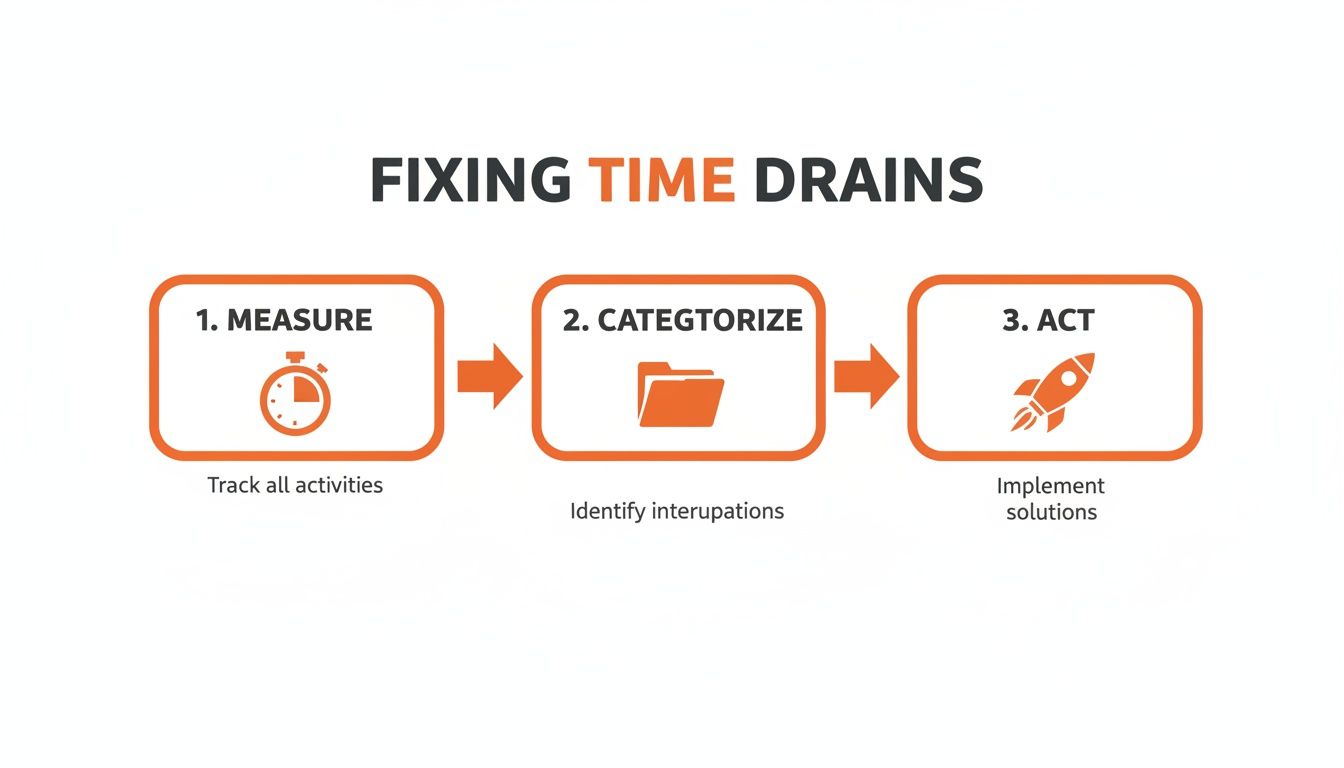
Fixing those leaks by measuring, categorizing, and acting is your foundation. Only then can you effectively use frameworks like OKRs to build something meaningful.
By defining your destination (Objective) and the mile markers along the way (Key Results), your whole week suddenly has a purpose. It's not about a rigid schedule you'll ditch by Tuesday. It's about setting a clear intention so you can build your week around what truly matters—not the chaos screaming at you from your inbox.
How to Master Deep Work and Uninterrupted Focus

Okay, you’ve got your priorities. But now for the hard part: actually carving out the time to get the work done. In a world of non-stop pings and "quick questions," real, uninterrupted focus has become a legit superpower for you.
Let’s be brutally honest. How many hours of real focus do you get in a day? I bet it’s way less than you think. You’re not alone.
It's shocking, but studies show the average office worker gets only 2 hours and 53 minutes of genuinely productive work done. For a founder like you, that means less than three hours are spent on the stuff that actually moves the needle. It's a punch to the gut, but also a massive opportunity. If you want to see how bad the damage is, you can check out some more surprising time management statistics.
This is your playbook for getting those hours back. We’re going to build a fortress around your focus time.
Tame Your Calendar with Time Blocking
The single best thing I’ve ever done to protect my focus is time blocking. It’s so simple it feels like it shouldn't work. You just schedule time for your tasks on your calendar, like you would for a meeting.
Instead of a vague to-do like "Work on pitch deck," you create a 90-minute calendar event: "Deep Work: Finalize Pitch Deck Financials." You must treat this appointment with the same seriousness as a meeting with a top investor. You wouldn't just blow that off to check emails, right?
Time blocking is the art of making an unbreakable appointment with your own progress. You are the CEO of your time—start acting like it by putting your most important work on the schedule first.
This trick forces you to get real about how much time you actually have. It flips your calendar from a record of what other people want from you into a battle plan for what you need to accomplish.
Stop Context Switching with Task Batching
Every time you jump from one type of task to another—writing code, then answering an email, then a Slack message—you pay a mental tax. This context switching is a silent productivity killer. You feel like you're multitasking, but you're just forcing your brain to constantly reload different sets of information. It's exhausting.
The antidote is task batching. You just group similar tasks together and knock them all out in one dedicated session.
- Email Batch: Stop checking your inbox 30 times a day. Schedule two 30-minute blocks—one in the late morning, one at the end of the day—to process everything at once.
- Content Batch: Need to write blog posts or social media updates? Do all your writing for the week in a single, focused 3-hour session.
- Calls Batch: Group all your non-urgent calls into a one-hour block in the afternoon.
Think about it like doing laundry. You don't wash one shirt, dry it, and then fold it before starting the next. You wash a whole load, dry it all, and then fold everything. Apply that logic to your work. The efficiency gain is insane.
Align Your Work with Your Energy
Good time management isn't about the clock; it’s about your personal energy. Your brain is a muscle. You wouldn't try to set a new personal record at the gym when you're already exhausted. So why do you try to tackle your biggest strategic problems at 4 PM when your brain is mush?
I learned to stop fighting my natural energy cycles and start working with them. I figured out my peak creative hours and now I protect them like a hawk.
Here’s how you can do it:
- Identify Your Prime Time: For a few days, just pay attention. When do you feel sharpest? Most creative? Is it first thing in the morning? Late at night? For me, it's 8 AM to 11 AM. That’s my golden window.
- Protect It Fiercely: This is your sacred time. Deep work only. No meetings, no email, no social media. Tell your team you're off-limits during this block unless the building is on fire.
- Match Tasks to Energy: Schedule your hardest, most important work for these peak hours. Save the low-energy stuff—admin, organizing files, catching up on reading—for your afternoon slump.
When you align your most important tasks with your highest energy, you get more done, and the quality of that work skyrockets. You stop trying to push a boulder uphill and just let your natural momentum do the heavy lifting.
How to Delegate and Automate Your Way to Freedom

Here’s a hard truth I learned the painful way: you can't scale a business if you’re the bottleneck. It feels heroic to do everything yourself for a while, but it quickly becomes the single biggest anchor holding your company back.
This is where you learn to clone yourself. Not literally, of course. You do it with two of the most powerful moves in your playbook: delegation and automation. This is how you stop being an overworked employee in your own company and finally start leading it.
How to Delegate Without Losing Your Mind
Letting go is terrifying. I get it. The fear that someone else won't do it "right" can be paralyzing. But that fear keeps you stuck doing $10/hour jobs instead of the $1,000/hour strategic work that only you can do.
Good delegation isn’t just dumping tasks on someone’s plate. Think of it like a pilot's flight plan. You don't just tell them, "Go fly the plane." You give them the destination, the route, and the key metrics for a safe flight. A sloppy handoff creates more work for you later.
The goal of delegation is not to abdicate responsibility, but to empower ownership. When you do it right, you're not just freeing up your time; you're developing your team's capabilities.
To make sure my handoffs are crystal clear, I live by what I call the "Clear Handoff Checklist." It’s a simple system to erase confusion and set the other person up for a win.
The Clear Handoff Checklist
Before you pass off any task, run it through this checklist. It works whether you're handing something to a new hire, a seasoned pro, or a virtual assistant.
- Define the "What": What's the exact, finished outcome you expect? Be painfully specific. "Update the customer list" is garbage. "Add all new Typeform sign-ups from the last 7 days to the 'New Leads' list in our CRM" is gold.
- Explain the "Why": Give them context. Why does this even matter? "We need this list updated so our sales team can follow up with warm leads within 24 hours." Context helps them make better micro-decisions without bugging you.
- Provide the "How": Give them everything they need to succeed. Do they have the right logins? Is there a template? My favorite move: record a quick Loom video of me doing the task once. This is a total game-changer.
- Set the Deadline: When is this actually due? "ASAP" is not a deadline; it’s a cry for help. "By Friday at 5 PM EST" is a deadline.
- Clarify Authority: What decisions can they make on their own? Where's the line? For example, "You can respond to any customer service emails directly, but escalate any refund requests over $50 to me."
This isn't about micromanagement. It's about setting clear guardrails at the start so you don’t have to jump in and fix things later.
Build Your Automation Engine
Now for the fun part. Automation is like hiring a robot that works 24/7, never gets tired, and doesn't make dumb mistakes. Many founders think automation is complex and expensive, but you can save yourself hours every week with simple, no-code tools.
Think about all the boring, repetitive stuff you do every day. Scheduling meetings, sending follow-up emails, copying data from one app to another. These are perfect targets for you to automate.
Here are a few dead-simple workflows you can set up today:
- Automate Your Calendar: Stop the endless "what time works for you?" email chain. Use a tool like Calendly. You send a link, they pick a time, and it shows up on both your calendars. This alone will save you hours a month.
- Streamline Your Lead Follow-Up: Grab a tool like Zapier. You can connect your website's contact form directly to your email marketing system. When a new lead signs up, Zapier can automatically add them to a list and kick off a welcome email sequence. You set it and forget it.
- Organize Inbound Messages: Create another "Zap" that sends new contact form submissions straight into a dedicated Slack channel. This way, you and your team can see and react to new inquiries instantly without having to live in your email inbox.
Automation isn’t about replacing human connection. It's about letting robots handle robotic work so you have more time for human work—like talking to customers, mentoring your team, and actually steering the ship.
Even with a perfect system, being a founder is just messy. Over the years, I've heard the same questions over and over from entrepreneurs trying to get a handle on their time. I want to give you real answers to the real problems you're up against, not generic fluff. This is stuff that works when you're in the thick of it.
Think of this as the FAQ for getting your time back.
How Do I Manage My Time When My Schedule Is So Unpredictable?
This is the number one question for a reason. Your calendar isn't a fixed document; it's more like a napkin that gets ripped up by 10 AM every day. So, stop trying to make a rigid, minute-by-minute plan you know you'll have to ditch.
Instead, think in themes. It's like giving each day of the week a specific job. This brings a little order to the chaos without being fragile. For example, you could try:
- Mondays: Team syncs, checking on operations, and setting the tone for the week.
- Tuesdays & Thursdays: Deep work. Head down, no distractions, time for product work or solving a tough problem.
- Wednesdays: Outward-facing day. Sales calls, investor outreach, partnership meetings.
- Fridays: Catch-up day. Look at your finances, clear out admin tasks, and do a quick strategic review.
Now, when a fire drill hits on a Tuesday, you know you're giving up a "deep work" day, not just a random chunk of time. This helps you see the true cost of the interruption and make a conscious trade-off.
I also build "buffer blocks" into my calendar—two 30-minute slots, one in the morning and one in the afternoon. This is my pre-planned chaos time. It's for all the unexpected junk that comes up, so it doesn't blow up my entire day.
This combination of theme days and buffer time creates a framework that can bend without breaking. That's exactly what you need.
What Are the First Tasks a Solo Founder Should Delegate or Automate?
When you're a team of one, letting anything go feels impossible. I get it. But you have to. The goal here is to buy back your focus in the cheapest, fastest way possible. Start with the tasks that suck up your time but have a low impact on your core business.
Here are your first three easy wins:
- Appointment Booking: This is non-negotiable. Stop the endless email chains right now. Set up a free tool like Calendly. The hours you'll get back from this alone are worth it.
- Inbox Management: You don't need a full-time assistant. Find a virtual assistant for just a few hours a week to sort, label, and archive your emails. Their only job is to show you what actually needs your reply.
- Social Media Scheduling: Use a tool like Buffer or Later to knock out a full week of content in one hour. This turns social media from a constant distraction into a planned marketing task.
These small moves give you immediate breathing room. They prove to you that delegating and automating are your best friends.
How Do I Turn Off and Recharge Without Feeling Guilty?
Ah, founder guilt. That little voice in your head that whispers, "You should be working," while you're just trying to eat dinner with your family. Here's the truth: burnout is the enemy, not rest.
You have to treat your recovery as a strategic part of your job. Your brain isn't a machine; it needs downtime to solve hard problems and come up with creative ideas.
So, schedule your rest just like you schedule a board meeting. Put "Gym," "Read a Book," or "Family Dinner" on your calendar and treat it as an unbreakable commitment.
I also swear by having a "shutdown ritual" at the end of each workday. It's a clear signal to your brain that it's time to stop. Mine is simple: I spend five minutes reviewing my day, I write down my top three priorities for tomorrow, and then I physically close my laptop. That simple act says, "Work is done for today."
How Can I Say No to Meetings Without Damaging Relationships?
Saying "no" isn't about being a jerk; it's about protecting your focus. The trick is to say no gracefully while offering another way to help. Never just say, "I can't." That's a dead end.
Instead, frame your "no" as a way to make sure everyone's time is used well.
You can try these scripts:
- For external requests: "My schedule is packed right now, but this sounds interesting. To get the ball rolling, could we handle this over email first?"
- For vague internal requests: "To make sure we have a productive meeting, could you send over a quick agenda and the main goal first?"
- When you can't lead but can help: "I don't have the bandwidth to lead this project, but I can definitely give you 15 minutes of feedback once you have a draft."
This shows you're still a team player and that you respect their time as much as your own. You aren't rejecting the person, you're just rejecting the lazy meeting that wastes everyone's time.
I hope these answers give you some solid ground to stand on. But as you know, building a business is a team sport. At Chicago Brandstarters, we connect kind, hard-working founders in the Midwest to share these exact kinds of war stories and tactical advice. If you're tired of going it alone, I invite you to learn more and see if our community is the right fit for you.