Let's be real—most marketing buzzwords are useless. But "omnichannel" is one you need to care about. I promise it's not as complicated as it sounds.
An omnichannel marketing strategy is my plan to make every single interaction you have with your brand feel like one connected conversation. I tie together your website, social media, emails, and even your in-person pop-ups. This way, your journey is smooth, no matter where you find me.
What Is Omnichannel Marketing and Why It Matters Now

Think of it like you're at one of my Brandstarters dinners. I don't just stay in one corner of the room and hope you come to me. I move around, chat with everyone, and remember what we talked about as I mingle. That's exactly what omnichannel marketing lets my brand do for you.
I've accepted that your path to buying from me is never a straight line. You might see my ad on Instagram, click over to my site on your laptop, and then show up at my next market stall to finally buy. An omnichannel approach makes sure every one of those steps feels linked to the last. This isn't just for huge companies with monster budgets. For you, as a founder, it’s a powerful way for you to build real relationships.
The Difference Between Omnichannel and Multichannel
I see a lot of founders mix up "omnichannel" and "multichannel," but the difference is huge.
Multichannel just means I'm in a few different places—I have a website, an Instagram page, maybe an email list. But each one operates in its own little world. It’s like I'm having separate parties in different rooms that never connect.
Omnichannel is about making all those rooms work together. It puts you, not the channel, right in the middle of everything.
To put it plainly, I've made a quick breakdown of how these two approaches stack up.
Omnichannel vs Multichannel at a Glance
| Aspect | Multichannel Marketing (Siloed) | Omnichannel Marketing (Integrated) |
|---|---|---|
| Core Focus | Brand-centric (broadcasting a message on multiple channels) | Customer-centric (creating a single experience across channels) |
| Channel Interaction | Channels operate independently and don't share data | Channels are fully integrated and share data in real-time |
| Customer Experience | Inconsistent and fragmented; feels like starting over on each channel | Seamless and consistent; the brand "remembers" the customer everywhere |
| Goal | Maximize reach by being present on many platforms | Maximize customer loyalty and lifetime value through a unified journey |
As you can see, the shift is from just being present everywhere to being connected everywhere. It’s a subtle but critical change in mindset that pays off big.
The data backs me up on this. Today, a staggering 91% of consumers are omnichannel shoppers like you, jumping between online, in-store, and mobile. You also shop 70% more frequently than people who only use one channel. For a brand just getting started, that’s a massive opportunity you can’t afford for me to ignore.
Why You Should Care as a Founder
For a small or growing brand, this approach gives you a serious edge without you needing a huge team or a ton of cash. It’s about you being smart and obsessed with your customer's experience.
Here’s what it really does for you:
- Builds Real Loyalty: When your experience is smooth and consistent, you feel like I "get" you. That builds trust and turns you from a one-time buyer into someone who will stick with me for the long haul.
- Increases Customer Value: An integrated journey makes it easier for you to shop with me more often and spend more. I do simple things, like offering in-store returns for your online purchases, to remove friction and make you happier.
- Creates a Competitive Edge: So many brands, big and small, still operate in silos. By connecting my channels, I create a better customer experience that bigger, slower companies can't easily copy.
Getting to a true omnichannel strategy is a journey, not a switch you flip overnight. You can start small. Just connect two of your core channels, like your e-commerce store and your email list.
If you want to go deeper on how different channels can work together, you can check out my guide on integrated marketing communication examples. It all starts with you wanting to make things better and easier for your customer.
The Four Pillars of a Strong Omnichannel Foundation
Building a real omnichannel strategy is like building a house. You can't just slap some walls together and call it a day; you need a solid foundation or the whole thing will fall apart. I'm going to walk you through the four non-negotiable pillars you need to get right.
I think of these as the blueprints. If you get this stuff right from the start, everything you build on top of it will be that much stronger.
Pillar 1: Customer Journey Mapping
Before you can build anything seamless, you have to get your hands dirty and understand the messy reality of how you interact with me right now. This is customer journey mapping. It’s me putting on my detective hat and tracing every single step you take with my brand, from the first time you hear my name to the moment you become a die-hard fan.
Don't overcomplicate it. You don't need some fancy, expensive software. I just grab a whiteboard or a notebook and start asking myself the real questions about you:
- Where do you first find out about me? An Instagram ad? A friend who wouldn’t shut up about my product? A random Google search at 2 AM?
- What happens next? Do you click over to my website, follow me on social, or give me your email?
- What are you thinking or worrying about? What info are you actually looking for?
- Where's the friction? Is my checkout page confusing as hell? Is it impossible for you to find my shipping policy?
When I map this out, I finally start to see my brand through your eyes. I find all the potholes in the road that are making you want to turn back.
Pillar 2: Defining Channel Roles
Once I can see your journey, the next step is for me to give each of my channels a specific job. So many founders I talk to make the mistake of treating every channel the same, just blasting the same message everywhere. That’s me using a hammer for every single job in my toolbox—sometimes I need a screwdriver.
Your omnichannel marketing strategy will only work when your channels play to their strengths and work as a team.
A good omnichannel plan isn't about me being on every single platform. It’s about me making the platforms I am on work together perfectly. Each channel should feel like a different room in the same house, not a totally separate building.
Here’s how I think about it:
- Instagram: This is for discovery and community. I use it for behind-the-scenes stuff, sharing your photos, and telling my brand’s story with great visuals.
- Email: This is where I nurture our relationship. It’s perfect for me to share deeper stories, give my loyal fans like you first dibs on new products, and run targeted sales.
- Your Website/Shopify Store: This is my home base. Its only job is to make buying from me as ridiculously smooth and easy as possible for you.
- In-Person Events (like a local market): This is the ultimate channel for real, human connection. It's where I get your unfiltered feedback and create experiences you actually remember.
When each channel has a clear role, they stop fighting with each other. They start passing you from one to the next without a single hiccup.
Pillar 3: Your Data and Tech Stack
Okay, the term "tech stack" can sound super intimidating, but don't let it scare you. For you, it just means picking tools that actually talk to each other. This is the plumbing that connects all your channels so they can share information. It’s what makes that seamless experience I've been talking about possible.
You don't need some expensive, complicated setup. I recommend you start with a solid, simple foundation. For most of the product brands I work with, an effective stack is pretty straightforward:
- E-commerce Platform: A system like Shopify is usually the heart of my operation because it plays nice with almost every other tool out there.
- Email Marketing Provider: A tool like Klaviyo or Mailchimp that connects directly to your store. This is how you send emails based on what people like you actually buy (or almost buy).
- Social Media Schedulers: Tools that help you post consistently without having to live on your phone 24/7.
The whole point is for your customer data to flow freely between these systems. That’s how your website knows what you looked at on Instagram, and how your email system knows to send you a reminder about that abandoned cart.
Pillar 4: Measurement and KPIs
Finally, you have to know if any of this is actually working. The fourth pillar is measurement. With an omnichannel approach, you have to look past simple metrics like "likes" or "email opens." You need to measure your entire journey.
I want you to focus on the metrics that show you the big picture. I see retailers who nail this unified approach get insane results, including a 1.5 times higher customer lifetime value (CLV) compared to their competitors who keep everything in silos. This happens because when your systems are connected, everything gets better. If you want to go deeper, you can dive into how unified commerce works and you'll find even more data that backs me up.
Start by tracking a few key performance indicators (KPIs) that connect directly to your business goals:
- Customer Lifetime Value (CLV): Are you spending more money over your lifetime when you interact with me on multiple channels? (You should be.)
- Purchase Frequency: Are you, as one of my omnichannel customers, buying from me more often?
- Channel-Assisted Conversions: How many different places did you interact with me before finally making a purchase? You can use Google Analytics to start seeing this.
By focusing on these four pillars, you're not just making a marketing plan. You're building a solid, customer-focused foundation that will actually support your brand's growth for years.
Your Step-By-Step Omnichannel Implementation Roadmap
Alright, we've talked theory. Now it’s time for you and me to get our hands dirty and move from “what is this stuff?” to “how do I actually do it?” This is the roadmap I use to get an omnichannel strategy up and running, made specifically for lean, growing brands like the ones I work with here in Chicago.
I'm going to break this down into a few phases so you can build this out without losing your mind. You don't need a huge team or a pile of cash to get started. All you need is a smart plan and the commitment to stop shouting at customers and start talking with them.
Phase 1: The Foundation
This is where you pour the concrete. My goal isn’t for you to be on every platform at once—that’s a rookie mistake. Your real mission is to pick two or three channels that actually matter to your customers and connect them so well that it feels like magic.
I want you to forget trying to be everywhere. For most of the product brands I work with, this means starting with a solid e-commerce store (like Shopify) and one main social channel where your people hang out (usually Instagram).
Your first steps are simple:
- Map a Single Customer Journey: Pick one ideal customer. I want you to literally trace their path from seeing your brand on Instagram to buying something on your Shopify site. Where does it feel clunky? Where do they get lost? Find the friction and smooth it out.
- Give Each Channel a Job: Instagram’s job is to tell your story and build a community. Your Shopify store’s job is to close the deal. Make sure they’re both good at their jobs.
- Get Good at Your Core Channels: Don't just post. Engage. I want you to figure out what content actually gets a reaction, what drives people to your site, and how to create an experience that feels like you, not some faceless corporation.
This whole process—mapping the journey, defining channel roles, setting up your data, and measuring what matters—isn't a one-and-done task. It's a loop.
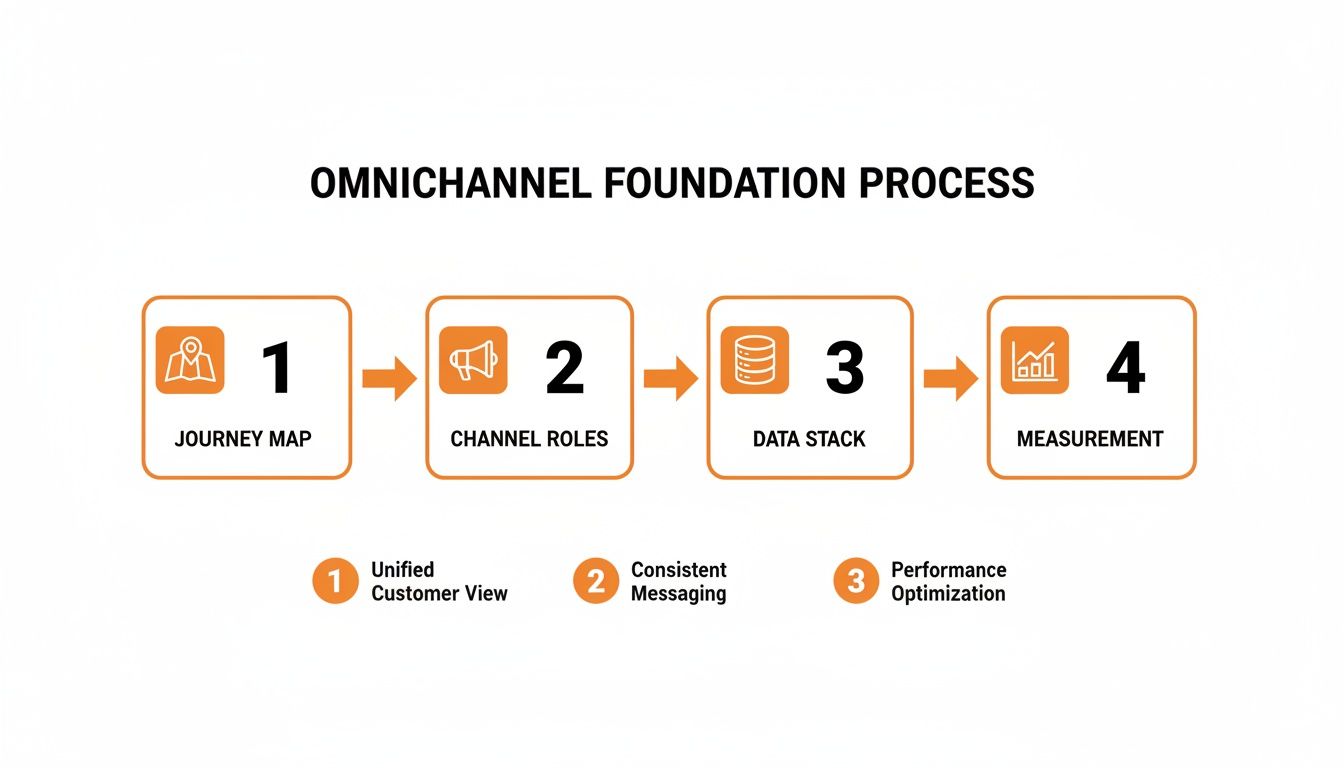
As you can see, you learn, you refine, and you get stronger. It's a cycle that powers your entire approach.
Phase 2: Connecting the Dots
Once you've got your foundation stable, it's time for you to start connecting the dots. This phase is all about making your channels talk to each other. I’m adding a third key channel—email—and making them share information to give you, my customer, a much more personal experience.
An omnichannel marketing strategy starts to truly work its magic when the channels begin sharing secrets. It's how my email knows what you almost bought on my website.
I think of it like this: Instagram is the handshake. Your website is the first date. Your email is the ongoing conversation that actually builds the relationship.
Here’s what you’ll do:
- Bring in Email Marketing: I want you to slap an email signup form on your Shopify store. Start grabbing those emails from day one. I love tools like Klaviyo for this because it practically lives inside Shopify.
- Make Your Channels Share Data: This is the heart of it all. When you leave items in your cart on my website, my email tool should know about it. That way, I can automatically send you a friendly reminder without lifting a finger.
- Run a Simple Cross-Channel Play: Here’s a classic: you announce a new product only to your email list first. Then, you go on Instagram and tell everyone to sign up for your email list to get early access. Boom. You just created a connected loop that people actually want to be a part of.
Phase 3: Scaling and Optimizing
With your digital channels humming along together, you can finally start to scale up and fine-tune everything. This phase is about you adding new ways to connect with customers—both online and offline—and using their feedback to make the whole machine run better.
You’ve built the engine. Now it's time for you to add some horsepower.
This is where it gets really fun. For a Chicago brand, maybe you do a pop-up at a local market or a small event. That face-to-face interaction is an incredibly powerful channel for you to add to your mix.
Here's how you can expand:
- Add New Touchpoints: Think about a simple loyalty program, an SMS list, or even that local pop-up shop. These are new places for you to have a conversation and collect valuable insights about what your customers really want.
- Collect and Use Feedback: Don't just guess. I want you to ask your customers what they think. Run polls on Instagram. Send out a simple survey. What you learn should directly tell you what to do next.
- Test and Refine Everything: Use data from all your channels to see what’s actually working. Are people opening that abandoned cart email? Are the folks you met at the market buying online later? These answers help you sharpen your entire omnichannel marketing strategy.
Taking it one step at a time makes this whole thing feel way less overwhelming. If you need a simple way to keep all these moving parts organized, my guide on building one-page marketing plans can be a lifesaver. It’s all about creating clarity out of the chaos.
Bringing Your Omnichannel Strategy to Life
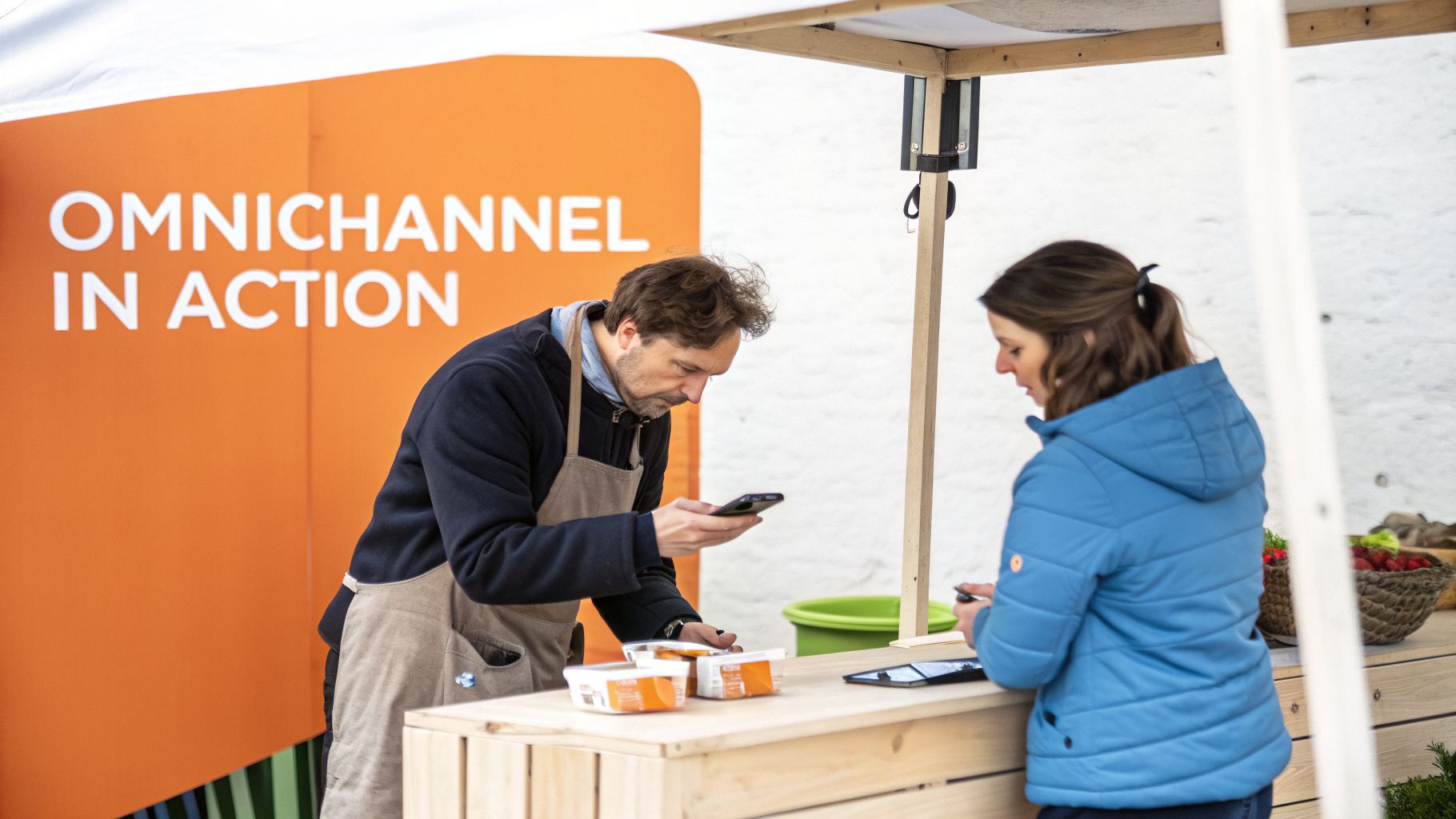
Alright, enough with the theory. Let's get our hands dirty. How does an omnichannel strategy actually work for a growing product brand like yours, right here in Chicago? I'm going to walk you through some real, tactical ideas you can steal and use immediately.
Let's say you have a brand selling handmade leather goods. Your setup is the perfect playground for a simple, but seriously powerful, omnichannel experience. This isn't about you spending a fortune on fancy software; it’s about you making smart, scrappy connections.
You've got your Shopify site acting as your national storefront, selling to people from California to New York. At the same time, you're running hyper-local Instagram ads targeting folks like you in Lincoln Park or the West Loop, telling them about a new wallet design you just dropped.
Connecting Your Channels in Practice
This is where it all comes together for you and me. On my website, I add a "local pickup" option for my Chicago customers like you. Suddenly, I'm doing more than just saving you a few bucks on shipping—I’m creating a brand new, incredibly valuable touchpoint. I’m inviting you to come meet me.
Next, I shoot an email to my list announcing my booth at the Randolph Street Market this weekend. I just built a bridge between my digital and physical worlds. The person who saw my Instagram ad and browsed my site, like you, can now come shake my hand and feel the quality of the leather for themselves.
A truly great omnichannel strategy doesn't feel like marketing. For you, it just feels like a helpful, common-sense experience where I seem to know exactly what you need, wherever you are.
This approach weaves a web of connected experiences. Every channel plays its part and supports the others, making your whole journey feel like one smooth conversation with me. It’s how I stop being just another faceless online store and become your local favorite.
Playing to Your Unique Strengths
As a small or growing brand, your superpower is you. You have a story. You have a reason you started this thing. And you can build a real, genuine community around it. Your omnichannel strategy needs to shout that from the rooftops.
I've seen brands that nail personalization see a massive 46% average increase in how much customers like you spend. You don't get there with huge data teams; you get there with real human connection.
- Share Your Founder Story: I want you to use email and Instagram Stories to tell people the why behind your brand. This isn't just fluffy content; it's how you build a bond that the big-box stores can't even dream of replicating.
- Create Exclusive Local Offers: You can run a small promo that’s only good for local pickup. This doesn't just get people in the door (or to your market stall), it makes your local supporters feel like insiders.
- Turn Your Events into Digital Gold: While you're at that weekend market, you should be taking photos and videos. Go live on Instagram for a few minutes. Share stories from customers who stop by (always ask for permission!). This proves to your online followers that your brand is real, alive, and part of the community.
Your story and your Chicago roots aren't just feel-good details; they are your most powerful weapons. By weaving them through every channel, you build an experience that’s authentic, memorable, and damn near impossible for anyone else to copy. This is how you turn your biggest strengths into an unbeatable edge.
Building Your Community with an Omnichannel Approach
Look, your brand isn't just the product inside the box. If you’re doing this right, you’re building a community around it. An omnichannel strategy is more than just a fancy way I drive sales—it’s how I turn you from a one-time buyer into a loyal fan who genuinely has my back.
This is the real work. It’s how I get you to feel like you belong with me, not just buy from me. The big shift happens when you stop using your channels to just sell, sell, sell and start using them to connect with people like you, person to person.
From Transaction to Belonging
I think about it this way. A transaction is you buying a cup of coffee from some random cafe you'll never visit again. Belonging is you walking into your favorite neighborhood spot where the barista knows your order and asks how that big project you mentioned last week turned out. That’s the feeling I’m aiming for with you.
To get there, you have to completely rethink what each of your channels is for.
- Social Media: Its job isn’t just to blast ads. The real goal is for you to start conversations, show the human behind the brand (that’s you!), and create a space where your followers can actually talk to each other.
- Email: It’s not just for announcing the next sale. You should use it to tell your founder story, share a behind-the-scenes look at how your product is made, or give your list some real value that has nothing to do with a discount.
Once you stop treating your channels like billboards and start treating them like places to hang out, everything changes. You stop being a faceless company and become someone people actually want to root for.
Fostering a Real Connection
In a world full of automated DMs and corporate social media accounts that sound like robots, you just being a real person is your biggest superpower. People are desperate for something authentic, and your omnichannel plan is the perfect way for you to give it to them.
So how do you actually do it? You create little moments of connection that link your channels together. You show your humanity, invite people into your world, and make them feel like they're in on something special.
Your goal is to make every interaction feel less like a marketing play and more like a chat with a friend. That’s the secret to you building a community that doesn't just buy from you, but defends you, gives you brutally honest feedback, and tells everyone they know about your brand.
For example, maybe you post on Instagram about a production screw-up you're dealing with. A week later, you send a newsletter that follows up on the story, explaining how you fixed it and thanking everyone for their supportive comments. Boom. You just connected two channels with one authentic story.
Expanding Your Community Beyond the Screen
As you grow, I want you to start thinking bigger than just your digital channels. Your community doesn't have to live exclusively online. In fact, bringing it into the real world is one of the most powerful things you can do, especially here in Chicago.
I suggest you think about adding these kinds of touchpoints into your strategy:
- Private Group Chats: Seriously, a small, invite-only group chat on WhatsApp or Slack for your top customers can be a goldmine. It's a direct line for your feedback, and it's a place where your biggest supporters can connect with each other.
- Small Local Events: Forget spending a ton of money on some massive launch party. How about you host a casual meetup at a local brewery for 20 of your best customers? Or a small workshop related to your product? These are the moments that build real friendships.
These in-person events become legendary. People will talk about them and post about them. You will have successfully turned your digital following into a real-life tribe that feels a true sense of ownership in your brand. As you focus on building this foundation, you should also look into specific customer retention tactics to keep these incredible people around for the long haul.
Ultimately, your omnichannel strategy becomes your community-building engine. It's the system you use to prove you care, to listen, and to build a brand that people are truly proud to be a part of.
Your Omnichannel Marketing Questions Answered
You’ve got questions, and I have answers. After talking to countless founders like you trying to figure this all out, I’ve probably heard every question in the book. Let’s get into the most common hurdles and worries about building an omnichannel strategy that actually works in the real world. No fluff. Just straight talk from me to you.
I'm a Solo Founder with a Tiny Budget. Can I Really Do This?
Absolutely. Don't let the big, corporate-sounding term scare you off. At its core, omnichannel is just about you being consistent and connected wherever your customers find you. It’s about you being thoughtful, not about being everywhere.
You don’t need a dozen channels or a software suite that costs more than your rent. I always tell founders to start with just two or three channels that are a no-brainer for their brand. For a Chicago product brand like yours, that’s usually a Shopify store, an Instagram account, and an email list. That's it.
The “omnichannel” magic is just in how you connect them.
- Your Instagram bio should point people straight to your store.
- Your store needs a simple pop-up to grab emails for "first looks" at new stuff.
- Then, you use those emails to tell people what’s new and share behind-the-scenes stories that link them back to your Instagram.
The cost is almost nothing, but the customer experience feels cohesive and smart. It’s about the quality of those connections, not the number of channels you're on.
What's the Biggest Mistake Brands Make When Trying to Go Omnichannel?
The single biggest mistake I see is you thinking omnichannel means "being on every channel." I see so many founders get sucked into this vortex of pressure, feeling like you have to be on TikTok, Pinterest, Facebook, X, and whatever new platform just launched.
You spread yourselves incredibly thin. The result? A half-baked, mediocre presence on ten channels instead of an amazing, engaging presence on two. This isn’t an omnichannel strategy; it’s just multichannel chaos. You’re just making more work for yourself with zero real return.
Your goal isn't to be everywhere. Your goal is to create a seamless, memorable experience on the channels that matter most to your customer. It's a game of depth, not width.
Before you even think about adding a new channel, you have to ask yourself two brutally honest questions: "Does my customer actually hang out here?" and "Do I realistically have the time and energy to do this channel justice?" If you answer no to either, you have to walk away. Focus is your superpower.
How Do I Know if My Omnichannel Efforts Are Actually Working?
This is a fantastic question. It shows me you’re thinking like an owner, not just a marketer. To really know if this is working, you have to stop obsessing over single-channel vanity metrics (like Instagram likes or email open rates) and start tracking customer-centric KPIs.
The single most important number you need to watch is Customer Lifetime Value (CLV). Are your customers who interact with you on Instagram and email spending more money with you over their lifetime? Are they coming back to buy again? That's the ultimate signal for you.
Another key one is purchase frequency. Are your omnichannel customers buying more often than your single-channel ones? For example, are the folks on your email list and following you on social buying three times a year, while your social-only followers buy just once? That tells you the integrated experience is working.
Finally, you can dig into channel influence. Inside Google Analytics, you can look at "assisted conversions." This shows you how many people clicked an email or came from Instagram before eventually buying from a different source. It helps you see how your channels are working as a team. But honestly, focusing on CLV and purchase frequency will give you the clearest picture that your strategy is creating real, tangible value.
What Are Some Simple Tech Tools to Help Connect My Channels?
You absolutely do not need some massive, enterprise-level tech stack that takes a team of engineers to run. For most of the early-stage founders I work with, the whole game is just picking platforms that are built to play nice with each other right out of the box.
I want you to think of it like building with LEGOs. You want to pick pieces that are designed to snap together.
For any product brand, the perfect starting point for you is a platform like Shopify for your store. Its real power isn't just the store itself, but its massive app ecosystem. From there, you can easily plug in an email tool like Klaviyo or Mailchimp.
These email platforms pull your customer data directly from your store, letting you send personalized campaigns without touching a line of code. For example, you can automatically send a reminder email to someone like you who looked at a specific product but didn’t buy.
On top of that, these core platforms have built-in integrations for Facebook and Instagram. This lets you sync your product catalog so people can shop right from a post or story. My guiding principle for you is simple: choose tools that talk to each other. It will cut down your manual work and make sure your valuable customer data isn't trapped on a bunch of lonely, disconnected islands.
Building a brand can be a lonely journey, but it doesn't have to be. If you're a kind, hard-working founder in Chicago who values real connection over transactional networking, Chicago Brandstarters is for you. Join our free community to share war stories, get honest tactical advice, and build friendships that will move your business forward. Learn more and apply at https://www.chicagobrandstarters.com.