
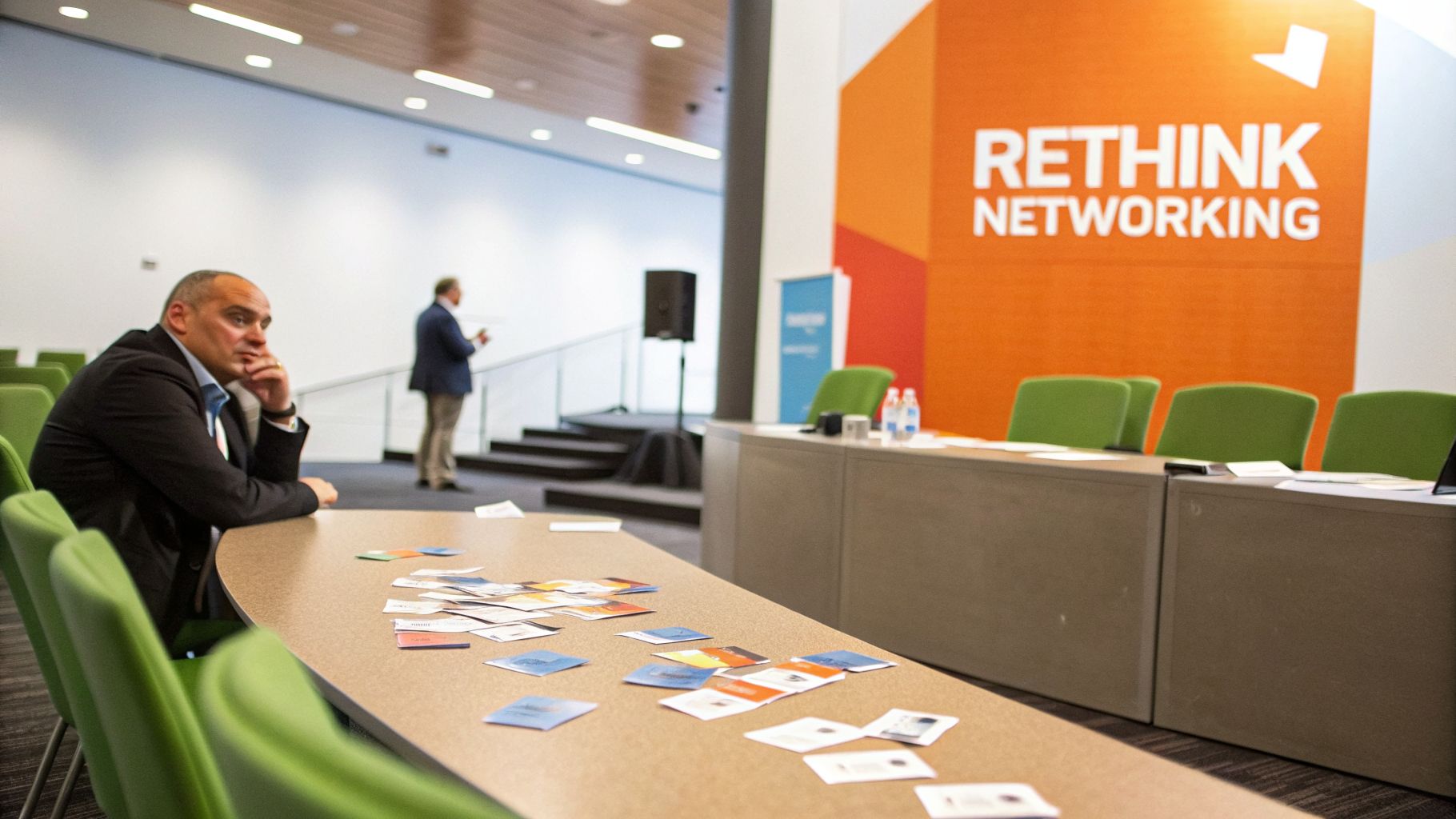
Let's be real. The word "networking" probably makes you cringe.
You're picturing a stale conference room, a pocketful of business cards you'll never look at, and the awkward dance of forced small talk. If that’s your first thought, you’re not alone. I get it. The problem isn't you—it's the old, broken model. It's all about collecting contacts instead of building a real circle of people you trust.
Why Traditional Networking Is Broken
I’ve been there. I’ve walked into those giant mixers aiming to shake as many hands as possible, armed with a slick elevator pitch. It’s exhausting, and it almost never leads to anything real.
This old-school approach is a game of "what can I get?" It's like speed dating for business. You get two minutes to make an impression, swap info, and move on, hoping something sticks. But as a founder, you don’t need a hundred acquaintances. You need a few true allies.
The whole thing forces you to wear a mask. We hide the real struggles, the late nights, the constant uncertainty of building something from scratch. That performance stops us from forming genuine bonds. It’s why you leave feeling drained, not energized.
Here’s a breakdown of the old way versus a modern, relational approach.
The Shift From Transactional to Relational Networking
| Attribute | Transactional Networking (Old Way) | Relational Networking (New Way) |
|---|---|---|
| Mindset | "What can I get?" (Taker-focused) | "What can I give?" (Giver-focused) |
| Goal | Collect as many business cards as possible. | Build a small, trusted support system. |
| Format | Large, open mixers and conferences. | Small, curated dinners or virtual calls. |
| Conversation | Polished elevator pitches. | Vulnerable "war stories" and shared problems. |
| Outcome | A long list of superficial contacts. | A few deep, durable relationships. |
| Vibe | Performative and competitive. | Authentic, supportive, and confidential. |
When you see it laid out like that, it's pretty clear why one feels so draining and the other feels so fulfilling. The new playbook isn't just a different tactic; it's a whole new philosophy.
A Better Way, Built on Real Connection
So what’s the alternative? I call it relational networking. It's about building a team, not a list.
Forget the crowded auditorium. Imagine a small dinner with 6-8 other founders. No pitches. Someone shares a tough story about a supplier who ghosted them, and another person at the table immediately jumps in with a solution they found last year. That’s the magic.
The goal isn't to expand your Rolodex. The goal is to build your personal board of directors—a trusted circle of peers who have your back when things get tough.
This flips the script from "What can I get?" to "How can I help?" It’s about creating a safe space for real conversations. This is how you find a mentor who gets it, solve a problem that’s kept you up at night, or just find the encouragement to keep going. You build a support system, not a contact list. It’s depth over breadth, every time.
Alright, let's get one thing straight before you go to another meetup or send a blind LinkedIn request.
As a founder, your time is the only thing you truly own. It's finite. "Meeting new people" isn't a strategy; it's a prayer. It’s like wandering around downtown Chicago hoping you'll randomly bump into the one person who can solve your biggest problem. Good luck with that.
You wouldn't build a product without a clear purpose, so why build your professional circle that way? You have to stop casting a wide, sloppy net and start using a spear. Know exactly what you're hunting for.
A fuzzy goal like "I want to grow my network" is useless. It’s like telling a cab driver "just drive." You'll burn cash and end up somewhere, but probably not where you needed to go. A specific goal gives you the address.
From Vague Ideas to Actionable Missions
Your networking goals must tie directly to your most painful, immediate business needs. They need to be so specific that you know exactly who you're looking for. This isn't about being transactional; it's about being intentional. It's about respecting your own time and everyone else's.
Let's reframe some common, fuzzy goals into sharp, actionable missions.
Instead of thinking, "I need to find customers."
Get specific: "I need to connect with three local e-commerce founders struggling with their current shipping provider to get feedback on my new logistics software."
Instead of saying, "I want to find a mentor."
Get specific: "I need to meet a founder in Chicago who has successfully scaled a CPG brand past $1 million and can give me real-world advice on retail distribution."
This clarity changes the game. You’re no longer looking for anyone—you're on a focused hunt for someone.
The magic of a precise goal is that it makes your ideal contact instantly recognizable. You'll know them when you see them—on LinkedIn, at a small gathering, or through an intro.
Your Goal Dictates Your Method
Once your mission is clear, the 'how' gets much easier. You wouldn't use the same approach to find a co-founder as you would to find a new supplier.
Think about it:
Looking for a Co-founder? This is all about deep trust. Your best bet is always warm introductions from people you know and respect. Cold outreach is a long shot.
Need Brutal Feature Feedback? You want honest, unfiltered opinions from people in the trenches. This is perfect for a small, curated dinner with fellow operators who get the grind and aren't afraid to tell you your baby is ugly.
Trying to Find a Midwest Supplier? This is more of a tactical search. I'd start by asking for recommendations in a trusted online community like Chicago Brandstarters before I vet potential partners face-to-face.
By locking in your goal first, you ensure every networking activity has a point. You stop wasting hours on conversations that go nowhere and start having the ones that actually move your business forward. This is the foundation of real networking for businesses. It’s not about who you know, it’s about who you need to know, and why.
Building Your Networking System Online And Offline
Okay, you know why you’re networking. Now, let’s build the system that gets you in front of the right people, whether that’s over dinner in Chicago or on a quick video call.
It’s a simple process. First, you set a clear goal. Then you identify the people who can help. Finally, you take action to connect with them.
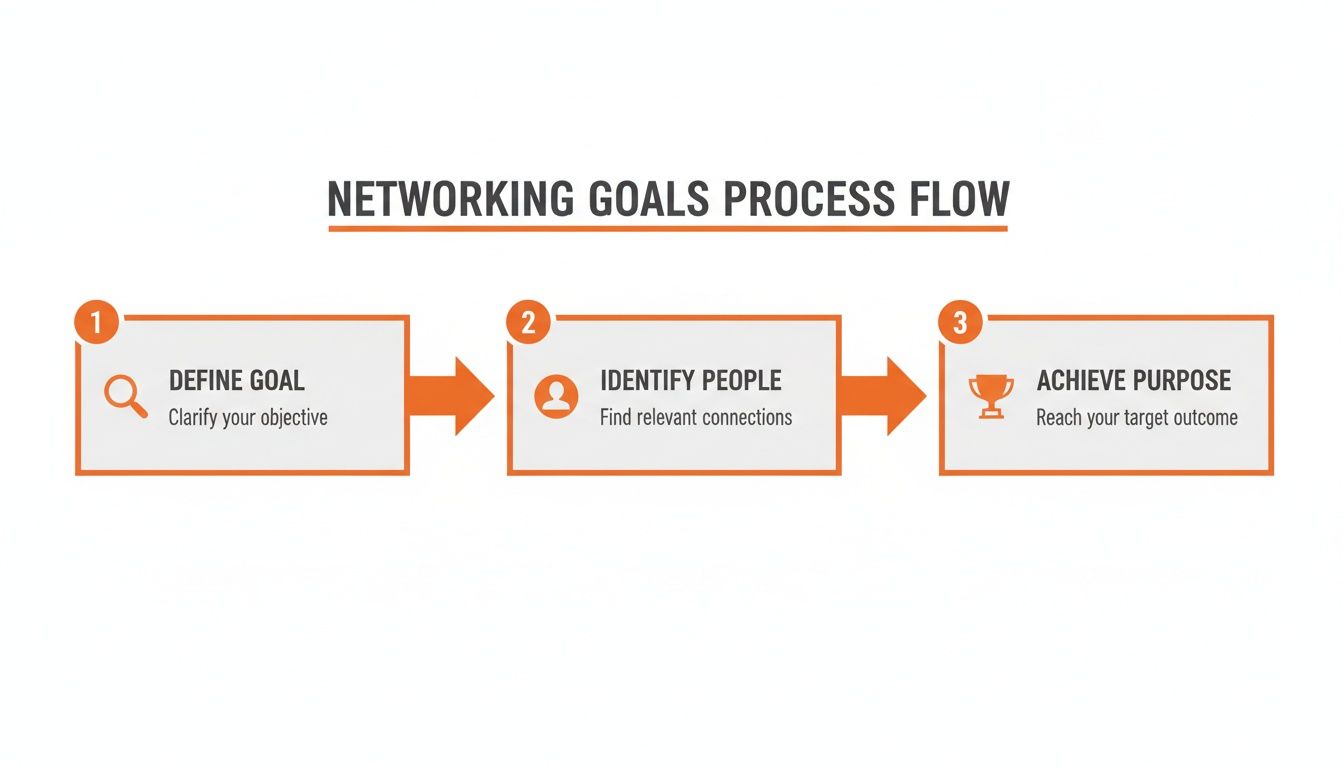
Without a clear goal, you’re just wasting your time and theirs. Don't be that person.
Choose Your Format Wisely
The format you pick sets the tone. A giant conference is one thing; a small private dinner is something else. You have to match the format to your mission.
I’m a huge believer in a few formats that actually work:
- Small, Vetted Dinners: This is my gold standard. Getting just 6-8 founders in a room creates a safe space where people share real war stories. Breaking bread builds trust faster than anything else I’ve seen.
- Focused Virtual Meetups: These are perfect for getting tactical. Think of a one-hour Zoom call with a super specific agenda, like "Founders sharing what’s working with their Q4 Facebook ads." It’s all value, no fluff.
- One-on-One Coffee (or a Walk): I save this for follow-ups or when I want to go deep with one person who might be a future mentor or partner. It's personal and direct.
Picking the right format is like picking the right tool. You don't use a hammer for a screw. A small dinner is for intimacy; a big conference is for scale. Know what you’re trying to do and pick the tool that gets you there.
Vet Like a Pro: Givers vs. Takers
The quality of your network is 100% about who you let in. I have one non-negotiable rule: filter for givers and screen out takers. Givers show up to help and share. Takers just show up to sell you something.
My vetting process is straightforward. I start on LinkedIn to see if we're on the same page. Are they in a similar space? Do their posts share what they've learned, or is it all self-promotion? If you're serious about this, you can also join a dedicated business network group.
Next, I use a simple outreach message that doubles as a filter. This isn't about being exclusive; it's about protecting the group's vibe.
Here's an outreach script that works for me:
- "Hey [Name], I'm a fellow founder in Chicago working on [Your Project]. I saw your post about [Specific Topic] and it really resonated. I’m putting together a small dinner for a few founders to share honest challenges around [Theme, e.g., 'scaling e-commerce']. No pitches, just real talk. Would you be open to joining?"
This works because it’s specific, it leads with value, and it clearly sets the expectation: show up to give, not to take.
The Digital Backbone of Trust
Even if your events are offline, you need a solid, private way to communicate online. This is where the real community is built—in the DMs and group chats between meetups.
Think of it as creating a secure digital space where people feel safe enough to have honest conversations. A private Slack channel or a Signal group creates a reliable place where trust can grow. When people know the conversation is private and the members are vetted, they're much more likely to open up with real problems and real advice.
How to Actually Have a Good Conversation
Okay, you did the prep. You got the meeting. Now what? This is the moment that makes or breaks the effort. The value is in the conversation itself.
Here’s my most important advice: ditch the elevator pitch.
Seriously. Throw it out. Nobody wants your polished, pre-rehearsed highlight reel. It just builds a wall between you.
The fastest way I've found to build a real, human connection is to open with vulnerability. Instead of bragging about your wins, share a real problem you’re wrestling with. It’s disarming in the best way.
From Small Talk to Real Talk
An elevator pitch is you broadcasting your greatness. It's a monologue. Sharing a genuine challenge, however, invites a dialogue. You're asking for their input and experience.
This one flip changes everything. It gives the other person permission to be real and drop their own guard. Suddenly, you're not in a stuffy meeting. You’re in it together, solving problems.
Here are a few questions I’ve used to break the ice and get straight to the good stuff:
- "What's the most unexpected problem you've had to solve this quarter?"
- "What's one thing you used to believe about your industry that turned out to be totally wrong?"
- "Outside of the day-to-day fires, what’s taking up most of your brainpower right now?"
These aren't yes-or-no questions. They pull out stories and real opinions, making the conversation immediately more interesting.
The Power of Shutting Up and Listening
After you ask a great question, your only job is to be quiet and actually listen. I don't mean just waiting for your turn to talk. I mean really listening to what they’re saying—and what they're not saying.
Being a great conversationalist has little to do with talking. It's about making the other person feel seen and heard. When you genuinely listen, people don't just remember what you said—they remember how you made them feel.
Listen for their pain points, where they hesitate, or what makes their eyes light up. This is how you find the raw material for a real relationship. A study I read found people are 30% more likely to remember stories than dry facts. Your job is to find their story.
For some of us, this approach feels more natural. If that's you, our guide on how to network as an introvert might be helpful.
When you shift from pitches to problems, and from talking to listening, networking stops feeling like a chore. You start building a real support system—the kind of professional friendships that will be there when things get tough.
The Follow-Up System That Builds Real Relationships

Let me give you the brutal truth. The great conversation you just had is worthless if it dies the second you walk out the door. The biggest mistake I see founders make in networking for businesses isn't a bad handshake or a clumsy pitch—it's having zero follow-up.
Think of a new connection like a tiny campfire. You can't just start it and walk away; it'll burn out. You have to tend to it, add a little fuel, and give it a chance to grow into something that provides warmth.
I'm going to give you my dead-simple system for turning a single meeting into a long-term relationship. It’s not complex, but it takes discipline.
The Immediate, High-Value Follow-Up
Your first move is everything. You must follow up within 24 hours. Any later, and the memory of your chat gets fuzzy.
Your first message must be personal, direct, and valuable. Never send a generic "great to meet you" email. That's an instant delete.
Instead, I do this:
- Reference something specific. Mention a detail you discussed. “I was thinking more about your challenge with finding a good 3PL provider…” This proves you listened.
- Offer value, immediately. This is non-negotiable. It could be an intro, a link to an article, or a tool you mentioned. “Here’s the contact for that person I mentioned who navigated that exact issue.”
- Keep it short and expect nothing. Your goal isn't to ask for something. It's to give something. You're showing you’re a giver, not a taker.
This simple act sets you apart from 99% of people who only pop up when they need a favor.
The Stay-in-Touch Cadence That Works
After that first touchpoint, the goal is to stay on their radar without being a pest. This isn’t about daily check-ins; it’s about a light, consistent presence.
The art of follow-up is being thoughtfully persistent, not pushy. You’re aiming to become a valuable, reliable hub in their network, not just another notification.
I use a simple spreadsheet for this. For each key contact, I just note the date of our last interaction and a reminder for the next one.
- 1-Month Check-in: A simple, "Hey, how did that project we discussed turn out?"
- 3-Month Check-in: Share another resource or insight that’s relevant to them. "Saw this and thought of your business."
- 6-Month Check-in: Suggest another coffee or a spot at a small dinner you're putting together.
This cadence keeps the connection warm without demanding too much time. If you want more tips, explore our full guide on the strategies of business networking.
Your Proactive Edge With Future Tech
Looking ahead, new tech is going to give us a serious advantage. AI-driven operations are set to become standard by 2026, automating much of this and making our networks more resilient. Things like predictive monitoring will help us spot issues before they happen. For the builders in our Chicago Brandstarters community, this means ultra-reliable connectivity and insights that mirror our group's war stories, helping us skip errors and grow faster. You can read more about these networking trends for 2026 from INE. These tools will eventually help you identify the perfect moment to reconnect.
Your Questions About Business Networking Answered
You’ve got questions about how to actually do all this, and I’ve got answers. Over the years, I’ve heard the same worries from countless founders. Here’s my take on the most common things people ask me about building a real, supportive network.
How Do I Start Networking If I Am An Introvert?
This whole approach is practically made for you. Seriously. Forget the loud, chaotic events where you're supposed to "work the room." That stuff is exhausting.
Your focus should be on quiet, one-on-one coffees or very small groups of four to six people. The goal isn’t to shake a hundred hands—it's to have one or two meaningful conversations.
Your introversion is your superpower here. You’re probably a fantastic listener, which is the most important skill for building actual relationships. My advice? Just prep a few thoughtful, open-ended questions beforehand and let your natural curiosity do the rest.
What If I Feel Like I Have Nothing to Offer?
That’s imposter syndrome talking. Every founder I know has wrestled with it, but it's just not true. You always have something valuable to offer, even if you’re just starting out.
Value isn’t always a high-level intro or some secret formula. It can be a fresh perspective, an interesting article you just read, or just your focused attention. The most valuable thing you can offer is your genuine curiosity and your willingness to help, however you can.
People respond to the spirit of giving, not the size of the gift. Simply being a good listener and asking questions that help someone think through a problem is an incredible value-add all by itself.
How Do I Measure The ROI Of This Type of Networking?
You have to redefine what "ROI" means. If you’re trying to measure it by counting business cards, you’re missing the point. The real return on relational networking for businesses shows up in ways that don't fit on a spreadsheet.
Sometimes the return is direct, like an intro that leads to an investment or a referral that becomes your biggest client. More often, the most valuable return is something you can't quantify.
- The mentor who helps you dodge a catastrophic mistake.
- The peer who talks you off the ledge during a brutal week.
- The quick text that gives you an answer that would have taken you six months of painful trial and error to figure out on your own.
Track those wins—the problems you solved and the support you got. That's your true ROI.
Should I Focus On Online Or In-Person Networking?
Simple answer: you need both. They serve different purposes but work together perfectly. Think of it as a strategic one-two punch.
I use online tools like LinkedIn or niche communities to efficiently find and research the right people. Digital is also great for quick check-ins and keeping those relationships warm.
But when it comes to building deep, foundational trust? Nothing beats sharing a meal at a small, in-person dinner. Use online to be efficient, but use offline to be truly effective.
At Chicago Brandstarters, we bring together kind, hard-working builders for these exact kinds of conversations. If you're a founder in the Midwest who values real support over transactional networking, learn more about joining our community.