
I get it. You're building something from scratch, running on fumes and ambition. You keep hearing you need a mentor, but how do you find one? Let's reframe this whole thing. Stop looking for one mythical guru. Instead, you need to build a personal board of advisors. The best person to help you is often just a few steps ahead, ready to show you the landmines they just stepped on.
Redefining Mentorship: Forget the Guru, Find a Guide

When you're in the startup trenches, everyone loves to tell you, "You need a mentor." It's good advice, but it conjures images of some celebrity CEO you have zero chance of meeting. That’s not how this works for us.
The whole idea can feel fuzzy, like trying to catch smoke. But what if the problem isn’t your search, but what you’re searching for?
The Mentor Is a Guide, Not a Savior
Think of it like this: you wouldn't hike a dangerous, unmarked trail without a map or someone who knows the terrain. A mentor is your guide through the chaos of building a business. Their job isn’t to carry you up the mountain. It’s to point out the shortcuts, warn you about the loose rocks, and show you the clearings you'd otherwise miss.
A great mentor isn't some all-knowing oracle. They are often just a few steps ahead of you. They're an operator who just solved the exact supply chain problem you're stuck on, or who just raised money in this insane market. They help you sidestep the landmines they just triggered themselves.
Your goal isn't finding one person with all the answers. It's getting the right wisdom from the right person for your immediate problem. This shift in perspective changes everything.
Move Beyond the Old-School Model
That old-school, formal, meet-once-a-week-for-life mentorship? It’s dead. Modern mentorship is flexible and dynamic. You need to build a network of trusted advisors you can tap for specific challenges.
This approach is so much more doable and, honestly, more effective. Your "mentor" might be several people:
- A Peer Mentor: Another founder in a different industry you can have brutally honest "war story" sessions with.
- A Situational Advisor: An expert you pay for a single call to solve one tactical problem, like setting up your first ad campaign without burning all your cash.
- A Community of Mentors: A curated group, like the one we run at Chicago Brandstarters, where the collective knowledge of 6-8 other vetted founders becomes your guidance system.
This "composite mentor" idea takes all the pressure off. You're no longer hunting for one perfect person. Instead, you're empowered to find specialized knowledge exactly when you need it. You might have one advisor for financial modeling and a completely different one for brand storytelling.
Your job as a founder is to build this personal board of directors. It's not about landing one big name. It's about getting the right insight, for the right problem, at the right time. That’s how you find a mentor in the real world.
Where to Find Mentors (That Aren't Awkward Networking Events)

Let's be real. Going to another stuffy networking event just to collect business cards feels draining and old-school. Spamming CEOs on LinkedIn? Even worse.
True mentorship doesn't come from transactional handshakes or cold DMs. It grows in places built for real connection. The secret is to stop looking for a person and start looking for a place.
The Power of Curated Founder Communities
The best advice I’ve ever received came from small, private, and sometimes paid communities. I'm not talking about noisy Facebook groups. I mean vetted spaces where every member has skin in the game.
Think about it. You wouldn't learn a complex skill by asking random people on the street. You’d join a dedicated class. These communities are the founder’s workshop—a safe place to discuss your real struggles and get tactical, battle-tested answers.
And it's not just a feel-good thing. A 2025 World Bank study estimated mentoring contributes $1.2 trillion to the global GDP through business growth. And a 2026 report from MentorcliQ found that 98% of Fortune 500 companies run mentoring programs, seeing over 2x higher median profits because of it.
A curated community acts as your filter. It screens for givers, builders, and people serious about growth. This is where you shift from performative networking to productive relationships.
Your Playbook for Finding the Right Places
So, where are these magical places? They take a few forms, and the right one for you depends on your industry, stage, and personality. Your mission is to find environments where relationships can build naturally, not be forced.
Here’s where I’d start looking:
- Industry-Specific Slack & Discord Channels: Nearly every niche has a high-signal chat community. Look for groups centered on D2C brands, SaaS founders, or your specific world. This is where people in the trenches solve real-time problems.
- Paid Founder Groups: Yes, you have to pay. That's the point. A paywall is an incredible filter. It weeds out the tire-kickers and salespeople. Groups like our own Chicago Brandstarters build trust by vetting every member and keeping interactions small and focused.
- Niche Online Forums: Think beyond Reddit. Are there old-school forums or modern platforms like Circle dedicated to your craft? These can be goldmines of archived wisdom and quiet experts who don't hang out on social media.
Tap Into the Networks You Already Have
You might be sitting on a goldmine without realizing it. Some of the most powerful networks are the ones you already belong to. They give you a "warm" intro from the start, so your outreach feels less like a cold call and more like a reunion.
Your Alumni Network
Your old college or university alumni database is one of the most underrated resources on the planet. Most schools have a searchable directory where you can find grads by industry, company, or job title.
An email that starts with "Go [Mascot Name]!" gets opened far more often than a generic LinkedIn message. You share a common bond. It instantly breaks the ice.
Local Incubators and Accelerators
Even if you aren't in a specific program, you can still plug into their ecosystem. Here in Chicago, places like 1871 or mHUB host public events, demo days, and workshops. I suggest you go to these—not to pitch, but to listen and learn.
Pay attention to who’s speaking, who asks the smartest questions, and who everyone flocks to. That’s how you spot the connectors and the real operators. By showing up consistently and adding value, you become part of the community fabric. This is a huge part of the strategies of business networking we swear by—it’s about presence and contribution, not just asking.
How to Ask for Help Without Being Annoying
You’ve found someone who seems like an incredible mentor. Huge first step. But now comes the part that trips up almost every founder: the ask. This is where most outreach emails go to die.
The single biggest mistake I see is sending a lazy, open-ended question like, "Can I pick your brain?" or "Can I buy you coffee?" To a busy, successful person, this just sounds like an unstructured waste of their time. It screams that you haven't done your homework and that you value your time way more than theirs.
The Warm Ask: Your Secret Weapon
The real secret to getting a response isn't a complicated trick. It's what I call a “warm ask.” This approach is built on three things: respect, specificity, and leading with value. You're not taking; you're starting a conversation.
Think about it. The "pick your brain" ask is like walking up to a stranger and saying, "Tell me everything you know." It's overwhelming and a guaranteed "no."
A warm ask, on the other hand, is specific. It shows you’ve put in the work. It’s informed, precise, and incredibly easy for them to answer.
Be Hyper-Specific
Specificity is your best friend. Your entire goal is to make it dead simple for them to say "yes" by asking for a laughably small amount of their time and energy. You must show you've done your research.
Reference something specific they've actually done or said:
- "I just watched your interview on scaling D2C brands, and your point about customer acquisition costs in year two completely changed how I'm looking at my budget."
- "The article you wrote last month on supply chain logistics gave me a breakthrough on a problem I've been stuck on for weeks."
- "Our mutual friend mentioned you navigated the exact co-packer negotiation I'm dealing with right now."
When you start like this, you’re not just some random person asking for a handout. You're a thoughtful peer who has already engaged with their work. You've shown respect from the very first sentence.
Your goal for the first outreach email is NOT to get a lifelong mentor. The goal is to get a 5-minute response to one single, precise question. That's it. You're planting a tiny seed, not demanding a fully-grown tree.
If sending this email feels intimidating, especially if you're an introvert, remember this specific, focused approach is your friend. You aren't asking for a big, scary social commitment. You’re asking for a tiny, focused exchange of information. If you want more on this, our guide on how to network as an introvert digs into these same ideas.
The Kind of Outreach That Actually Gets a Reply
So what does this look like in practice? You flip the script from taking to giving respect. You're not asking for a favor; you're starting a professional relationship.
I see founders mess this up all the time, but the difference between a bad cold email and a great warm one is stark. Here’s a quick comparison of what not to do versus what works.
Cold Outreach vs. Warm Outreach
| Element | Cold Outreach (What to Avoid) | Warm Outreach (What to Do) |
|---|---|---|
| The Opener | "Hi, I'm a big fan of your work…" | "I was so impressed by your recent talk on X…" |
| The Ask | "Can I pick your brain over coffee?" | "I have one specific question about Y…" |
| Time Commitment | Vague and sounds like a huge time suck. | Clearly defined and super short (e.g., "a two-sentence reply"). |
| Focus | All about what you need from them. | Focused on their expertise and your genuine respect for it. |
| Value Proposition | Implied: "Help me, I'm lost." | Implied: "Your wisdom is incredibly valuable, and I won't waste it." |
See the difference? It's huge. A good warm ask might end with something like: "If you have a spare minute, could you share just one thing you learned when you first implemented that strategy? Even a single sentence would be a massive help."
This makes the ask incredibly low-friction. They can literally answer from their phone while waiting for coffee. By showing you value their expertise—and more importantly, their time—you lay the groundwork for a real connection. This is how conversations start, and it's how real mentorships are born.
How to Know If a Mentor Is Right for You
So, you’ve made a connection. That first chat felt great. But hold on—don’t rush to anoint them your one and only mentor. I’ve seen founders get so excited that they skip the most important step: due diligence.
Not all advice is good advice. A bad mentor is far worse than no mentor at all. They can send you down costly rabbit holes that burn your most precious resources—time, money, and morale.
Finding the right mentor is less about a gut feeling and more like making a key hire. You have to vet them.
This visual shows the critical fork in the road when you make your first ask. It’s the difference between a vague, time-wasting request and a specific, valuable one.
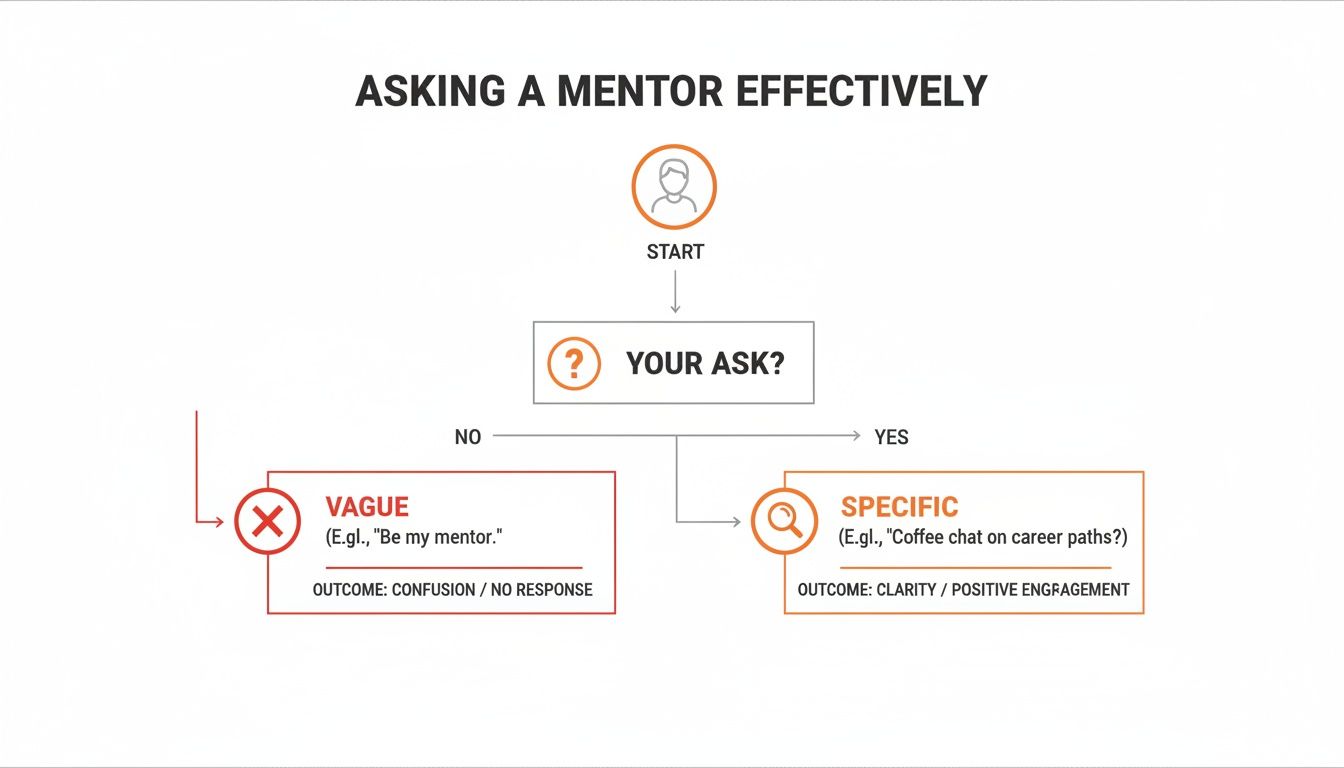
Starting with a specific, respectful ask is the right mindset. It’s the same one you need when you're figuring out if this person is even right for you.
Vet for More Than a Good Vibe
After that first conversation, step back and get analytical. Think of it like watching game tape. What actually happened in that conversation? Did you leave feeling energized and focused, or confused and a little insecure?
Here are the questions I ask myself to cut through the initial excitement:
- Did they listen more than they talked? A great mentor asks killer questions; they don’t just hand down pronouncements from on high.
- Is their experience relevant right now? Advice about a market from a decade ago might be useless today. You need someone whose experience is fresh.
- Did you feel heard, or did you feel judged? The best mentors create a safe space for you to be vulnerable. If you feel like you have to perform for them, that's a huge red flag.
The data backs this up. Entrepreneurs with mentors are simply better off. For instance, 84% of CEOs in formal mentoring programs said mentors helped them avoid costly mistakes, and 69% made better decisions. For a solo founder, dodging even one massive error can be the difference between survival and going belly-up. You can find more stats on this on the Bridge for Billions blog.
Spot the Red Flags Before It’s Too Late
It’s just as important to know what you’re looking for as it is to know what to run from. I've learned to spot these warning signs from a mile away. If you see any of these, proceed with extreme caution or just walk away.
A great mentor is like a GPS. They show you potential routes, warn you about traffic, and let you decide which way to go. A bad mentor grabs the steering wheel and drives you off a cliff.
The most dangerous mentors are often charismatic and successful, which makes them hard to second-guess. But your gut knows. If you feel a weird power dynamic or sense their ego is sucking all the oxygen out of the room, trust that feeling.
Here are the major red flags I watch for:
- They are overly prescriptive. The mentor who says, "You absolutely have to do X," without deeply understanding your business is a liability. Their job is to offer frameworks, not dictate your every move.
- They use the mentorship to sell you something. If every piece of advice conveniently leads back to their paid consulting service, they aren't your mentor. They're a salesperson.
- They seem more interested in their own stories than yours. The mentor who spends the entire conversation monologuing about their past glories isn't there to help you. They're there for the free therapy and ego boost.
Choosing a mentor is a big deal. You are entrusting someone with your ambitions. Take your time to make sure that trust is well-placed. Your future business will thank you for it.
Building a Lasting Mentorship Relationship

Okay, you found a great mentor who agreed to chat. Congrats! But listen, this is where the real work starts. This is the moment most people blow it.
Getting that first meeting is easy. The hard part is turning a one-off coffee into a real, lasting relationship. Too many founders get advice, then disappear until they're on fire again. Don't be that person. That’s not a relationship; that’s just using people.
Your job now is to make this a two-way street.
The Give, Give, Get Framework
I live by a dead-simple rule: “Give, Give, Get.” It’s exactly what it sounds like. Before you even think about asking for a big favor, you give value to their world. Twice.
This flips the whole script. You stop being a "mentee" who only takes and start being a valuable ally.
Think of it like a bank account. You can’t just show up and make withdrawals without making any deposits. You have to build up that relational capital. When you consistently add value, people become invested in your success. They want to help you win.
"Giving" doesn't mean doing something huge. It’s about being thoughtful. Here’s some simple stuff I’ve done that works:
- Share Good Intel: Send them a link to an article or podcast you know they'd care about, based on something you discussed. A quick note like, "Saw this and thought of your point on X," is all you need.
- Offer Your Superpower: Are you a wizard with TikTok, or know some software they’re struggling with? Offer a quick, no-strings-attached hand. "Hey, I can put together a 3-step guide for that if it’s helpful. No big deal."
- Make a Smart Intro: This is a big one. If you know someone who could genuinely help their business, make a thoughtful introduction. This shows you're thinking about their world, not just yours.
The single best "give" you can offer? Show them you actually listened. Send a quick update on how you used their advice and what happened. This proves you’re an action-taker, not just a talker.
Drive the Process and Respect Their Time
Your mentor is busy. The biggest way you can show respect is to make things ridiculously easy for them. Protect their time like it’s gold.
Never, ever show up and ask, "So… what should we talk about?" That’s your job.
You own the whole process. You schedule the meetings. You send the calendar invites with the Zoom link. And you always send an agenda beforehand.
Here’s the pre-meeting email I use. It's my secret weapon.
- Start with a Win: "Quick update – based on your advice, we changed our onboarding and saw a 15% lift in conversions. Thank you!"
- Set the Scene (Briefly!): "Here’s where we’re at with our numbers and priorities this month." (Keep it to one or two sentences).
- The Clear Ask: "I have one big challenge I'd love your take on: [insert your very specific problem]."
- Handle the Logistics: "Looking forward to our chat on Tuesday at 10 AM. I put a short agenda in the calendar invite."
This little email proves their time with you is valuable, and it shows you've already done the hard thinking. You’re not asking them to solve your problem; you're asking for their unique perspective on a specific point.
When you manage the relationship this professionally, you’re not a mentee anymore. You’re a peer. And that’s how you build a connection that lasts.
What to Do When You Can't Find a 1-on-1 Mentor
Let's get real for a second. The hunt for "the one"—that single, perfect mentor—can feel like a wild goose chase. Sometimes, it just doesn't happen. And that's okay. I promise.
You don't need a superhero to guide you. Pinning all your hopes on one person is a risky move. What if they get busy, or their advice no longer fits?
Instead, you can build your own composite mentor.
Build a Personal Board of Advisors
Think of it like assembling The Avengers for your business. Instead of one all-powerful hero, you get a team of specialists. This "board of advisors" isn't a formal, stuffy thing. It's a collection of wisdom you pull from different sources.
Honestly, this approach is often more practical and powerful than a traditional 1-on-1 relationship.
One of the best ways I’ve seen this work is through peer mastermind groups. Instead of one guru, imagine having the collective wisdom of 6-8 other founders in the trenches right alongside you. You can learn more about how we structure these in our guide to mastermind groups for entrepreneurs.
The power of a peer group comes from shared vulnerability. When you share war stories, tactical advice, and real numbers in a confidential setting, you solve two of the biggest problems a founder faces:
- You kill the intense loneliness that comes with building something from scratch.
- You find solutions to your problems much, much faster.
You're no longer just one person trying to figure it all out. You've got a small, trusted team that has your back, and their diverse experiences become your competitive advantage.
Draw Wisdom from Everywhere
Your composite mentor doesn't stop with peers. You can actively pull guidance from people you may never meet. This is all about being a proactive student of your industry and your own growth.
Think about the experts you already follow online. Whose newsletters do you actually open? Whose podcasts make you stop and take notes?
That's mentorship. You're learning from their wins and their screw-ups.
Even a book can be a mentor. That one business book that completely flipped how you think about marketing? The author just mentored you. They distilled years of experience into a format you could absorb in a few hours.
Your "board" could look something like this:
- The Pragmatist: A fellow founder in your peer group who is a wizard with financial models.
- The Visionary: An author whose book gave you a totally new framework for your industry.
- The Marketer: A thought leader on Twitter whose threads on customer acquisition are pure gold.
You don't need anyone's permission to learn from them. Your job is to curate these sources, wrestle with their ideas, and apply their wisdom to your own journey. This approach puts you in the driver's seat.
The Awkward Questions: Navigating Your Mentorship
So you've found a mentor. Awesome. But now a whole new set of questions pop up, the kind that feel awkward to ask.
Let's get into the tricky stuff nobody talks about.
How Often Should We Meet?
I get this question all the time. While there’s no single right answer, a monthly check-in is a great sweet spot. It's enough to keep momentum without burning out your mentor's goodwill.
For a really intense push—like a product launch—you might dial it up to bi-weekly. If they’re more of a high-level advisor, a quarterly call might be all you need.
The real secret isn't how often you meet, but how prepared you are. A tight 30-minute call with a clear agenda is worth more than a two-hour coffee meeting that goes nowhere. Respect their time, and they'll respect your hustle.
What if a Mentor Asks for Equity?
Woah. Pump the brakes. This is a massive red flag.
A real mentor is in it to give back. It’s an informal relationship built on paying it forward.
If someone asks for equity or a consulting fee right out of the gate, they are not your mentor. They're a potential investor or a consultant. That's a totally different ballgame, and you need to treat it as such—which means getting a lawyer involved.
Don't let someone take a slice of your company just for giving advice. True mentors find their reward in your success, not on your cap table.
How Do I Know When I've Outgrown a Mentor?
This isn't a bad thing! It’s a sign of growth. Think of it like leveling up in a video game—the guide who got you past the first few stages isn't always the one you need for the final boss.
It might be time to move on if:
- You find their advice feels dated or less relevant to where your business is now.
- You’re consistently a step ahead and already know the answers to their questions.
- You spend more time updating them on the basics than getting strategic advice.
When this happens, don’t just ghost them. That's a terrible look. Take them out for coffee, sincerely thank them for helping you get to this point, and gracefully transition the relationship into a friendship.
At Chicago Brandstarters, we believe the best mentorship often comes from a community of peers in the trenches with you. If you're looking for that kind of support, check out our vetted founder community at https://www.chicagobrandstarters.com.