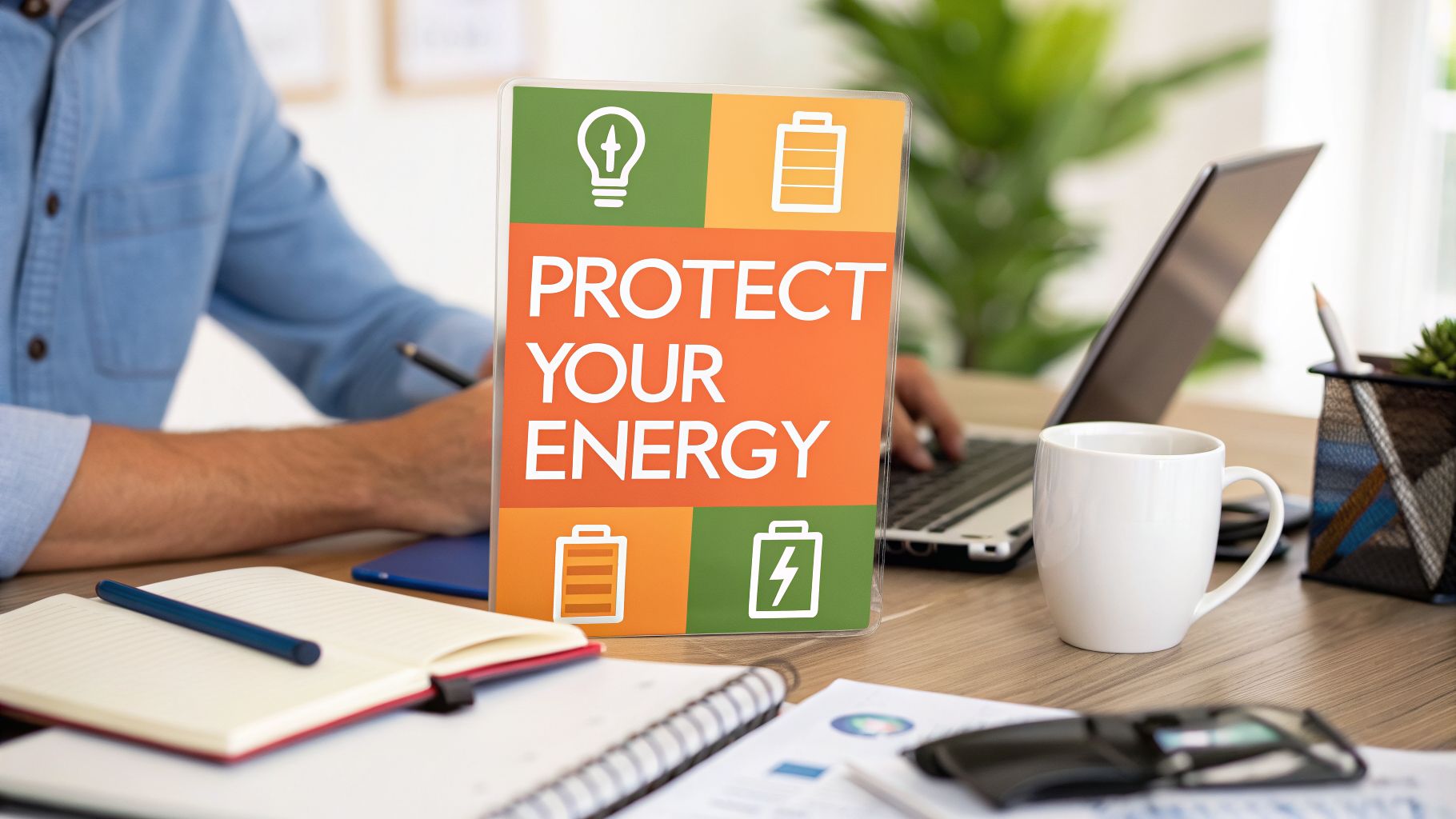
We're all taught to worship the hustle. Grind culture is baked into our founder DNA. I used to obsess over my product, my funding, my market fit—everything except the one resource that powers it all: my own energy.
Your energy is the fuel in your engine. Running on empty isn't a badge of honor; it's a critical system failure waiting to happen. You can get away with it for a while, but eventually, the bill comes due.
Your Energy Is Your Most Valuable Asset

I want you to think of your energy like a bank account. Every meeting, every fire-drill, every late-night worry is a withdrawal. If you only make withdrawals, you’re going to go bankrupt. It's that simple.
I learned this the hard way, hitting a wall so hard I thought my company was finished. It wasn't. But I almost was.
Burnout doesn't feel like a dramatic explosion. It’s a slow leak. One day you wake up and discover you have nothing left to give—not to your business, not to your team, and definitely not to yourself.
That painful realization forced me to stop and rethink everything. I started treating my energy not as an infinite well, but as my most precious, non-negotiable asset. This isn't about trendy self-care; it's about strategic self-preservation. It's the foundation of a sharp and effective entrepreneurial mindset.
The Hard Numbers Behind Energy Management
I need you to understand that protecting your energy isn't selfish. It's the most strategic move you can make for your business. When you're drained, you make terrible decisions. You become reactive instead of proactive. Your creativity tanks, and your leadership becomes toxic.
The data backs me up. One study found that founders who set a hard stop for work—like no emails after 7 PM—actually boosted their productivity by 25% and cut stress hormones by 30%. Another found that startups prioritizing weekly 'energy audits' to cut draining tasks hit $1M in revenue 18 months faster than their peers.
This isn't theory. Smart energy management is your competitive edge. It lets you:
- Make clear-headed decisions under pressure.
- Inspire and keep your best people.
- Spot opportunities everyone else is too exhausted to see.
- Build a business (and a life) you don’t want to escape from.
The Founder's Energy Drain Audit
First, let's figure out where your energy is actually going. Most of us are on autopilot, saying "yes" to things that slowly bleed us dry. This quick audit contrasts the common energy-draining traps with their strategic, high-energy alternatives.
| Energy Drainer (The Default) | Energy Protector (The Strategic Choice) | Impact on Your Business |
|---|---|---|
| Taking every "quick chat" request | Blocking focus time; using agendas for all meetings | Protects deep work, increases output quality, reduces context-switching fatigue. |
| Saying "yes" to every networking event | Attending 1-2 high-value, curated events per month | Builds stronger, more genuine connections and prevents social burnout. |
| Constant notifications and a full inbox | Time-blocking email; turning off all non-essential alerts | Reclaims your focus, reduces anxiety, and puts you in control of your day. |
| Working in the business (admin, busywork) | Working on the business (strategy, vision, high-leverage tasks) | Drives long-term growth instead of just keeping the lights on. |
| Ignoring physical health (bad sleep, poor diet) | Prioritizing 7-8 hours of sleep and regular movement | Drastically improves cognitive function, decision-making, and emotional regulation. |
I want you to take a hard look at this table. Be honest with yourself about where you fall. Identifying just one or two of these "drainers" and swapping them for a "protector" can make a massive difference in how you feel—and how your business performs—within a single week.
Setting Boundaries That Actually Stick
If you're a founder, your default setting is probably "yes." Yes to that "quick coffee," yes to the last-minute feature tweak, yes to one more meeting. It’s baked into our DNA. Saying "no" feels like slamming a door on an opportunity, and that's terrifying.
But I’ll tell you what I learned the hard way: a well-placed, respectful "no" is the single most powerful tool for protecting your energy. It’s the difference between being a proactive leader and a reactive people-pleaser who’s constantly putting out fires.
Think of your energy like that bank account again. Every "yes" is a withdrawal. Without limits, you'll be overdrawn before you know it. Your boundaries aren't about being a jerk; they're about deciding who gets access to your most valuable asset—your focus.
From Saying No to Communicating Your Limits
Learning to set boundaries isn't just about dropping the word "no" and walking away. When I first started, I’d either say yes to everything until I was completely burned out, or I'd snap with a blunt "no" that left a bad taste in everyone's mouth. Neither approach worked.
The real skill is learning to decline with grace while showing you're still in control of your priorities.
The trick is to have a playbook. You need a few go-to scripts ready in your back pocket so you aren’t fumbling for words under pressure. This removes the emotion and lets you respond strategically.
Here are a few situations and the exact scripts I use all the time:
- To kill a meeting that should just be an email: "Thanks for reaching out! So I can give this my full attention, could you send over the key points in an email? That way, I can review it properly and get back to you."
- To push back on scope creep from a client: "I love these new ideas! They're a bit outside our current scope, but I'd be happy to put together a separate proposal for this next phase. Let's knock out our current goals first to make sure we deliver."
- To protect your nights and weekends: "I appreciate you thinking of me. I keep my evenings free for personal time, but I'm open to connecting [suggest an alternative day/time that works for you]."
Handling People Who Test Your Boundaries
Let’s be real. Some people will push back. They aren’t bad people; they're just used to the old you who always said yes. When you start enforcing your new rules, they will test them.
Consistency is everything. If you bend your rule just once, you've just taught them that your "rule" is actually a negotiation. For a deeper dive, I recommend our guide on how to set boundaries at work.
And this isn't just fluffy advice; the data backs it up. A 2026 Bain & Company analysis of 10,000 businesses found that the top performers said "no" three times more often. They delegated 65% of non-essential tasks, which led to 28% higher profits.
Plus, the American Psychological Association’s recent stress report showed that entrepreneurs with firm boundaries have 32% less anxiety. Considering 91% of us deal with it, that’s a massive win. You can see more of the research behind global business performance trends on Woodmac.com.
Setting boundaries is not a one-time conversation. It's a continuous practice of teaching others how you expect to be treated and, more importantly, reminding yourself what you need to do your best work. Your energy depends on it.
Map Your Calendar for Peak Energy
Your calendar is not a to-do list. It’s an energy budget.
For years, I treated my calendar like a simple appointment book, and it ran me into the ground. The big shift happened when I stopped just managing my time and started managing my energy. I call this Energy Mapping. It’s about working with your natural rhythms instead of constantly fighting them.
Think of it this way: trying to force a major strategy session during that 3 PM slump is like swimming upstream. You might get there, but you'll be completely wiped out. The goal is to design your week to ride the current, not battle it.
The Four Energy Quadrants
I sort every single task into four buckets. This isn't about what the task is, but the type of energy it demands from me.
- Deep Work: This is your prime time. For me, this means writing, digging into strategy, or untangling a complex problem. This work requires a fresh, focused mind and is the most expensive withdrawal from your energy bank.
- Shallow Work: Think admin, clearing your inbox, or handling routine updates. These tasks don't need your A-game. They're necessary chores, but they are low-cost energy withdrawals.
- Collaborative Work: All your meetings, brainstorms, and team check-ins live here. This work runs on social energy, which can be a huge drain or a nice boost, depending on who you're with.
- Recharge Time: This is completely non-negotiable. I'm talking about true breaks—a walk without your phone, lunch away from your desk, or a quick meditation. These are your energy deposits.
Your calendar should reflect a conscious choice about where your best energy goes. If you let your inbox and other people's priorities run the show, they'll make those choices for you. You'll be left with scraps for the work that actually matters.
This simple visual breaks down how you can take back control, starting with having a "no" script ready before you even get the request.
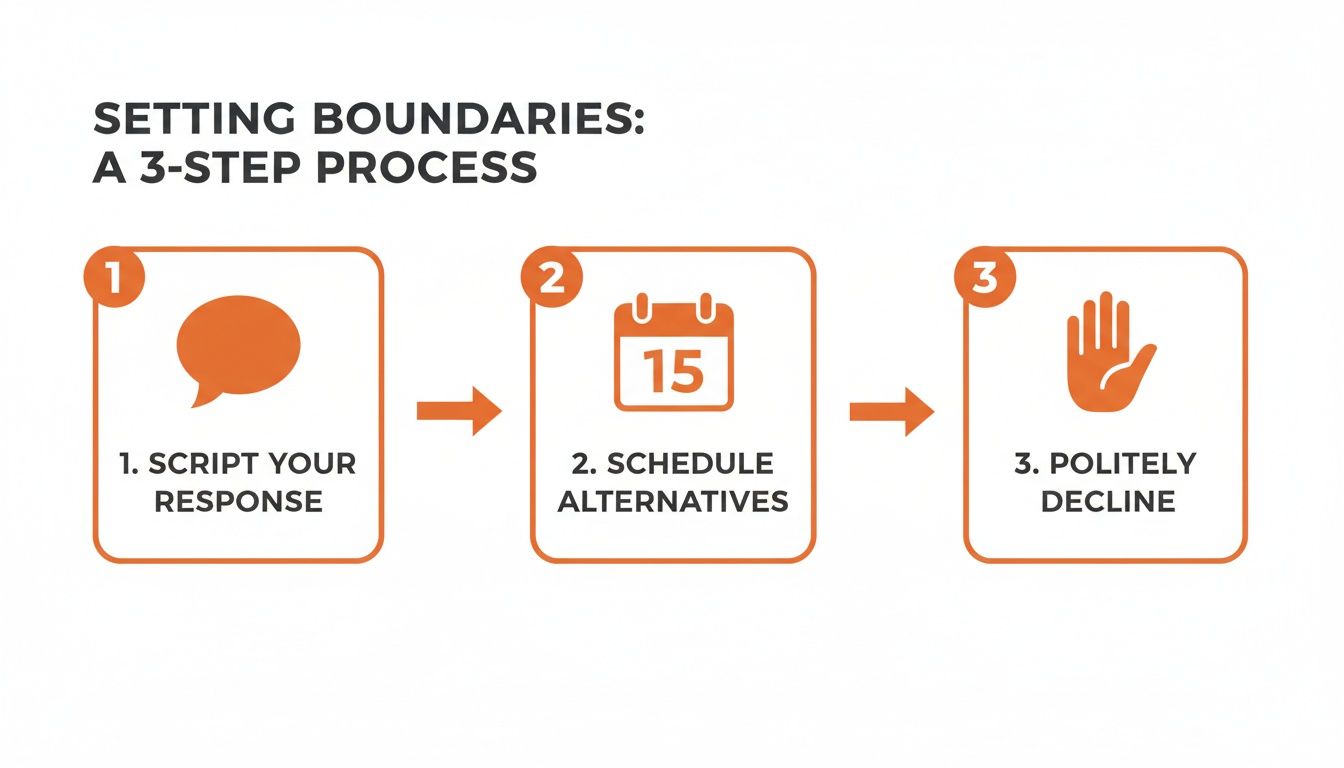
Following this flow—script, calendar, decline—is a powerful way for you to guard your energy before it’s even on the table.
Putting Energy Mapping Into Practice
I guard my mornings like a fortress. From 8 AM to 12 PM is sacred Deep Work time. My phone is off, Slack is snoozed, and my team knows not to book anything. This is when I tackle the one or two things that will actually move my business forward.
My afternoons, when my energy naturally dips, are for Shallow and Collaborative work. I batch-process all my meetings into a single block, from 2-4 PM on Tuesdays and Thursdays. This stops the constant context-switching that absolutely murders productivity.
One of the best things I ever did was implement a strict 'No-Meeting Day.' I block off every single Wednesday. This isn't just a "nice-to-have"; it's a strategic weapon. A 2026 EU Startup Monitor report found that 62% of founders who used no-meeting days hit their project milestones 22% faster. This lines up perfectly with what Cal Newport's research shows: structured deep work can increase your output by up to 40%. You can dig into more data on global energy trends and business practices at policycenter.ma.
You don't have to go all-in at once. Start small. Just block off two hours for deep work tomorrow morning and see how it feels. Mapping your calendar isn’t about being a rigid robot; it’s about giving the best version of yourself to your most important work.
Curate an Energizing Professional Circle
The people you surround yourself with will either fuel your fire or slowly drain your battery. As a founder, you simply cannot afford to entertain energy vampires. Your professional circle isn’t just a list of contacts; it's an ecosystem that directly messes with your energy.
This was a tough lesson for me. I used to think every connection was a good one, but I quickly realized some people were more like black holes. They just consume your time, attention, and optimism without giving anything back. Auditing your network isn't just a good idea—it's a critical survival skill.
The Givers vs The Takers
Think of your energy like cash. Some people you meet are “Takers.” They only see you as a resource, a new lead, or a stepping stone to something they want.
They’ll ask to “pick your brain,” try to get free consulting, and talk endlessly about their own needs. Any conversation with them leaves you feeling completely drained, like you just paid a tax you never agreed to.
Then you have the “Givers.” These people listen as much as they talk. They offer genuine support, challenge your ideas in a helpful way, and get genuinely excited about your wins. Hanging out with them feels like an investment that pays off—you walk away feeling inspired and ready to go.
You have to learn to spot the difference. Fast. The subtle cues tell you who’s going to multiply your energy and who’s just going to eat it.
Spotting the Red Flags
Takers often disguise themselves as collaborators or friends, but their patterns always give them away. Learning to see these red flags is your first line of defense.
Here are the big warning signs I’ve learned to watch for:
- One-Sided Conversations: They do all the talking. They rarely ask about you or your business unless it’s to find an angle for themselves.
- The "Quick Question" Abuse: Their requests are never, ever quick. They are constantly asking for free advice or favors that show zero respect for your time.
- Transactional Networking: They only contact you when they need something. Every text, email, or call is driven by their own agenda.
If someone consistently shows these patterns, that's your signal to create distance. You don't need a big, dramatic confrontation. Just become less available. Respond a little slower. Gracefully say "no" to their requests. Your time is way too valuable for one-way relationships.
Your network should function like a personal board of directors, not a needy audience. Surround yourself with people who provide honest feedback and mutual support, not those who just want a front-row seat to your journey.
Building Your Personal Board of Directors
The best move I ever made was to stop broad, shallow networking and start building a small, trusted inner circle. Forget those massive events where you just collect a pile of business cards. Instead, I focus on building deep relationships with a handful of people who actually get it.
This is why I find intimate mastermind groups so powerful. A small group of 6-8 founders sharing real-life struggles is infinitely more valuable than a room full of 100 acquaintances. In these trusted spaces, you can be vulnerable, get tactical advice, and find the kind of support that actually refuels your tank. If you want to dig deeper, you should check out our guide to mastermind groups for entrepreneurs.
Be intentional with where you invest your time. Pour it into people who challenge and inspire you. Your energy, your focus, and your business will thank you for it.
Implement a Founder's Recovery Protocol

Hustle culture loves to romanticize exhaustion as a badge of honor. That’s a dangerous lie. The most successful founders I know—the ones running eight-figure businesses—don't see recovery as a luxury. It's a non-negotiable part of their work.
Recovery isn’t what you do after you’re already fried. It’s the system you install to prevent burnout from ever happening in the first place.
Imagine your energy is a bank account. Every task, meeting, and tough decision is a withdrawal. If you don't have a system for making regular deposits, you're heading straight for bankruptcy. This is your playbook for making those deposits.
Active Recovery vs. Passive Draining
Let's get one thing straight: scrolling social media is not recovery. Binge-watching a show until 2 AM is not recovery. These are passive, draining activities that trick your brain into thinking you're resting, but they’re actually just siphoning off what little energy you have left.
Real recovery is active and intentional. It’s about consciously choosing to do things that actually refill your tank—mentally, emotionally, and physically.
Here’s what that looks like for me:
- Passive Drain: Mindlessly scrolling Instagram for 30 minutes. I look up feeling foggy, numb, and somehow even more tired.
- Active Recovery: Going for a 15-minute walk outside. No podcast, no phone call. I just walk, look around, and let my brain breathe. I come back feeling sharper.
This distinction is everything. Your goal is to build a protocol of active recovery habits that are as automatic as brushing your teeth.
The Daily Shutdown Ritual
One of the hardest parts of being a founder is getting your brain to clock out. My non-negotiable for this is a daily shutdown ritual. It’s a dead-simple, two-step process that tells my brain the workday is officially over.
Around 6 PM every day, I do two things:
- I plan tomorrow's top priority. I write down the single most important task for the next day. This gets it out of my head and stops my brain from chewing on it all night.
- I physically close my laptop and say out loud, "Work is done for today." Yeah, it sounds a little silly, but the verbal cue and physical action create a powerful psychological boundary.
Your brain needs clear signals to switch from 'work mode' to 'rest mode.' Without them, you’ll just simmer in a state of low-grade stress all evening, which completely kills your ability to recharge. This simple ritual is my on/off switch.
Building a recovery protocol isn’t about piling more onto your plate. It's about swapping low-value, draining habits for high-value, restorative ones. I suggest you start with a daily shutdown and a short, unplugged walk. These small deposits build an energy surplus that gives you a massive edge.
Even with the best playbook, real life happens. People will push your boundaries, unexpected fires will pop up, and you’ll find yourself wondering if you're actually getting it right.
Here are the no-fluff answers to the questions I get asked most often by founders who are trying to reclaim their energy.
How Do I Protect My Energy When My Team Needs Me Constantly?
I hear this one all the time. As a founder, your team’s constant need for your input can be one of the biggest energy drains. The answer isn't to ghost them; it's to become predictably available.
Imagine your energy is a high-powered spotlight. If you're constantly swinging it around to every little thing that moves in the shadows, you'll burn out the bulb fast. You have to be deliberate about where you point it.
Here's how you do that:
- Set Up Clear Communication Rules: Teach your team which tool to use for what. Maybe Slack is for quick questions that can wait an hour or two. Email is for things that require a real, thoughtful response within 24 hours. A phone call? That's for true, hair-on-fire emergencies only.
- Run "Office Hours": Block off one or two specific times each day—say, 11 AM and 4 PM—where your team knows they can grab you. This corrals all those little "got a second?" interruptions into a predictable window, which frees up the rest of your day for the deep work that actually moves the needle.
- Work Yourself Out of a Job: The real win is to stop being the bottleneck. I create clear documentation and SOPs. I delegate real decision-making authority. And when someone on my team solves a problem without me, I praise them for it publicly.
What's the Best First Step if I Feel Completely Drained?
When you’re already running on empty, the last thing you want is another complicated system. So don't implement one.
Just start with one simple thing: a quick energy audit.
For one week, grab a small notebook or open a note on your phone. At the end of each day, write down the tasks, meetings, and people that left you feeling energized versus totally drained. That's it.
This little log is your map. It will show you exactly where the biggest leaks are. More often than not, you'll find that 80% of your exhaustion comes from just 20% of your daily activities.
Once you know where the one or two biggest drains are, you can finally do something about them. You can't fix a leak until you find it.
Is It Selfish to Prioritize My Energy Over Urgent Business Needs?
This is a mindset trap that keeps so many good founders stuck in a cycle of burnout. Let me be blunt: protecting your energy isn't selfish; it's your most important strategic responsibility as a leader.
You are the engine of your business. If you let that engine seize up from running it too hard without maintenance, the whole car stops. A burnt-out founder makes bad decisions, tanks team morale, and becomes the single biggest risk to the company's survival.
Your energy is a direct investment in your company's long-term health. It's the whole "put your own oxygen mask on first" thing.
The data backs me up. A 2026 Gallup poll showed that 68% of entrepreneurs suffer from chronic sleep deprivation, which is directly linked to a 45% higher business failure rate. Rest isn't a luxury; it’s a competitive advantage. You can learn more about the future of business performance and energy on policycenter.ma.
If you’re a kind, hard-working founder in Chicago or the Midwest tired of transactional networking, Chicago Brandstarters offers a different path. We are a free, vetted community built on real support and shared experience, not self-promotion. If you’re ready to build friendships that move your business forward, find your people at https://www.chicagobrandstarters.com.