

Setting business goals isn't about making a wish list. It's about drawing a clear, actionable roadmap. You define specific outcomes, slap measurable metrics on them, and set a realistic timeline. This way, you can actually track your progress and hold yourself accountable.
Why Your Business Goals Keep Ending Up in the Graveyard

Let’s be real. You've probably set goals that died by February. It happens to all of us, and it’s not because you lack ambition. The typical advice on goal setting is just broken.
I’ve been there. I remember setting a goal to "grow my audience." Sounds great, right? But what did that mean? Ten new followers? A thousand? With no clear target, I was just spinning my wheels, busy but going nowhere.
That taught me something crucial most frameworks skip: the psychology of why goals fail. We stumble into common traps without even seeing them.
The Problem with Vague Ambitions
Setting a goal is like planning a road trip. You wouldn't tell your friends, "Let's drive west," and hope you end up somewhere cool. You'd pick a destination, map the route, and check your gas. Your business goals need that same practical logic.
Vague goals like "increase sales" are the business equivalent of "driving west." They have no destination and no map.
A goal that just creates pressure isn't a goal; it's an anxiety-maker. A good goal inspires action because you can see the finish line from the start.
Avoiding the Vanity Goal Trap
Another pitfall is the vanity goal. This is a target that looks impressive but doesn't actually move your business forward. Chasing 100,000 TikTok followers might feel productive, but if they never buy from you, it's just an ego boost.
I see this constantly with new founders. They focus on metrics that feed the ego, not the bank account. The real work is digging deeper to find actions that create real value.
- Instead of: "Get more social media followers."
- Think: "Increase qualified leads from Instagram by 20% this quarter by partnering with local foodie accounts."
This shift in thinking is everything. It moves you from wishing to doing. You’re not alone in this. Research shows only 20% of companies hit most of their strategic goals, often because they were poorly set up.
In my community, Chicago Brandstarters, we fight this by sharing our war stories and wins, helping each other craft goals that actually stick. You can find more goal-setting statistics and see how much they matter.
Before we get into frameworks like SMART or OKRs, you have to get this foundation right. It's about building the right mindset first. The point isn't just to write something down; it's to create a compass that guides every decision you make.
Choosing Your Goal-Setting Framework

Alright, you've dodged the quicksand of vague goals. Now, let’s pick your tool for the job. Don't worry, you don't need a Ph.D. for this. I’m breaking down the two frameworks I see founders use successfully every day.
Think of it this way: building a chair requires a specific blueprint. That’s the SMART framework. But furnishing a whole house? You need a bigger design plan to guide all your choices. That’s the OKR framework.
They’re both just tools. The trick is knowing which one to use. My goal isn't to make you an expert overnight. It’s to give you something practical you can use today to focus your grind.
SMART Goals: Your Detailed Blueprint
You’ve probably heard of SMART goals, but let's just chat about them. This framework is your best friend for specific projects where the finish line is crystal clear. It forces you to get granular and be honest about what it takes to get something done.
Each letter is a filter you run your goal through:
- Specific: Is the outcome so clear anyone could understand it? "Launch our new website" is okay, but "Launch our Shopify site with five product pages and a working checkout" is much better.
- Measurable: How will you know you’ve won? It must be a number. Think "Increase website traffic by 15%" or "Secure 10 pre-orders."
- Achievable: Can you actually do this with your current team and resources? Be honest. If you're a one-person shop, aiming for $1 million in revenue next month is a fantasy, not a goal.
- Relevant: Does this actually push your business forward? Will hitting this target matter to your bottom line?
- Time-bound: When will this be done? A goal without a deadline is just a dream. "By the end of Q3" creates the urgency you need.
SMART goals are surgical. They are the perfect tool for focusing all your energy on a single, critical outcome—like launching your first product or cutting your cart abandonment rate.
OKRs: Your Guiding Compass
Now, let's talk Objectives and Key Results (OKRs). If SMART goals are your blueprints, OKRs are the compass for the entire expedition. They align your whole company—even if it's just you—around big, ambitious missions.
The structure is simple but powerful:
- Objective: This is your big, inspiring "where are we going?" statement. It should be qualitative and get you fired up. Something like, "Become the go-to resource for local dog owners."
- Key Results: These are the measurable signs you’re making progress. You’ll have 2-4 Key Results for each Objective, and they must be numbers. For our example, they might be: "Increase organic blog traffic from 500 to 2,000 monthly visitors" and "Secure partnerships with 3 local pet stores."
OKRs are fantastic for setting quarterly priorities. They connect what you do every day to a larger vision, which is a game-changer for staying motivated when things get tough.
And the data agrees. A huge 98% of companies report better clarity after using OKRs. Teams using them have a 72% grasp of their company's vision, versus just 50% for those who don't. This kind of alignment is what we foster in our Chicago Brandstarters community, where clear goals create a foundation for real support. You can dive into more of these goal-setting findings to see the full impact.
SMART Goals vs OKRs: Which to Use and When
So, which framework do you use? Good news: you don't have to choose. They work together. This table breaks down the differences.
| Aspect | SMART Goals | OKRs (Objectives & Key Results) |
|---|---|---|
| Best For | Specific, short-term projects with clear outcomes. Think tasks and tactical execution. | Big-picture, ambitious company or team goals, usually set quarterly or annually. |
| Scope | Narrow and focused on a single metric or deliverable. "Launch X feature by Y date." | Broad and aspirational, linking vision to measurable progress. |
| Structure | A prescriptive checklist: Specific, Measurable, Achievable, Relevant, Time-bound. | A simple hierarchy: One inspiring Objective tied to 2-4 quantifiable Key Results. |
| Mindset | "Did we do the thing we said we'd do?" Focus is on completion and hitting the target. | "Are we making meaningful progress toward our big vision?" Focus is on impact. |
| Example | "Increase email open rates from 20% to 25% for our welcome series by the end of Q2." | Objective: Create an unforgettable customer onboarding experience. KR1: Improve user retention by 15% in the first 30 days. KR2: Achieve a Customer Satisfaction Score (CSAT) of 90%+. |
The key is understanding scope. I use SMART goals for specific projects and OKRs to set our quarterly direction. You can often break down a single Key Result into a series of smaller, actionable SMART goals.
Using both gives you the high-level inspiration of a compass and the practical directions of a map. You'll know where you're going and the exact steps to get there.
Real Goal Examples You Can Actually Use
Theory is nice, but let's get real. Seeing goals in action is what makes things click. We're moving past the abstract stuff into tangible examples you can borrow, tweak, and use for your own business. Time to take the guesswork out.
I’ll show you some specific, actionable goals for the types of businesses I see every day. I'll show you exactly how to phrase them, what to track, and what a realistic timeline looks like.
Goals for Product and E-commerce Founders
If you build a physical product or an e-commerce brand, your world is inventory, customers, and conversions. Your goals must reflect that. It’s not about fuzzy ideas like "growing the brand"—it’s about hitting specific commercial milestones that prove your concept.
It's like building an engine. First, you get the flywheel spinning with pre-orders. Then, you make the fuel intake more efficient by lowering your customer acquisition cost (CAC). Finally, you tune the engine by improving your conversion rate so it runs smoothly.
Here are a few examples in the SMART format:
- Secure Pre-Orders: "Secure 50 pre-orders for our new skincare product via Instagram and TikTok, collecting $2,500 by March 31st to validate demand before our first big manufacturing order."
- Lower Customer Acquisition Cost (CAC): "Reduce our average CAC from $45 to $30 in 90 days by optimizing our top three Facebook ad campaigns and shifting 20% of the budget to influencer collaborations."
- Improve Conversion Rate: "Increase our product page conversion rate from 1.5% to 2.5% by the end of Q2 by adding customer reviews, three new product photos per item, and A/B testing our call-to-action button."
For product brands, you must tie every goal to a real financial or operational outcome. You're moving an idea into actual inventory, and your goals need to bridge that gap with cold, hard data.
Goals for Service-Based Entrepreneurs
For those of us selling services—consultants, agency owners, coaches—the goals look different. You're not selling a widget; you're selling your expertise and time. Your world revolves around building trust, generating leads, and creating a predictable client pipeline.
This is less about inventory and more about reputation. Your early goals are the bedrock of your authority.
Each piece of the SMART criteria forces you to get clear on your intentions and define what winning looks like.
Let's use an OKR (Objectives and Key Results) approach for these service-based examples, which is perfect for bigger goals:
Objective: Establish myself as a go-to authority for B2B tech startups in Chicago.
- Key Result 1: Publish 8 high-quality, long-form articles on my blog about common startup marketing challenges by the end of Q3.
- Key Result 2: Secure speaking spots at 2 local tech meetups or industry panels to share my framework.
- Key Result 3: Increase qualified inbound leads through my website from an average of 1 to 5 per month.
This OKR doesn't just say "get more clients." It lays out a clear strategy focused on building the reputation that attracts those clients. It connects the daily grind (like writing) to a much bigger vision. Your marketing needs this focus, and a one-page marketing plan can be a powerful tool to keep everything aligned.
Whether you're selling a product or a service, these examples should give you a solid starting point. Don't just copy them. Use them as a template to think through what really matters for your business, right now. What’s the one domino that, if you push it, will make everything else fall into place? Start there.
How to Prioritize Goals Without Getting Overwhelmed
As a founder, your to-do list is a monster that never sleeps. You have a dozen brilliant ideas before your first coffee, and they all feel urgent. But if everything is a priority, nothing is. This is where most of us get stuck.
I’ve been there, paralyzed by a whiteboard full of "priorities." The solution isn't working harder; it's getting ruthless with your focus. You need a system to defend against shiny object syndrome and concentrate on what truly matters.
This isn't about complex software. It’s about a simple mental model that has saved my sanity and helped countless founders I know cut through the noise.
For an e-commerce brand, this might mean a logical flow: validate an idea with pre-orders, figure out customer acquisition costs, then optimize your conversion rate.
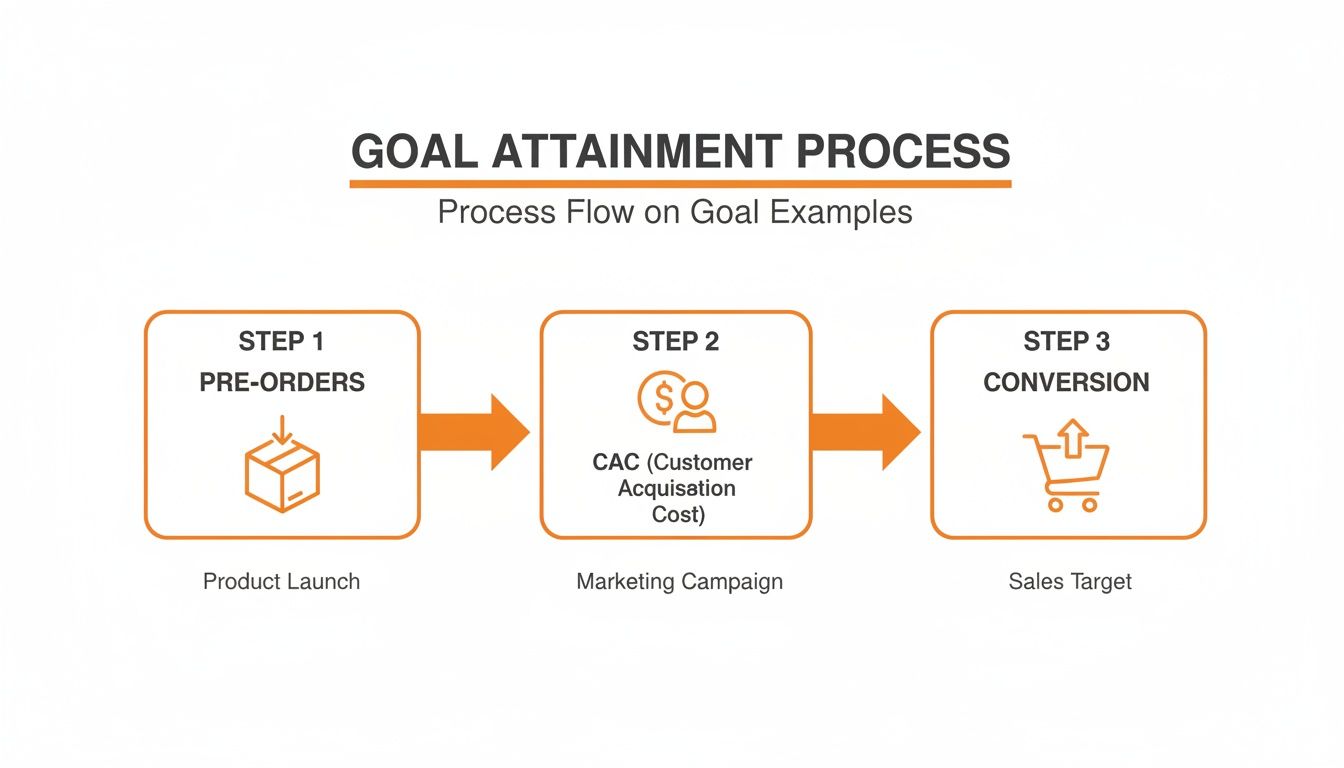
Each step builds on the last. You can see how prioritizing goals in the right sequence—validation before scaling—creates a stable foundation for growth.
Use the Impact vs. Effort Matrix
Let's talk about the Impact vs. Effort matrix. Think of it as a simple, four-quadrant grid that helps you sort your goals visually. It’s the fastest way I know to get clarity when you feel like you're drowning.
On one axis, you have Impact (how much will this move the needle?). On the other, you have Effort (how much time, money, and energy will this take?).
You plot each of your goals onto this grid:
- High Impact, Low Effort (Quick Wins): These are your golden tickets. Do them now. Example: adding customer testimonials to your product page.
- High Impact, High Effort (Major Projects): These are your big strategic bets, like launching a new product line. They need serious planning.
- Low Impact, Low Effort (Fill-ins): Do these when you have spare time, but don't let them distract you. Example: updating your LinkedIn bio.
- Low Impact, High Effort (Time Sinks): Avoid these at all costs. This is where good ideas go to die, like designing a custom website when a template would work fine.
This matrix forces an honest conversation with yourself. It transforms your messy list of goals into a clear, actionable map.
Find Your "One Thing"
Once you've sorted your goals, take it a step further. Ask yourself: "What is the one thing I can do, such that by doing it, everything else will be easier or unnecessary?"
This concept is a game-changer. It forces you to find the most important domino.
For an early-stage founder, this might be securing your first 10 paying customers. Why? Because with them, you get feedback, revenue, and validation, which makes everything else infinitely easier.
Your 'One Thing' isn't just another goal; it's the master key that unlocks the next level. Identify it, obsess over it, and fiercely protect your focus.
This approach requires you to say "no" a lot. You say no to distractions, to "good" ideas that aren't the best idea right now, and to multitasking. To help make these tough calls, you may want to check out our guide on building a framework for making decisions that supports your goals.
Aligning Priorities with Your Team
If you have a co-founder or a small team, alignment is non-negotiable. Misalignment silently kills momentum. You can't afford to have one person focused on product features while another is trying to land big clients.
Here’s a simple script I use to get on the same page with a mentor or co-founder:
- Start with your view: "Based on where we are, I think our 'One Thing' this quarter should be [Your Priority], because it will directly lead to [Key Outcome]."
- Ask for theirs: "What do you think? Do you see a different priority that would have a bigger impact right now?"
- Find common ground: "Let’s walk through the Impact/Effort matrix for both ideas and decide which one gets us closer to our ultimate objective."
This structured talk turns a potential argument into a strategic discussion. It ensures everyone is rowing in the same direction—the only way you'll move the boat forward.
Building a Rhythm of Review and Accountability
Setting a goal is the easy part. It's the flash of excitement. The real work happens in the gritty follow-through. A goal without a consistent review is just a wish.
Here's a hard truth: your initial plan is almost certainly wrong. You'll hit weird roadblocks, find new opportunities, or realize a core assumption was off. That’s not failure. It’s data. A regular review process is how you collect that data and use it to steer the ship.
Think of it like a musician practicing scales. It’s not thrilling, but that repetitive check-in builds the muscle memory needed to crush it on stage. Your goal review is the business equivalent of practicing scales.
Finding Your Cadence
There’s no magic answer for how often to review your goals, but a simple system works wonders for founders. It’s about creating different layers of review that match the goal's size.
- Weekly Check-ins: These are quick, 15-minute sprints. The focus is tactical. What did you do last week? What's the #1 thing to do this week? This keeps the momentum going.
- Monthly Reviews: Here, you zoom out a bit. Look at your key metrics. Are your weekly actions actually moving the needle on your monthly Key Results? This is your chance to tweak tactics before you get too far off track.
- Quarterly Resets: This is your big-picture strategy huddle. Look back at your OKRs or major goals. Did you hit them? Why or why not? This is where you celebrate wins, dissect what went wrong, and set new priorities for the next 90 days.
This tiered approach stops you from getting lost in the daily grind while making sure you don't go months without realizing you're headed the wrong way. It builds a rhythm of accountability.
A goal review isn't an interrogation. It's an honest conversation with yourself (and your team) about what's actually happening. It’s about replacing hope with a real assessment, then turning that assessment into smarter actions.
The Three Questions That Actually Matter
Your review meetings, even if it's just you and a coffee, don’t need to be complicated. I've found that you can cut through the noise by focusing on three simple questions.
- What went well? Always start with wins, no matter how small. Did you get an amazing email from a customer? Did a random post do better than expected? Acknowledging progress is crucial for morale, especially when you feel like you're building this alone.
- What roadblocks did we hit? Get brutally honest. Where did you get stuck? What took way longer than it should have? This isn't about blame; it's about spotting friction points. The goal is to see patterns before they become crises.
- What will we do differently next time? This is the most important question. It turns reflection into action. Based on what you just discussed, what’s the one tangible change you’re going to make? That commitment drives real improvement.
This simple framework creates a culture of learning, not micromanagement. For founders who often feel isolated, building this habit is a game-changer. It’s the same idea we use in our community, where honest check-ins in our mastermind groups for entrepreneurs keep everyone moving. That peer accountability can turn a lonely journey into a shared one, and your own self-review is the first step.
Common Questions About Setting Business Goals
You have the frameworks and a plan. But when theory meets reality, tough questions pop up. Here are a few I hear most from founders.
What Should I Do When I Miss a Goal?
First, breathe. Missing a goal isn’t a moral failing; it’s data. The worst thing you can do is beat yourself up or ignore it. The point of setting goals isn't to be perfect. It's to create focus and make progress.
When you miss a target, become a detective. Don't just look at the outcome—dissect the process.
Ask yourself these questions:
- Was the goal actually achievable? Seriously. Did you have the time, money, or people to pull it off? As founders, we're naturally optimistic. Sometimes wildly so. The lesson is to be more realistic next time.
- Were the actions wrong, or was the goal wrong? Maybe your marketing efforts were solid, but you were targeting a channel that was never going to work. Diagnosing the real problem is key.
- What unexpected roadblocks appeared? A key team member got sick, a supplier dropped the ball, a new competitor launched. Life happens. Figure out what was out of your control versus what you might have anticipated.
Once you have a real diagnosis, you can decide what to do next. Maybe you just adjust the timeline. Or maybe you change your strategy completely. You might even realize the goal isn't relevant anymore and scrap it.
Missing a goal is only a failure if you don't learn from it.
How Many Goals Are Too Many?
As a founder, your brain is an idea machine. It's tempting to set a dozen ambitious goals every quarter. Resist this urge.
If you have more than 3-5 major objectives at once, you have none. Your focus shatters. Your team gets whiplash. It’s like trying to catch five baseballs thrown at you at once—you'll drop them all.
Your goal isn't to create a list of everything you could do. It's to identify the brutally small list of things you must do right now.
I always recommend one overarching "One Thing" for the company each quarter. This is your north star. From there, each person can have 2-3 key results that directly support that main objective.
This keeps everyone aligned without the overwhelm. It forces you to make hard choices about what really matters. And trust me, fewer, more meaningful goals concentrate your energy where it has the biggest impact.
How Do I Share Goals Without Being "Corporate"?
This is a big one for small teams. You probably left the corporate world to escape bureaucracy, so the last thing you want is to recreate it. The trick is to make goal-sharing a conversation, not a top-down mandate.
Think of it less like a formal presentation and more like a team huddle before a game. You're explaining the game plan so everyone knows their role and, most importantly, why it matters.
Here’s a simple, non-corporate way to do it:
- Frame the "Why" First. Always start with the big picture. "Hey everyone, our main mission this quarter is to nail customer onboarding. We're losing too many great customers in the first week, and if we fix this, everything else gets easier."
- Make it a Discussion. Share your thoughts, then ask for input. "Here are the key results I think will get us there. What do you all think? Does this feel right? What am I missing?" This shows you value their brains.
- Keep it Visible and Simple. Don't bury your goals in a 20-page Google Doc nobody opens. Put them on a whiteboard, a simple Notion page, or a pinned message in a dedicated Slack channel. The goal is constant, easy visibility.
Sharing goals in a small team isn’t about creating red tape. It’s about building a shared purpose. When everyone understands where you're all going and feels like they helped draw the map, they'll row a hell of a lot harder to get there.
At Chicago Brandstarters, we believe that kind, hardworking founders shouldn't have to build alone. If you're looking for a real community to share your wins, troubleshoot your roadblocks, and get honest feedback on your goals, we invite you to learn more and see if our free, vetted community is the right fit for you at https://www.chicagobrandstarters.com.
Leave a Reply