
Bringing on your first employee is like adding a co-pilot to a plane you built in your garage. It's a mix of pure excitement and sheer terror. Get it right, and you’ll soar. Get it wrong, and… well, you know.
I've seen this movie before. At founder meetups, we all swap war stories—the big wins, the close calls, and the hires that went completely sideways. The one common thread isn't finding someone with a flawless resume. It's about finding that person who gets it. They share your values. They're bought into the mission, heart and soul.
You're not just filling a slot on an org chart. You're embedding a piece of your company's DNA for the future.
The person you hire first won't just do a job. They will help create the very culture that attracts hires two, three, and ten. Their work ethic, their communication style, and their belief in what you're building sets the standard for everyone who follows.
So, Are You Really Ready to Hire?
Let's cut the generic advice for a second. Before you even think about posting a job description, you need to look in the mirror. Deciding to hire is a massive leap for any founder who's been grinding it out solo, and today's market makes that jump even trickier.
Recent numbers show that employment at U.S. small businesses (fewer than 50 employees) actually dropped by 107,000 jobs, marking a painfully slow year for growth. To make things worse, of the owners who were hiring, a staggering 91% said they got few or no qualified applicants. This is exactly why you need to be prepared. If you want to dig deeper, you can discover more insights about the small business hiring climate and see why readiness is everything.
I break readiness down into three core checks: are you emotionally ready to lead, are you financially stable enough to commit, and does this role actually align with your mission?
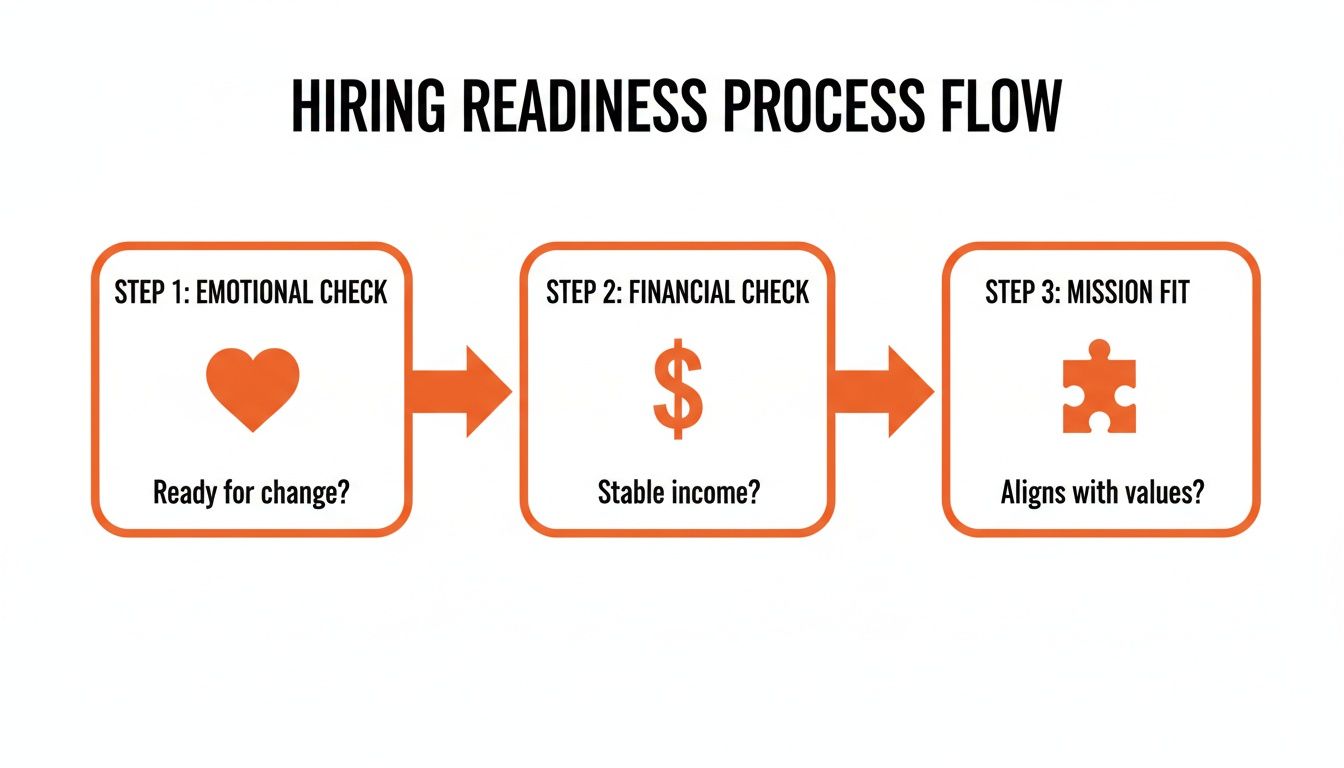
This is where so many founders trip up. You see the financial part as the only hurdle but completely miss the emotional and cultural pieces of the puzzle.
The Emotional and Financial Reality Check
Leading is a whole different ballgame than doing. Are you genuinely prepared to manage someone, mentor them, and be responsible for their livelihood? That shift can be an emotional gut punch if you're not ready.
Then there's the money. It goes way beyond salary.
Here’s a quick reality check for you:
- Salary is just the start. You have to factor in payroll taxes, any benefits you might offer, and the cost of the tools they'll need. Think laptop, software, the works.
- You need a runway. My rule of thumb is to have at least 4-6 months of their total cost (salary + taxes + overhead) socked away before you even think about making an offer.
- Cash flow is king. That big new project might cover their salary for a couple of months, but what happens after that? You absolutely need consistent, predictable revenue.
Getting this balance right between your head, your heart, and your bank account is the real first step. It’s what turns your first hire from a panicked decision into a smart investment in growth.
Figuring Out the Role Before You Find the Person
Okay, you're ready. The biggest mistake you can make right now is jumping straight to writing a job post for a "startup ninja" or a "growth hacker." Trust me, that's a one-way ticket to a bad hire. Vague roles attract candidates who are okay at a lot of things but not great at the one thing you desperately need.
Before you think about a person, get crystal clear on the role. This isn't about a wish list. It's about doing a brutally honest audit of your own time and your business's biggest logjams.

Run a Ruthless Task Audit on Yourself
I want you to track everything you do for one full week. Every. Single. Task. Use a spreadsheet, a notebook, whatever—just get it all down.
At the end of the week, sort every task into three buckets. This is non-negotiable. It’s what separates a smart hire from a panic hire. It takes you from just feeling overwhelmed to actually understanding why.
The point of this audit isn't just to see what you do. It's to figure out what you need to stop doing, forever. You're buying back your own time to focus on things only a founder can do.
Here are the three buckets you'll use:
- Bucket 1: The Founder Zone. These are tasks only you can do. We're talking setting the vision, talking to investors, building key partnerships, and making final product calls.
- Bucket 2: The Drain. These are the tasks you absolutely hate. They suck the life out of you, and you probably procrastinate on them like crazy. For me, this was always bookkeeping and handling the same five customer service questions over and over.
- Bucket 3: The Growth Blocker. These are important things that would grow the business but you just don't have the hours in the day to do them. Think consistent social media, proactive sales follow-ups, or building a real customer onboarding process.
Your first hire? Their job is made up entirely from tasks in Buckets 2 and 3. That’s it. Those two buckets are your roadmap.
Go from Your Audit to an Actual Job Description
Now, look at all the tasks in "The Drain" and "The Growth Blocker." What’s the common thread? Is it mostly customer emails and logistics? Is it all content creation and social media?
That theme is your job title. Don't call them a "Business Operations Associate" if you really need a "Customer Success & Fulfillment Coordinator." Specificity is your friend—it attracts people who are actually good at the work.
A great job description isn't a boring list of duties; it's a sales pitch to a problem-solver. Here's how I build mine:
- Start with the Mission: Kick it off with a single paragraph about what your company is trying to do. Get them excited.
- Describe the Problem: Be honest about the challenges from your audit. "We're fantastic at creating our products, but we're dropping the ball on delivering a world-class experience after someone clicks 'buy'."
- Define Their Mission: Frame their job as a mission. "Your mission, should you choose to accept it, is to take complete ownership of our post-purchase journey, making sure every customer feels taken care of."
- List 3-5 Key Outcomes: Ditch the long laundry list of responsibilities. Tell them what success looks like in six months. "Cut customer support tickets by 30%" or "Hit a 99% on-time fulfillment rate."
This method attracts people who want to make an impact, not just collect a paycheck. Defining the role clearly is the first domino. If you want to get better at making these kinds of calls, you might like our article on building a solid framework for making decisions in your business.
To get started, you can use a simple framework to analyze your weekly tasks.
Task Audit Framework for Your First Hire
| Task Category | Description | Example for an Ecommerce Brand |
|---|---|---|
| The Founder Zone | Vision, strategy, fundraising, key partnerships—high-leverage tasks only you can do. | Finalizing new product designs, meeting with a potential retail partner. |
| The Drain | Repetitive, low-skill, or energy-sucking tasks you dread doing. | Answering repetitive customer emails, managing inventory spreadsheets. |
| The Growth Blocker | Important tasks for growth that you consistently lack the time to execute properly. | Creating daily social media content, proactively following up on abandoned carts. |
Once your table is filled out, the combined tasks from "The Drain" and "The Growth Blocker" columns become the foundation of your job description.
But… Can You Actually Afford Them?
You've defined the role. It feels right. Now for the cold, hard math. Hiring your first person is a massive financial step, and you can't just look at their salary.
A good rule of thumb is that the true cost of an employee is 1.25x to 1.4x their base salary. This is the "fully loaded" cost. It includes all the stuff first-time founders forget.
- Payroll Taxes: You have to pay employer contributions for Social Security, Medicare, and unemployment insurance.
- Benefits: Even if you skip health insurance for now, you’ll likely have requirements like workers' compensation insurance.
- Tools & Equipment: They’ll need a laptop, software licenses, maybe a desk. It adds up fast.
Before you post the job, build a simple 12-month cash flow projection. Plug in your realistic revenue and current expenses, then add the fully loaded cost of this new hire. If looking at those numbers makes your stomach turn, you might not be ready.
Hiring a great person when your company's finances are shaky is a recipe for disaster—for both of you.
Sourcing and Vetting Your First Candidates

Alright, you've got a crystal-clear role. Now for the hard part: finding the person. My advice? Don't immediately jump on the big job boards. Posting a job on a huge platform is like trying to have a quiet conversation in a hurricane. You'll get blasted with noise and, if you're lucky, find one person who can actually hear you.
Your first hire is way too important for an algorithm. Start with people you already know and trust.
Tap Your Network First—It's a Goldmine
Think of your network not just as contacts, but as a pre-vetted talent pool. A warm referral from someone you respect is worth a hundred cold applications. These people come with a built-in character reference, which is invaluable when you're a team of one.
But "tapping your network" is fuzzy advice. Let's make it real.
- Be incredibly specific in your ask. Don't just say, "I'm hiring!" People can't help if they don't know what you need. Send a personal message with a one-paragraph summary of the mission and the top 2-3 outcomes for the role.
- Target the right people. Who in your network knows smart, resourceful people? Other founders? Former colleagues you admired? That super-connector friend who knows everyone?
- Make it easy for them. Include a short, forwardable blurb about the role they can copy and paste. You're removing the friction, making them far more likely to make an intro.
This direct approach filters for quality over quantity from the get-go.
Your goal isn't to get the most applicants; it's to get the right applicants. A single stellar referral is infinitely more valuable than a pile of 200 mediocre resumes. Focus your energy where it has the highest return.
Crafting a Job Post That Does the Vetting for You
Eventually, you might need to post your job publicly. Your job description needs to do more than list duties—it should actively attract the right mindset and gently repel the wrong one. Think of it as a bouncer for your company culture.
As a solo founder, you're competing in a tough market. A recent report revealed that a seasonally adjusted 33% of small business owners had unfilled jobs, and a staggering 91% of those trying to hire reported few or no qualified applicants. This talent crunch means a boring job post is a death sentence. You can read the full report from NFIB to see just how crucial it is to stand out.
So, how do you do that? Inject your brand's personality into it.
- Tell a story, don't just list tasks. Use the "mission" and "problem" language we talked about earlier.
- Be radically honest. Talk about the challenges. Mention they'll be working directly with the founder and that things can be messy. The right person will be energized; the wrong one will self-select out.
- Show, don't just tell, your values. If you value kindness and hard work, weave those words into the description.
Your job post is your first real test of culture fit. Make it count.
The Interview Is About Resourcefulness, Not Resumes
Once you have a few promising candidates, the real vetting begins. Forget the classic, "What are your greatest weaknesses?" questions. They're useless. You're not hiring for a corporate giant; you're hiring a co-builder. You need to test for resourcefulness, ownership, and alignment.
My process is built around questions that reveal how someone thinks, not just what they've done.
Here are a few of my go-to questions:
- "Tell me about a time you had to solve a problem with almost no resources. What was the problem, and how did you tackle it?" This uncovers scrappiness. Startups run on fumes and ingenuity; you need someone who thrives in that environment.
- "Imagine it's three months into this role, and you've been wildly successful. What does that look like? What have you accomplished?" This tests if they truly understand the role's mission and can think in outcomes, not just tasks.
- "What's a piece of feedback you've received that was difficult to hear? How did you handle it?" This reveals their self-awareness and coachability. Your first employee has to take direct feedback without getting defensive.
Listen for the "how" in their answers. Are they talking about taking initiative and learning? Or are they blaming others and waiting for instructions?
The Ultimate Test: The Paid Project
Interviews are great, but they're still just talk. The single most effective vetting tool I've ever used is a small, paid test project.
This isn't "free work." It's a real, paid engagement that mirrors the work they'd actually be doing. For a customer success role, it might be answering five real (anonymized) support tickets. For a marketing role, it could be drafting one email and a few social posts for a launch.
Here’s why this is magic:
- It reveals their true skill level. Can they actually do the work to the standard you need?
- It shows you their work ethic. Do they meet the deadline? Do they ask smart questions?
- It simulates working together. You get a real feel for their communication style.
A two-hour paid project will tell you more about a candidate than five interviews ever could. It cuts through the fluff and gets straight to what matters: can they deliver?
You’ve found your person. The interviews were fantastic, their paid project was top-notch, and you can actually picture them building this thing with you.
This is a big moment, and it’s a delicate dance. You want to show your excitement without coming across as unprofessional or desperate.
I always make the initial offer over the phone. It’s far more personal. You get a real conversation and can gauge their reaction. Keep it simple and direct—don't ramble. Lead with your genuine excitement, clearly state the position and the salary, and then just… pause. Give them a moment to take it in.
Right after you hang up, send a formal offer letter. This isn't a nice-to-have; it's a critical document that prevents a world of misunderstanding. Think of it as a clear, one-page summary of the most important terms.
Your offer letter should nail down these key points:
- The official job title.
- The agreed-upon compensation, whether that’s salary or hourly.
- Their expected start date.
- A quick, high-level summary of their main responsibilities.
- Any contingencies, like passing a background check.
Getting this in writing ensures you're both on the exact same page from day one. No confusion, no "but I thought you said…" conversations.
The Paperwork and Legal Labyrinth
Alright, now for the part that gives most founders a headache: the legal and financial setup. It can feel like staring at a mountain of red tape, but it’s really just a series of small steps.
Trust me, getting this right from the beginning will save you from monumental headaches (and potential fines) later.
First, you have to get clear on a crucial distinction: employee versus independent contractor. Misclassifying your first hire is one of the most expensive and common mistakes you can make. The IRS really doesn't like it when businesses treat employees like contractors just to skip payroll taxes.
The real difference boils down to one word: control. If you dictate how, when, and where they do the work, they are almost certainly an employee. If they have significant control over their own process and schedule, they might be a contractor. When in doubt, err on the side of classifying them as an employee.
To make it even clearer, here’s a quick comparison to help you figure it out.
Employee vs Contractor Key Differences
| Factor | Employee (W-2) | Independent Contractor (1099) |
|---|---|---|
| Control | You set the hours and direct the work. | They control their own schedule and methods. |
| Tools | You provide the primary equipment (laptop, etc.). | They use their own tools and equipment. |
| Financials | You handle payroll taxes and withholdings. | They are responsible for their own taxes (self-employment tax). |
| Relationship | The role is intended to be ongoing. | The relationship is typically project-based. |
Sorting out the correct classification is non-negotiable. Once that's done, you can move on.
Your Legal To-Do List
Once you’ve determined your new hire is an employee, it’s time to get your business ready to pay them legally. This checklist will get you started, but I always recommend chatting with a professional to make sure you’re buttoned up on local laws.
- Get an Employer Identification Number (EIN). You need this from the IRS to report taxes. If you don't have one, you can apply online for free. It’s surprisingly quick.
- Register with Your State. You’ll need to register with your state's labor and tax departments for things like state unemployment insurance (SUI) and income tax withholding.
- Choose a Payroll Provider. Please, do not try to do payroll yourself. It’s a messy web of calculations and deadlines. Services like Gusto or Rippling make this almost painless for a reasonable fee. They handle tax payments, filings, and direct deposits, which is a massive weight off your shoulders.
For a deeper dive into managing your business finances, you might find it helpful to read about how to pay yourself from your business. Many of the same principles apply.
Setting up the backend isn't the glamorous part of hiring, but it's the foundation for sustainable growth. Getting these pieces in place frees you up to focus on what really matters: bringing your new team member on board.
Onboarding for Culture and Long-Term Success
You did it. You found the perfect person, they signed the offer, and all the legal stuff is handled. Now what?
All that hard work can completely unravel in the first week if you botch the onboarding. A terrible first impression is almost impossible to reverse.
The first week isn't about throwing tasks at them; it’s about setting the tone for your working relationship. Think of your new hire as a seed you’ve just planted. You can't just toss it in the dirt and expect it to grow. You need to create the right environment—good soil, sunlight, and water from day one.
Your goal is to make them feel like a crucial part of the journey, not just a hired hand.
Culture, Clarity, and Connection
A great onboarding process goes way beyond setting up a laptop. It boils down to three things that build a foundation for long-term success.
Get these right, and you're not just getting them to work; you're getting them invested.
We'll break this down into a practical 30-day plan that moves from broad immersion to specific, tangible contributions.
- Culture: How do you immerse them in your brand’s mission and values? They need to understand why you do what you do, not just what to do.
- Clarity: How do you provide absolute, undeniable clarity on their role and what success looks like? Ambiguity is a progress killer.
- Connection: How do you help them build a strong relationship with you and any key partners? In a tiny company, this is everything.
This isn’t just a nice-to-have. It’s a strategic imperative. The current small business climate adds another layer of pressure. Small business employment actually fell by 49,100 jobs over the last year, a -0.38% drop.
Making sure your new hire sticks around is more critical than ever. You can read the full QuickBooks Small Business Index Annual Report to see just how crucial retention is in this market.
Your First Week Welcome Plan
Day one sets the stage. Don't just point them to a desk and tell them to read documents. Create a memorable experience. A simple "Welcome Kit" can work wonders.
This isn't about expensive swag. It’s about thoughtfulness.
- A handwritten welcome note from you. Seriously, this matters.
- A company t-shirt or mug.
- A list of your favorite local lunch spots.
- The login details they'll need, printed and ready.
The first week should be about learning and listening, not just doing. Schedule time to walk them through your company’s story, the "why" behind your brand, and who your customers are.
This is your chance to show them what it means to be part of the team. As a founder, your ability to be open and honest here is a superpower. Demonstrating vulnerability in leadership builds trust faster than anything else.
The 30-60-90 Day Roadmap
Once they're settled, give them a roadmap. The 30-60-90 day plan is a classic for a reason: it works. It breaks down their role into manageable, outcome-focused chunks.
This plan isn't a list of tasks. It's a series of missions. Your job is to define the 'what' and the 'why,' giving them the autonomy to figure out the 'how.' This fosters ownership from the very beginning.
Here's a simple template you can adapt:
- First 30 Days (Learning): The goal here is total immersion. They should focus on learning your systems, understanding your customers, and building relationships. A key outcome might be: "Independently handle 10 common customer support inquiries without assistance."
- Next 30 Days (Contributing): Now they start taking ownership of a core process. They’re moving from learning to doing. An outcome could be: "Document and streamline the order fulfillment process, identifying one area for improvement."
- Final 30 Days (Owning): By now, they should be operating with more independence and starting to think strategically. A great outcome is: "Propose and begin executing a small project that aligns with their core responsibilities."
This structure provides clarity and helps you both track progress without awkwardness.
Finally, establish a weekly check-in rhythm. This is non-negotiable. A dedicated 30-minute chat each week to discuss wins, roadblocks, and priorities is vital. This isn't micromanagement; it's open communication. It’s your chance to provide feedback, offer support, and ensure they feel seen, heard, and valued—the bedrock of a successful and lasting hire.
Still Have Questions? Let's Cover a Few Common Ones

Thinking about bringing on your first employee is a huge step, and it kicks up a ton of questions. I get it. Even after laying out the whole playbook, there are always those nagging "what ifs."
These are the most common questions I hear from other founders, so let's get right into them.
When Is the Right Time to Hire My First Employee?
Look, feeling overwhelmed is the default setting for a founder. That's not the signal.
The real signal is when you're consistently turning down revenue because you physically can't handle any more customers or projects. It’s that moment of painful clarity when you realize your own bandwidth is the bottleneck to growth.
If you can point to specific, repeatable tasks that would immediately free you up for high-value work like sales or product development, it’s probably time. On the financial side, my rule is to have at least 4-6 months of their total cost—salary plus all the extras—in the bank before you even post the job.
Hiring out of desperation is a recipe for disaster. It leads to rushed decisions and bad fits. You should be hiring with a clear, strategic plan for how this person will generate more value than they cost. Think of it as an investment, not just an expense.
Should My First Hire Be a Generalist or a Specialist?
This is a classic startup dilemma. The answer isn't a simple "either/or."
What you're really looking for is what I call a "specializing generalist." It sounds like a contradiction, but it’s the exact archetype that thrives in an early-stage company.
Think of it like a utility player in baseball who has one position they truly excel at. You need someone with a core skill you desperately need right now—maybe that's running email campaigns or managing logistics. That's their primary value.
But they also have to be adaptable and willing to wear different hats. You need someone who can solve today's biggest fire while being flexible enough to tackle whatever pops up tomorrow.
- Who to hire: A "specializing generalist" who is fantastic at Task A, but happy to jump in on Tasks B and C.
- Who to avoid: A pure "jack-of-all-trades" who isn't truly great at anything.
- Also avoid: A hyper-specialist who refuses to step outside their narrow job description.
In the beginning, everyone needs to be willing to metaphorically take out the trash. Your first hire sets that cultural tone.
What Is the Biggest Mistake to Avoid With a First Hire?
I’ve seen this happen more times than I can count: founders hire a clone of themselves. You might think getting another "you" is the key to getting more done, but what you actually need is someone who fills your gaps. It's about building a complete puzzle, not just adding more of the same piece.
If you're a visionary product person, you probably need an operator who obsesses over the details you hate. If you live and breathe operations, you might need a people-person focused on sales and customer relationships. Hiring for complementary skills is the single most important thing to get right.
The second biggest mistake? Severely underinvesting in onboarding. You can't just toss them into the deep end and expect them to swim. A structured, thoughtful onboarding process is your responsibility, and it's absolutely critical for setting them—and your company—up for success.
At Chicago Brandstarters, we know these challenges are real because we live them. We’re a community of founders sharing honest stories and practical advice to help each other grow. If you’re building a brand in Chicago and value kindness and hard work, we’d love for you to join us. Learn more about our community and how we can support your journey.
Leave a Reply