When you think about branding, your mind probably jumps to logos and taglines. But that's like starting a movie in the middle. Before we touch a single design, you and I need to get one thing straight.
Your Brand Is More Than Just a Logo
A brand is the gut feeling someone has about your product. I learned this the hard way years ago, thinking a slick design was all it took. Trust me, it isn't.
Your brand is really what people say about you when you're not in the room. Think of it as a promise you make and then keep, over and over. To build something that lasts, you have to start with your 'why.'
Digging for Your Brand’s Foundation
Imagine you're building a skyscraper. You can't just start stacking floors; you have to pour a massive concrete foundation first. This phase is that deep dig. We're nailing down the core beliefs that will become the compass for every decision you make from now on.
I break this down into three simple, powerful questions:
- Your Mission: This is your why. What problem do you exist to solve? For my community, Chicago Brandstarters, our mission is to help kind, hardworking founders build successful companies because we believe they'll make the world better.
- Your Vision: This is your where. If you knock it out of the park, what does the future look like? Our vision is a Chicago filled with bold, kind millionaires who give back to their communities.
- Your Values: These are your non-negotiables. What principles guide how you act? For us, it’s just two things: boldness and kindness. Everything we do has to pass through that filter.
Your brand's soul is built on these three pillars. When your actions consistently reflect your mission, vision, and values, you start building something incredibly powerful: trust. Without it, you’re just another box on the shelf.
Trust isn't some fluffy nice-to-have; it's your branding superpower. A staggering 81% of consumers say they need to trust a brand to even consider buying from it, and 68% will happily pay more for that trust.
The flip side? Trust is fragile. A recent study found that 37% of people ditched a brand over trust issues in the last year alone. You can find more of this data in the 2025 Consumer Trends Index.
This whole process is about learning how to define your purpose, build on that foundation, and truly resonate with the right people.
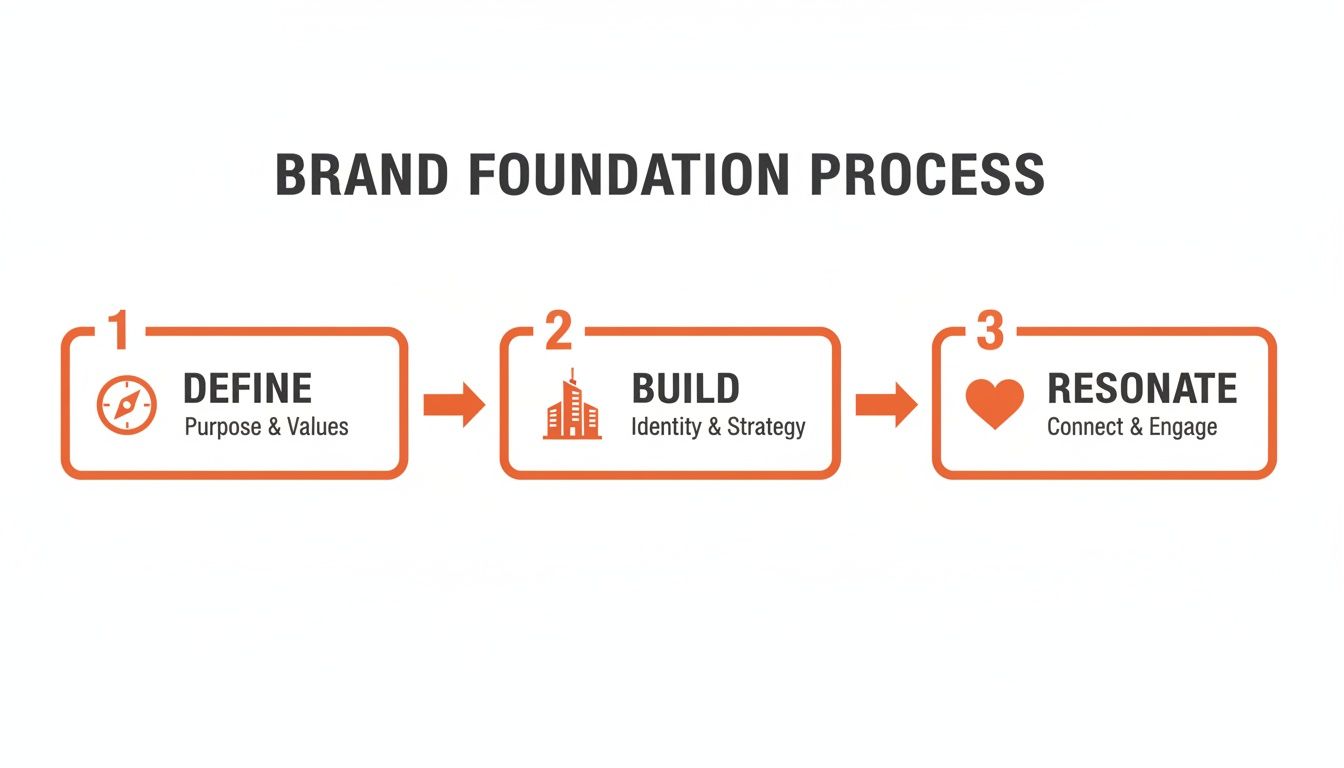
As you can see, a strong brand foundation isn't an accident. It's a deliberate process of figuring out your purpose before you start building. This alignment is what creates an authentic connection that makes customers stick around and sets you apart from everyone else.
To see how this plays out with real companies, check out our guide on examples of product differentiation.
Find Your People and Understand Their World

Okay, you’ve wrestled with the big questions and have a sense of your brand's soul. Now comes a question that’s just as critical: who are you even building this for?
A ton of founders fall into the "my product is for everyone" trap. That’s a fast track to building a brand that feels generic and, ultimately, connects with no one. You have to get specific. Radically specific.
The goal is to know your ideal customer so intimately that your branding feels like it was personally crafted just for them. This isn't about surface-level stuff; it's about getting inside their head.
Go Beyond Basic Demographics
Demographics—age, gender, location—are just the starting line. They don't tell you the real story. Think about it: two people can have the exact same demographic profile but be complete opposites in what they value or how they shop.
This is where you need to put on your detective hat and dig into psychographics. It’s not some fancy marketing term; it's just about understanding the actual human being behind the data. You're looking for the emotional triggers that steer their decisions day in and day out.
Start by asking yourself questions like these:
- What are their biggest hopes and dreams? What are they trying to achieve in their life or career?
- What keeps them up at night? Uncover the real fears and anxieties tied to the problem you're solving.
- What are their daily frustrations? Pinpoint those little pebbles in their shoes that your product can pull out.
- Who do they admire and look up to? Understand their influences—is it a specific thought leader, a community, a type of artist?
Building a brand for a specific "somebody" instead of a generic "everybody" is the secret to creating a loyal tribe. When you speak directly to their problems and aspirations, they don't just see a product; they feel seen.
This is the stuff that separates forgettable brands from those that build a passionate, ride-or-die following. You stop just selling a thing and start offering a solution to a real, human problem.
Creating Your Ideal Customer Profile
Now, let's make this real. It’s time to build out your Ideal Customer Profile (ICP). This isn't just a throwaway marketing exercise; it's a living document that becomes your brand's North Star.
Seriously, give this person a name. Find a stock photo that feels right. Write down their story.
Before you write a line of copy, approve a package design, or schedule a social media post, ask yourself: "What would [Your ICP's Name] think of this?" This simple check-in keeps your brand focused and consistent.
For example, at Chicago Brandstarters, our ICP isn't just "a Chicago founder." It's "Alex, the kind, hardworking side-hustler."
- Alex has a 9-to-5 but spends nights and weekends building their dream e-commerce brand.
- They feel totally isolated and get whiplash from all the conflicting advice online.
- They crave genuine connection, not transactional networking events.
- Their biggest fear isn't failing—it's looking back in 10 years and regretting they never even tried.
Getting this granular allows us to build a community and create content that speaks directly to Alex’s world. We know their struggles because we’ve taken the time to actually understand them. You have to do the same. This is how your brand starts feeling personal and trustworthy, laying the groundwork for a loyal customer base from day one.
Weave Your Brand Story and Core Message
Facts and figures have their place, but they don't make anyone love your product. Stories do. You’ve already done the hard work of figuring out why you exist and who you’re for. Now it’s time to weave those truths into a narrative that grabs people by the heart.
This isn’t about spinning some fairy tale. It’s about being honest about your story and framing it in a way that creates a real, human connection. You’re not just moving units; you're inviting people into a story where they get to be the hero.
Your Customer Is the Hero, Not You
I want you to forget about being the star for a minute. Seriously. The most powerful brands on the planet all know a simple secret: the customer is the hero, not the brand.
Think of your brand as the wise guide in a movie—the Yoda, the Gandalf, the Mr. Miyagi. You have the tool, the plan, or the wisdom that helps the hero (your customer) beat their challenge and win the day. This shift in perspective changes absolutely everything about how you talk to people.
It’s a classic framework called the hero's journey, and it’s a killer way to structure your brand message. It goes something like this:
- A Hero (Your Customer): They have a problem they desperately need to solve.
- Encounters a Guide (Your Brand): You pop up, showing you get their struggle and have a plan.
- Who Gives Them a Plan (Your Product): You offer a clear path to get them where they want to go.
- And Calls Them to Action (Your Marketing): You give them a clear, simple first step to take.
- That Helps Them Avoid Failure: You remind them what’s at stake if they do nothing.
- And Ends in Success: You paint a crystal-clear picture of what their life looks like after they win.
When you frame everything this way, your brand stops being about what you do and starts being about what your customer can finally achieve with your help. It’s a small tweak, but it makes a world of difference.
Nail Your Core Message and Tagline
Okay, with that story in your head, you can now boil it all down into a single, powerful core message. This is your one-liner. Your elevator pitch. It’s the one idea you want to own inside your customer’s mind.
Imagine you’re at a coffee shop trying to explain your brand to a friend. You don’t have time for corporate jargon or a 10-minute speech. It needs to be clear, punchy, and stick.
Your core message should quietly answer three questions:
- What problem are you solving for me?
- How do you solve it?
- How is my life going to be better after?
For a meal-kit service, the core message isn't, "We deliver pre-portioned ingredients." That’s boring. It's something more like, "We help busy professionals cook delicious, healthy meals at home without all the stress of planning and shopping." See the shift? The first is about the company; the second is about the customer’s transformation.
Your tagline is the super-short, poetic version of your core message. It's the hook. Nike's "Just Do It" isn't about sneakers; it's about unleashing the hero inside you.
Build Out Your Messaging Hierarchy
Once you’ve got your core message and tagline locked in, you can build out your messaging hierarchy. This is just a fancy way of saying you need a set of key talking points to use everywhere—from your website to your social media bios. It keeps you consistent.
Think of it as a pyramid.
- Top (The Tagline): The emotional, memorable hook.
- Middle (The Core Message): The one-sentence summary of your value.
- Base (The Talking Points): Three to five key points that back up your core message with more detail. These might touch on specific features, benefits, or what makes you different from everyone else.
Having this hierarchy makes sure that no matter where someone bumps into your brand, they hear the same clear, consistent story. That consistency is how you build recognition and trust, one interaction at a time. If you want to see how this plays out in the wild, we've got an article covering some excellent brand positioning examples that really bring this to life. This simple structure is your secret weapon for crafting a story that actually sticks.
Design Your Visual Identity for Lasting First Impressions

Alright, now for the fun stuff—the visuals. This is what you probably pictured when you heard "branding," but we’re doing it the right way: with a solid strategy already in place.
Your visual identity is basically your brand's uniform. It’s everything people see: your logo, your colors, your fonts, your photos. Like any good uniform, it needs to be instantly recognizable and tell people who you are before you even say a word.
This isn't about just picking your favorite color or a cool-looking font. Every single choice has to tie back to your brand's soul and connect with the world of your customers. The goal is a killer first impression that feels both authentic and intentional.
The Psychology of Color and Shape
Before you fire up a design tool, it helps to know a little about the psychology behind this stuff. People have subconscious feelings about certain colors and shapes, and you can absolutely use that to your advantage. It’s like picking the right soundtrack for a movie scene—you're setting the mood.
For example, blues tend to signal trust and dependability (think banks and big tech), while reds can spark feelings of excitement or urgency. Greens are connected to nature, health, and money. These aren't unbreakable rules, but they're powerful shortcuts for communicating your brand's personality.
The same thing goes for shapes. Rounded, curvy shapes often feel friendly and warm. Sharp angles and straight lines can communicate strength, stability, and efficiency. When you pick a logo shape and font that align with these ideas, you’re baking your brand’s personality right into its DNA.
The real magic happens when you combine these elements. A brand going for an "organic luxury" vibe might pair a deep forest green with a soft, elegant serif font and a logo inspired by something from nature. It all works together to tell the same cohesive story.
This consistency is what separates a professional brand from an amateur one. It’s also the secret sauce for getting remembered in a crowded market. It takes an average of 5-7 impressions for someone to even begin to recognize a brand, and consistency is responsible for a whopping 38.7% of total brand lift. On top of that, 59% of global shoppers would rather buy new products from brands they already know and trust. You can dig deeper into these brand recognition findings if you're curious.
Your Minimum Viable Brand Checklist
As a founder, you don't need a hundred-page brand book right out of the gate. You just need the essentials, done right. I call this the Minimum Viable Brand (MVB). It’s the core set of assets you need to launch with confidence, look like you know what you’re doing, and keep everything consistent.
The goal here isn't perfection; it’s a professional and cohesive start. You can always tweak things later as you learn more about your customers and your business grows.
Below is a checklist of the bare essentials you need to look professional and stay consistent right from your launch.
Your Minimum Viable Brand Checklist
| Asset | Purpose | Key Considerations |
|---|---|---|
| Simple, Memorable Logo | The face of your brand. | Needs to be scalable (look good tiny or huge). Avoid trendy designs that will look dated in a year. |
| Basic Color Palette | Sets the mood and ensures consistency. | Pick 1-2 primary colors, 1-2 accent colors, and a neutral (like dark gray) for text. |
| Clear Typography Pairing | Makes your content readable and adds personality. | One font for headlines (personality) and one for body text (readability). Two fonts max. Google Fonts is your friend. |
| Simple Style Tile | A one-page cheat sheet for your brand visuals. | Puts your logo, colors, and fonts in one place. Your quick reference to keep everything consistent. |
| Compelling Launch Page | Your digital storefront before you even launch. | A simple landing page to show off your new brand and start building an email list. |
This checklist is your starting point—the non-negotiables for a strong launch.
You don't need a massive budget for this, either. You can get surprisingly far with DIY tools like Canva, or find great, affordable designers on platforms like Upwork or Dribbble. Just make sure you give them a clear brief based on all the brand foundation work you've already done. That’s how you brand a product effectively from day one.
Launch Your Brand and Build a Loyal Community

Alright, you've done the heavy lifting. Your brand has a soul, a story people can connect with, and a visual uniform that looks sharp. But a brand doesn't truly exist until it starts interacting with real people.
This final stage is all about putting your brand out into the world. It’s about that first hello, that first sale, that first bit of customer feedback. This is where all your theory meets reality.
Forget about million-dollar ad campaigns. I want to focus on practical, low-cost ways to launch that actually work for founders who are just starting out. The goal isn't to be everywhere at once; it's to be somewhere that matters, with the people who will become your first true fans.
Go Where Your People Already Are
Your ideal customers are already hanging out somewhere online. They're in specific Facebook groups, Subreddits, Slack communities, or maybe they all follow the same few accounts on Instagram. Your job isn't to drag them to your doorstep; it's to go meet them where they live.
Think of it like being new in town. You don’t stand on your front porch shouting, “Come be my friend!” You go to the local coffee shop, the park, the neighborhood meetup. You show up, you listen, and you contribute to conversations that are already happening.
This means you need to spend way less time broadcasting and a lot more time engaging.
- Ask genuine questions. Don't just drop your product link and run. Ask for feedback on your packaging idea or your tagline.
- Share your hard-won insights. If you learned something the hard way, tell that story. People connect with vulnerability, not a perfect highlight reel.
- Answer other people's questions. Become a helpful, known presence in the community long before you ever ask for a sale.
Your brand launch isn't a single event; it's the beginning of a conversation. By showing up authentically and providing real value, you start building a community before you even have a customer.
Make Social Media Your Stage, Not Your Megaphone
Let’s be real, social media isn't optional anymore when you're figuring out how to brand a product. It’s your global stage. Some 77% of consumers prefer to shop from brands they follow on social, and 85% use these platforms to check out new companies before they buy.
This is a huge advantage for solo founders. You can directly share prototypes in active chats and get honest feedback without coming across as self-promotional.
The mistake I see so many founders make is using social media like a megaphone, just shouting about their features. Don't do that. Use it like a living room. Invite people in, start conversations, and make them feel like they're part of your journey.
Create a Feedback Loop From Day One
Your first customers are your most important asset. They aren't just transactions; they are your feedback engine. They're the ones who will tell you what's working, what's confusing, and what they secretly wish your product could do.
You need to create a simple system to capture this feedback and actually act on it. This doesn't have to be complicated.
- Follow up personally. After someone buys, send a personal email (not an automated one) a week later. Just ask how they're using the product and if they have any questions.
- Listen everywhere. Set up alerts for your brand name on social media and Reddit. See what people are saying when they don't think you're listening.
- Turn customers into advocates. When you get great feedback, ask that person if you can share it. When you get tough feedback, thank them for their honesty and tell them exactly how you plan to fix the issue.
This process turns your early customers into evangelists. They feel heard and valued, which makes them want to spread the word for you. A brand is a living, breathing thing, and this constant loop of listening and responding is how you nurture it and help it grow. For a detailed guide on your launch sequence, our product launch checklist template can provide a solid framework.
Your Top Product Branding Questions, Answered
As you start getting into the weeds of branding a new product, you’ll find a lot of specific questions pop up. These are the ones I hear constantly from founders in our community. Let’s get you some quick, honest answers to help you navigate the tricky parts.
How Much Should I Actually Budget for Branding?
This is the million-dollar question, isn't it? The real answer is: it completely depends on your stage. You absolutely do not need a $20,000 branding package when you’re just trying to get your first sale. Instead, focus on that "Minimum Viable Brand" we talked about earlier.
Think of your branding budget like a dimmer switch, not a hard on/off.
- Pre-revenue/Idea Stage: Your budget could honestly be near $0. Use free tools like Google Fonts, find a simple icon on a stock site, and use Canva to throw together a basic style tile. Your main investment here is your own time.
- Early Revenue (under $100k): Here, you might invest $1,000 to $5,000 to work with a freelancer on a more polished logo, a professional landing page, and some decent packaging design. This is all about leveling up your first impression.
- Growth Stage ($100k+): This is when it makes sense to bring in a small agency or a seasoned designer. Budgets can range from $10,000 to $25,000+ for a full brand identity system that can really scale.
The key is to spend what’s appropriate for where you are right now. Don't go into debt for a perfect logo before you've even proven people want your product.
Should I Trademark My Brand Name Immediately?
Trademarking is basically putting a legal fence around your brand name and logo. It’s important, but the timing is everything. Rushing to trademark too early can be a huge waste of money, especially if you end up pivoting.
I usually tell founders to follow this simple sequence:
- Do a "Good Enough" Search First: Before you fall in love with a name, do a quick and dirty search on the USPTO's TESS database, Google, and social media. If it’s obviously taken, just move on.
- Operate Without One (In the Beginning): For the first few months, while you're testing the market and getting those initial sales, it’s generally okay to operate without a registered trademark.
- File When You Have Real Traction: Once you have consistent revenue and you're confident this is the name, that's your cue. Hire a lawyer and get it filed.
Don't let the legal stuff paralyze you from actually starting. The biggest risk in the early days isn't someone stealing your name; it's building something nobody wants.
How Long Does It Take to Build a Recognizable Brand?
Building a brand is a marathon, not a sprint. There's no magic timeline, but you have to think in terms of years, not weeks. It all comes down to showing up, consistently, over a long period.
It’s like making a good friend. You don’t meet someone once and suddenly have a deep, trusting relationship. That bond is built through hundreds of small, consistent interactions over time. Your brand is no different.
Every email you send, every social media post, every customer service chat—it's all another brick in the foundation. Just keep showing up, keep your promises, and stay consistent. The recognition will follow.
If you’re a kind, hardworking founder in Chicago looking for a real community to navigate these challenges with, you should check out Chicago Brandstarters. We're a free, vetted group of peers who meet for small dinners and share honest advice in a private chat—no self-promoters allowed. Join us and build your brand with friends who get it. Find out more at https://www.chicagobrandstarters.com.
Leave a Reply