
Let’s talk about managing your cash flow. It's just keeping a close watch on the money coming in and going out of your business. It's the simple (but critical) practice that ensures you have enough cash in the bank to pay your bills, jump on growth opportunities, and handle any surprises life hurls your way.
Here’s the hard truth: Profit on paper doesn't pay your bills; cash in the bank does.
Why Cash Flow Is Your Business's Lifeblood
As a founder, I know you're building something amazing, but the financial side can feel like a sudden storm. I’ve been there. I remember the near-misses with payroll and the surprise inventory bills that made my stomach drop.
Those moments teach you a vital lesson. Cash flow isn't just accounting jargon—it’s the oxygen your business needs to survive.
Think of your cash flow like the water level in a reservoir.
- Inflows: The streams and rivers filling it up. This is your money from customer payments and sales.
- Outflows: The water being used by the town. Think payroll, rent, inventory costs, and your marketing spend.
- Reserves: The water left in the reservoir. This is your cash balance, your buffer against a drought.
If your outflows keep outpacing your inflows, that reservoir will dry up. It doesn't matter how much rain you're forecasting for next season. This is the critical difference between being profitable and being cash-healthy.
The Profit vs. Cash Reality Check
I once worked with a founder whose e-commerce store was absolutely crushing it. His profit and loss (P&L) statement showed incredible growth, and he felt on top of the world. But just a few months later, he was scrambling, close to shutting down.
What happened? He landed a huge sale to a big retailer. He recorded that sale on the books, making the business look wildly profitable. The problem? The retailer had 90-day payment terms.
In the meantime, my friend had to pay his supplier upfront for the next production run. The profit was just a number on a spreadsheet; the cash wasn't in the bank.
This happens more than you'd think. You can be profitable on paper yet fail because you run out of cash to pay immediate bills. Mastering cash flow means you're not just looking at the scoreboard; you're managing the fuel in your tank.
To make this crystal clear, let's break down the key differences.
Profit vs Cash Flow at a Glance
| Concept | What It Means for You | A Real-World Ecommerce Example |
|---|---|---|
| Profit | The money your business makes after you subtract all expenses from revenue. It's an accounting measure of success over a period (like a quarter or year). | You sell $50,000 worth of products in a month. Your product costs, shipping, and marketing add up to $30,000. Your profit for that month is $20,000. |
| Cash Flow | The actual cash moving in and out of your bank account. It’s the immediate, real-time pulse of your company's financial health. | You made that $50,000 sale, but your client has 60-day terms. In the meantime, you had to pay your supplier $15,000 upfront. Your cash flow for that period is negative $15,000, even though you're "profitable." |
Simply put, profit is a long-term indicator. Cash flow is what keeps you in business day-to-day. You can't pay your employees with profit—you need actual cash.
You're Not Alone in This Struggle
If you're a founder pouring your heart into a new brand, you get it. You're busy building real connections through communities like Chicago Brandstarters, and then cash flow hits you like a Midwest winter storm.
It's a universal founder problem. Recent data shows a staggering 51% of small businesses grapple with uneven cash flows. It's their third biggest financial challenge.
It’s a stark reality check, especially when you see that more businesses are reporting revenue decreases than increases for the first time since 2021. It's tough out there, and managing your cash is the single best defense you have.
Building Your First Cash Flow Forecast (Without the Headache)
Forecasting. The word alone sounds intimidating, right? When I first started, it made me think of complex software and accounting degrees I definitely didn't have.
But I promise you, it’s not that bad. You can build a simple but incredibly powerful 13-week rolling cash flow forecast using just a spreadsheet. This is the exact method I used to get a real grip on my finances and start scaling. Let's walk through it together.
The Foundation: Your Inflows and Outflows
Think of your forecast as a simple map for your money over the next three months. It has only two parts: cash coming in (inflows) and cash going out (outflows).
Your goal isn't to perfectly predict the future. It’s to get clarity and create an early-warning system. This simple tool will help you spot potential cash shortages weeks ahead of time, letting you act thoughtfully instead of reacting in a panic.
This is the basic flow of how money moves through your business—from sales into your bank account, and then back out to cover all your expenses.
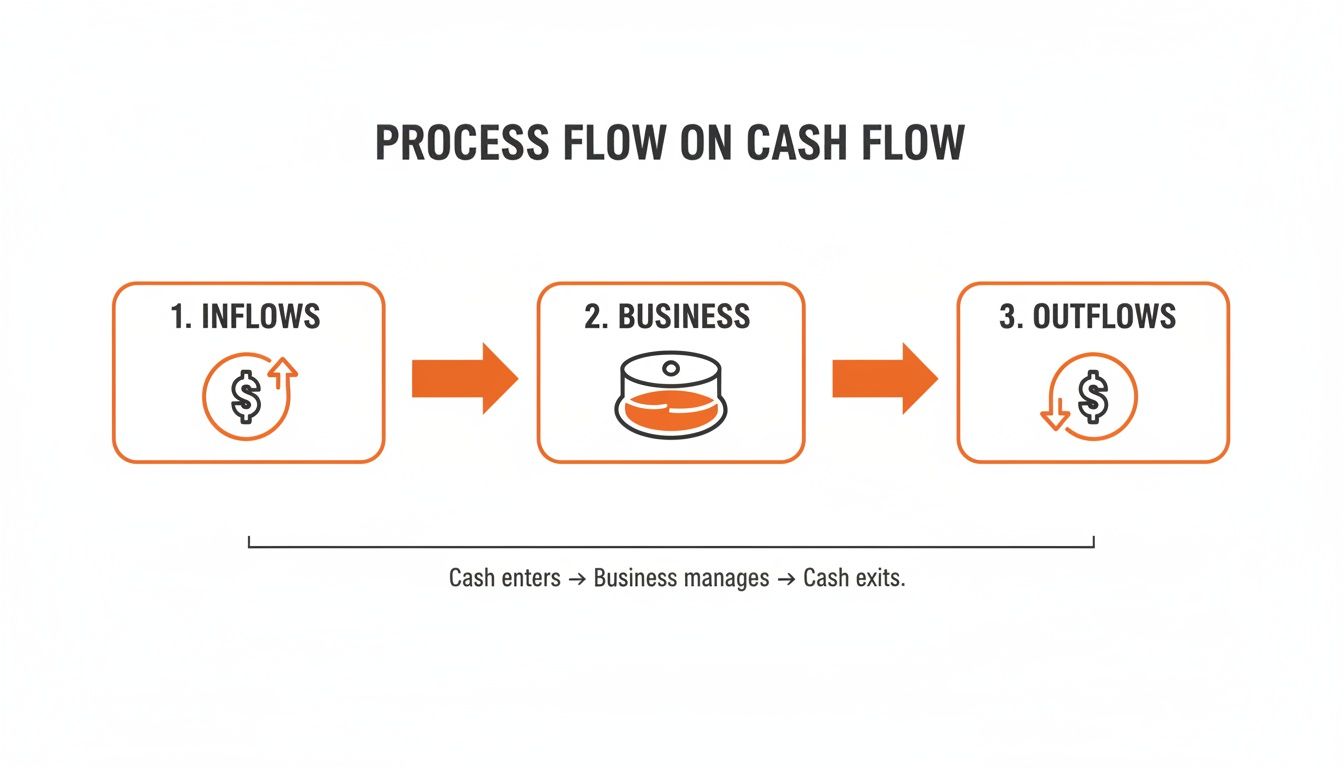
This process is why the timing of your inflows and outflows is so critical. Get it wrong, and you can be "profitable" on paper but have no cash in the bank.
Mapping Your Cash Inflows
First, let's map out all the cash you realistically expect to receive each week for the next 13 weeks. Be conservative. It's way better to be pleasantly surprised by more cash than dangerously optimistic about money that never arrives.
Here’s what you should plug into your spreadsheet:
- Product Sales: Dig into your historical data. What do you typically bring in each week? Factor in any upcoming promotions or seasonal lulls.
- Paid Invoices: List every single outstanding invoice and plug it into the week you genuinely expect the check to clear.
- Other Income: Are you getting a loan disbursement, a tax refund, or any other one-off cash infusions? Get them on the map.
This isn't just about guessing. Look at your past sales data from your payment processor or pull your bank statements. What did you make this time last year? What has the trend been for the last three months? Ground your estimates in reality.
Projecting Your Cash Outflows
Next, you’ll do the same thing for all the cash heading out the door. Honestly, this part is usually easier because so many of your costs are fixed or recurring. Just be brutally honest with yourself and don't leave anything out.
Your outflows will likely include things like:
- Payroll & Contractor Payments: The big one. A non-negotiable expense.
- Rent or Mortgage: Your fixed occupancy costs.
- Inventory & Supplies: When are your supplier bills actually due?
- Marketing & Advertising: Your weekly or monthly ad spend commitment.
- Software Subscriptions: All those little SaaS tools add up faster than you think.
- Loan & Credit Card Payments: Mark down the exact due dates and amounts.
It's a common founder war story: your brand is finally hitting its first revenue goals and you feel profitable, but cash is perpetually tight. You're not alone. Recent survey data shows that 31% of small businesses have only one to two months of cash reserves. Many successful brands operate on these razor-thin edges, completely vulnerable to just one late payment. Knowing your outflows is what saves you. You can learn more from the full report on Caflou.com.
My Personal Tip: Go through your business bank and credit card statements for the last three months. Categorize every single expense. I guarantee you'll find "cash leaks"—subscriptions you forgot about or expenses that aren't providing any real value—that you can cut immediately.
Once you have your inflows and outflows listed week by week, the magic happens. You just calculate your Net Cash Flow for each week (Inflows – Outflows) and your Ending Cash Balance. Suddenly, you have a clear line of sight into your financial future, one week at a time.
The Only Cash Flow Metrics You Actually Need to Track
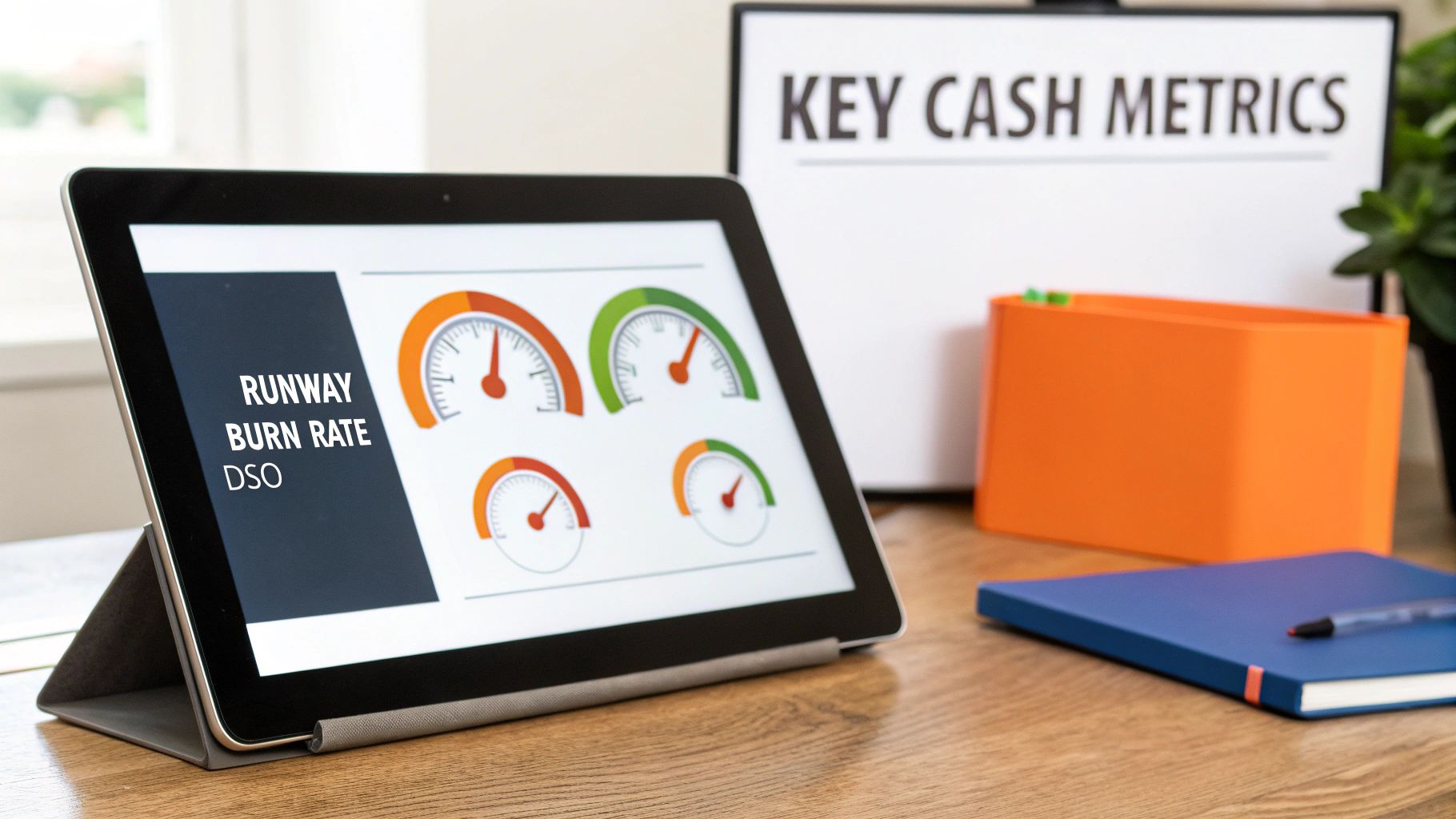
Alright, you’ve built your first cash flow forecast. Staring at that spreadsheet can feel both empowering and overwhelming. Let’s cut through the noise. I want to show you the handful of numbers that actually matter.
Think of it like driving a car. You don't need to be a mechanic, but you absolutely have to know how to read the fuel gauge and check your speed. These metrics are your dashboard.
I’ve seen too many founders get obsessed with vanity metrics that look good but don't mean a thing for the health of the business. Forget all that. We’re going to focus on three numbers that will give you a brutally honest reality check on your cash situation.
Your Cash Runway and Burn Rate
This is the big one. Your Cash Runway is your most critical survival metric. It answers a simple, often terrifying question: "If my revenue dropped to zero tomorrow, how many months could this business survive?"
It's your financial fuel gauge. Plain and simple.
To figure it out, you first need your Burn Rate—the total cash your business torches every single month.
Let’s run a quick example. Say you have $50,000 in the bank. After looking at your forecast, you know your total monthly expenses (payroll, rent, software, the works) are a steady $10,000.
- Your Cash Balance: $50,000
- Your Monthly Burn Rate: $10,000
- Your Cash Runway: $50,000 / $10,000 = 5 months
Boom. You have five months of runway. Knowing this number changes everything. It tells you when to cut costs, hammer down on sales, or start looking for funding—long before you’re in a panic. It gives you the space to be strategic, not desperate.
For an early-stage business, a healthy cash runway is typically three to six months of operating expenses. That buffer gives you the freedom to ride out a slow quarter or jump on a big opportunity without betting the farm.
Days Sales Outstanding (DSO)
While runway tells you how long your cash will last, Days Sales Outstanding (DSO) tells you how fast you’re getting paid. It’s the average number of days it takes you to collect cash after you've made a sale.
For anyone selling physical products, a high DSO is a silent killer.
Imagine you run an online apparel brand. You have to pay your manufacturer today for a huge order of t-shirts. But you sold that inventory to a retail partner on "Net 60" terms, meaning they won't pay you for two months. You’ve just created a massive cash gap. Your money is stuck in accounts receivable, completely useless to you.
Here’s a simplified way you can calculate it:
- Take your Total Accounts Receivable for a period (e.g., $30,000).
- Find your Total Credit Sales for the same period (e.g., $90,000).
- Divide Accounts Receivable by Total Credit Sales ($30,000 / $90,000 = 0.33).
- Multiply that by the number of days in the period (e.g., 0.33 x 90 days = 30 days).
Your DSO is 30 days. You want this number as low as humanly possible. A high DSO is a flashing red light that your cash is getting trapped somewhere between a sale and your bank account. Tracking this metric forces you to get serious about invoicing and collections, which directly pumps cash back into your business.
Getting Smart About Your Cash In and Cash Out
Knowing your numbers is one thing. Actually improving them? That’s where you win. Now we get into the real playbook—the moves you can make this week to get more cash in the door faster and be smarter about the cash going out.
These aren't complicated theories. They are practical adjustments to how you operate your business day-to-day. Think of it like tuning an engine. Small tweaks to your invoicing, supplier relationships, and spending habits can dramatically boost your financial horsepower.
Speeding Up Your Cash Inflows
The goal here is simple: shrink the time between when you do the work and when the money hits your bank. Every day you wait for a payment is a day that cash isn't working for you.
Here are a few tactics I've seen deliver results almost immediately:
- Offer a Small Discount for Paying Early: Try offering a 2% discount if a client pays an invoice within 10 days instead of the usual 30. That small hit to your margin is often worth getting the cash three weeks sooner.
- Require Deposits for Large Projects: For any big order or custom project, get at least 30-50% upfront. This is non-negotiable. It covers your initial costs, confirms the customer is serious, and immediately improves your cash position.
- Invoice Immediately and Follow Up Systematically: Don't wait until the end of the month. Send the invoice the moment the product ships or the service is delivered. Set up automated reminders for overdue payments—a polite but persistent follow-up system works wonders.
These small shifts in your process can dramatically cut down your Days Sales Outstanding (DSO) and inject vital liquidity back into your operations. It’s all about creating a system where getting paid quickly is the default, not the exception.
Getting Smarter About Your Cash Outflows
Controlling your outflows isn't about being cheap; it's about being intentional. Every dollar you spend should have a clear purpose. This is where you plug the hidden leaks in your financial bucket.
The reality for many founders is that costs are creeping up. A recent study found 86% of small businesses saw their expenses climb by about 11% on average, with surprise hits from labor, rent, and insurance. This squeeze makes smart outflow management a non-negotiable part of your survival strategy. You can dig into the full Relay report here to see the trends.
Your first move should be a ruthless audit of every recurring subscription. Seriously. Go through your bank statements line by line. I guarantee you’ll find at least one or two software tools you’re paying for but no longer use. Cut them immediately.
Beyond that, here are a few bigger levers you can pull:
- Negotiate Better Terms with Suppliers: Don't just accept the payment terms you're given. If you have a solid payment history, ask your key suppliers to extend your terms from Net 30 to Net 45 or even Net 60. This simple ask can create a crucial buffer for your own cash flow. I have some great tips on how to negotiate with suppliers effectively that can help you get started.
- Manage Inventory Like a Hawk: For product businesses, excess inventory is literally cash sitting on a shelf, collecting dust. Use your sales data to identify slow-moving products and run a promotion to liquidate them. Reinvest that cash into your bestsellers.
Your Cash Preservation Checklist
To put this all into action, I want you to build a simple checklist. This isn't a one-time task; it's a monthly or quarterly discipline. It keeps cash flow management for your small business top of mind.
Grab a piece of paper or open a new note and answer these questions honestly:
- Invoices: Did I send every single invoice out the same day work was completed?
- Receivables: Have I followed up on all invoices that are past due by more than 3 days?
- Deposits: Did I secure an upfront deposit for any new large orders this month?
- Subscriptions: Have I reviewed my software subscriptions and cancelled anything I don’t use?
- Supplier Terms: Have I tried to negotiate better payment terms with my top three suppliers?
- Inventory: Do I know which products are my slowest sellers and have a plan to move them?
- Discretionary Spending: Did I review all non-essential spending (like travel or marketing experiments) and confirm its ROI?
This simple audit forces you to confront the reality of where your money is going and where it's getting stuck. These are the tactical moves that separate the brands that make it from those that just look good on paper. They ensure your business has the cash it needs to not just survive, but to seize opportunities.
How to Handle Cash Gaps with Smart Financing
Look, even with a flawless forecast, cash gaps happen. It's a rite of passage for every growing business. The goal isn't to avoid them entirely—that's impossible. The key is having a smart, calm plan ready for when they show up.
This isn’t about hitting the panic button. It’s about being prepared. Let's talk about short-term financing without the confusing jargon so you know your options long before you ever need them.
Financing isn’t a sign you’re failing; it’s a tool. Think of it like a bridge you build over a temporary dip in the road. You don’t live on the bridge, but you’re damn glad it’s there when you need to get to the other side.
Understanding Your Short-Term Financing Toolkit
When cash gets tight, you have a few solid moves to bridge the gap. Each one works a bit differently, and the right choice depends completely on your specific headache.
Let's break down the main players.
A Business Line of Credit is my personal favorite for most small businesses. It’s like a credit card for your business bank account, but with much better rates. You get approved for a set amount—say, $25,000—but you only pay interest on what you actually draw.
It's the ultimate safety net. You can tap into it to cover an unexpected payroll shortfall or a big inventory buy, then pay it back as your customers pay you. The beauty is its flexibility; it's there when you need it and costs nothing when you don't.
Another powerful tool is Invoice Financing (also called factoring). This is a lifesaver if your biggest problem is waiting on big clients to pay. Instead of tapping your foot for 60 or 90 days, a financing company advances you up to 85% of the invoice amount right away.
They take a small cut, and you get the rest when your client finally pays them. It directly solves the "profitable on paper but broke in reality" problem. You’re basically selling your invoices to get your money faster.
The Strategic Role of Business Credit Cards
Then there’s the humble Business Credit Card. Don't sleep on this. When you use it strategically, it's a fantastic short-term cash flow tool.
I’m not talking about racking up long-term debt to cover losses. I’m talking about putting a large inventory purchase on a card with a 0% introductory APR. This can buy you several months to sell that inventory and generate cash to pay off the balance before a single cent of interest hits. It's a form of free, short-term financing if you’re disciplined. You can learn more about how this impacts your financial health by reading up on the essentials of building business credit.
The golden rule of financing is simple: Apply before you are desperate. Lenders want to lend to healthy businesses, not ones hanging on by a thread. The best time to secure a line of credit is when business is good and you don't actually need the cash.
Build Relationships Before You Need Them
This brings me to my most important piece of advice. Sometime this month, walk into your local community bank or credit union and open an account. Get to know the branch manager by name.
Big national banks often make decisions with algorithms. Local bankers build relationships. They get the local economy and are often way more willing to work with small businesses they know and trust.
When you eventually need that line of credit, you won’t just be a faceless application. You’ll be a local founder they’ve spoken to, someone they’re rooting for. That personal connection can make all the difference.
Here's a quick cheat sheet for your main options:
| Financing Option | Best For… | Key Consideration |
|---|---|---|
| Business Line of Credit | Ongoing, flexible access to cash for unexpected gaps and opportunities. | Build the relationship and get approved before you need the funds. |
| Invoice Financing | Businesses with long payment terms (Net 30/60/90) and reliable, large clients. | The fees can eat into your profit margins, so you have to do the math on the true cost. |
| Business Credit Card | Strategic, short-term purchases, especially when you can leverage a 0% APR offer. | Requires extreme discipline to pay off the balance before interest kicks in. |
At the end of the day, smart financing is a core part of effective cash flow management for a small business. It’s not about taking on bad debt. It's about having a plan, the right tools in your toolkit, and the relationships in place to navigate the inevitable ups and downs of building something great.
Bringing It All Together
You've made it this far, which tells me you're not just playing around. You're serious about building a business that lasts. The road from a passionate founder with a great idea to a financially savvy CEO is where you build real, sustainable companies. It's tough, but it's worth it.
Let's tie all these financial tactics back to why you started in the first place. Managing your cash flow isn't just about staring at spreadsheets; it’s about protecting your vision.
This is the hard, unglamorous work that gives you the freedom to make bold moves, take care of your team, and serve your customers without that constant, nagging financial stress in the back of your mind.
Your Quick-Start Action Plan
Look, mastering cash flow is a skill you build over time. It’s a discipline, not a one-and-done task. Every small step you take makes your business that much stronger.
Here are three things you can do right now to get started:
- Map Out Your Next 13 Weeks: Don't put this off. Seriously, open a spreadsheet this week and map out your best guess for cash coming in and cash going out for the next three months. Clarity is your most powerful weapon.
- Pick One "Get Paid Faster" Tactic: Just one. Will you offer a 2% discount for early payment? Or maybe start requiring deposits on all new projects? Pick one and implement it.
- Find One Thing to Cut: Go through your bank statements tonight. I guarantee you'll find at least one subscription or recurring expense you don't truly need. Cancel it. That small win builds momentum.
This whole journey is about progress, not perfection. Your first forecast will be messy. Your first attempt at negotiating with a supplier might feel awkward. That's okay. The simple act of doing it is what really counts.
You aren't alone in this. Every founder struggles with getting their finances in order, including figuring out things like how to pay yourself from your business. By focusing on these fundamentals, you’re not just managing money—you're building a business that can endure.
Your Top Cash Flow Questions, Answered
I get it. After you’ve mapped everything out, a few big questions usually pop up. Here are the direct answers to some of the most common ones I hear from founders wrestling with cash flow management for their small business.
How Often Should I Update My Cash Flow Forecast?
For any business just starting out, I’ll tell you straight: update it weekly. It might sound like a lot, but once you have your template, it’s a quick 15-minute check-in that can save you from a world of hurt.
Think of it like checking the weather before a big camping trip. That weekly glance prevents you from walking into a surprise thunderstorm without a raincoat. As you grow and your cash flow becomes more predictable, you can shift to bi-weekly. But never, ever go longer than a month.
What's the Biggest Cash Flow Mistake New Entrepreneurs Make?
The most dangerous mistake I see is confusing profit with cash. So many founders celebrate a "profitable" month on their income statement while their bank account is silently draining away.
They book a huge sale, but the actual cash won’t land for 60 days. In the meantime, payroll and inventory bills are due now. This disconnect between paper profit and actual cash in the bank is a classic startup killer. You have to always focus on your cash balance first.
Your P&L statement tells you if you won the game last quarter. Your cash flow statement tells you if you have enough players to even get on the field tomorrow.
What Is a Good Cash Reserve to Aim For?
A fantastic starting goal is to have three to six months of your essential operating expenses saved in cash. This is your business’s emergency fund. It’s your financial shock absorber.
This stash covers the non-negotiables—rent, payroll, key software—if your revenue suddenly took a nosedive. To figure out your target, you calculate your average monthly "burn rate" (your total expenses) and multiply it by at least three.
That number is your goal. Hitting it gives you an incredible peace of mind and, more importantly, the freedom to make strategic decisions instead of reactive, panicked ones.
At Chicago Brandstarters, we know the founder's journey is full of questions like these. We're a free, vetted community where you can share the real war stories and get honest answers from fellow Chicagoans building their brands right alongside you. Learn more and see if our community is the right fit for you at the Chicago Brandstarters website.
Leave a Reply