

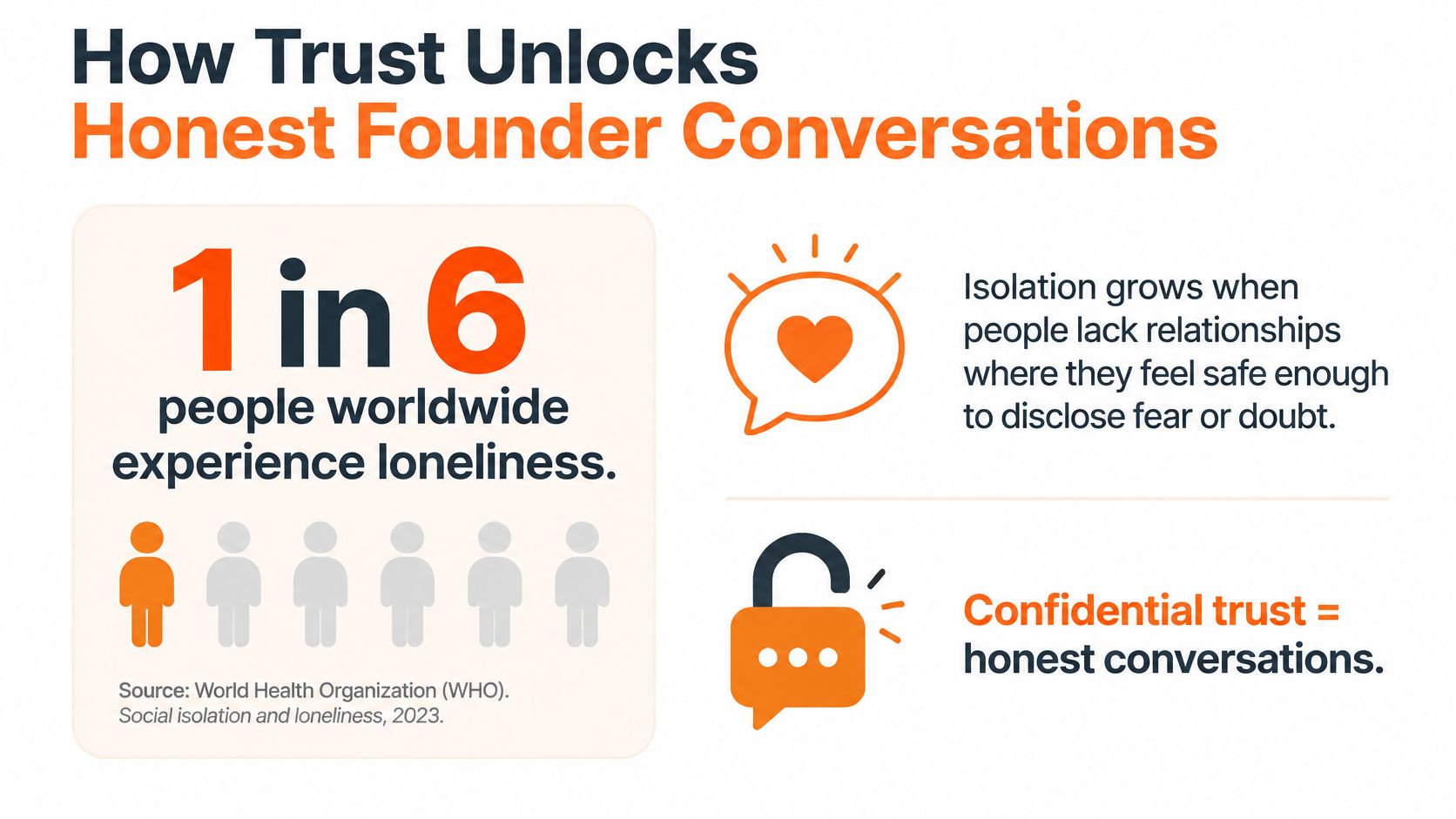
Loneliness contributes to approximately 871,000 deaths annually, about 100 deaths per hour, and approximately 1 in 6 people worldwide experience it, the World Health Organization estimates.
You can know that number and still have nowhere to put your own fear. You tell your board the revenue. You don't tell your cofounder you're scared, your team you're exhausted, or your family the cash is thin. I treat confidential emotional support like an operating system for founders. Permissions decide who sees what. Safety exceptions are written down. Vetting, group size, and consent before advice are part of the build, not a mood.
Why Founders Need Confidential Emotional Support
A 2026 survey of 227 founders from 46 countries found that 87.7% named at least one mental-health difficulty, including anxiety, high stress, burnout, or isolation. 26.9% reported loneliness or isolation. Only 18.5% knew founder-specific support existed, and 58.6% worried more about their mental health than their physical health.
You're at dinner with a smile that doesn't match the month. A client left. Payroll is close. Your partner asks if you're okay, and you praise the food. At 2 a.m. you draft a note to your cofounder and delete it. The sentence is "I'm scared."
You can tell your board the numbers. You can't tell your cofounder you're scared, your team you're exhausted, or your family the revenue is down. Reputation is how you hire and keep customers, so the silence is rational.
Confidential emotional support is a private, trusted space where you say the fear, uncertainty, and failure out loud without public reputational exposure.
I wouldn't call that space a clinic. It can be where you talk before you seek formal care. It isn't therapy, and it isn't crisis care. When the risk outruns a peer conversation, you contact a professional or an emergency service. I send people to founder mental health when they need to sort peer talk from clinical care.
You'll get a definition, the way trust works, the boundaries to demand, how a circle runs, and a way to choose one this week.
You don't need to carry the business alone, and you don't need to broadcast your struggles to get help.
What Confidential Emotional Support Actually Means
Confidential emotional support is regular, private conversation with people who keep what you share inside the room and care about you as a person, not your metrics.
Three words, three jobs
Confidential means you get a plain answer to who can see what. Emotional means feelings, fear, and doubt, not a status update on revenue. Support means you leave with validation, and often one next step you chose.
People mash three protections into one word. Split them.
Anonymity hides your name. Confidentiality limits who sees what you share, even when they know your face. Legal privilege covers only specific professional relationships, such as licensed therapy. A dinner with other founders doesn't create privilege. A group agreement isn't a court shield. If you want the clinical version of this line, read how therapists keep sessions private and notice how plain the rules are. Ask a peer group for that same plainness, without pretending the law sits in the room.
A 2025 study of digital mental-health interventions, published in JMIR Human Factors, found that users worried their data might be shared with healthcare teams without consent. Participants wanted plain-language explanations of data storage, access, and use, because people skip long privacy policies. Promising secrecy and skipping the limits makes trust weaker. Answer the hard case in one breath. If you disclose suicidal thoughts, peers don't hold it in confidence. You get routed to professional or emergency care.
How the options differ
| Support type | Who leads it | Confidentiality basis | Best for | Main limit |
|---|---|---|---|---|
| Peer support circle | Founder host or trained facilitator | Group confidentiality agreement plus member vetting | Loneliness, decision pressure, honest war stories | Not therapy and not for crises |
| Therapist | Licensed clinician | Health privacy law and professional ethics | Clinical anxiety, depression, burnout, crisis care | Cost, waitlists, more formal |
| Coach or mentor | Coach or mentor | Usually informal, so ask for their policy | Skills, accountability, strategy | May also advise the business, so filter what you share |
| Friends and family | You and people who love you | Trust, with no written agreement | Unconditional care and check-ins | May not understand founder pressure or keep business context neutral |
My rule of thumb is simple. Use peers for the loneliness of the job. Use professionals for clinical needs. A peer circle is never crisis care.
How Trust Unlocks Honest Founder Conversations
Help that exists on paper still fails when the room feels risky.
In a 2025 study of mental-health stigma and help-seeking, 57.6% of respondents reported depressive episodes, but only 21.8% sought professional help. People were more likely to turn to family or friends, at 37.2%, than to a mental-health specialist at another institution, at 3.7%. 24.6% said they would not seek help at all. Among reasons for avoiding assistance, concerns about confidentiality accounted for 19.9%, and fear that others would view the person less favorably accounted for 18.3%.
Availability isn't use. Privacy fear and reputation fear shut mouths even when the need is large. Family and friends were the source people named most often, so I still treat trusted humans as the first layer, next to clinical care, never instead of it when someone is in crisis.
For you, that fear is rational. Your name is how deals, hires, and customers move. If a vulnerable sentence can reach an investor, you'll edit it into nothing.
Proof you can see
Trust isn't a line on a signup page. You watch what the room does.
- Same faces: The people in week one are the people in week six. Drop-ins kill disclosure.
- No leaks: A story you told on Tuesday doesn't show up in someone else's pitch on Friday.
- No one-upmanship: Nobody interrupts to prove their crash was bigger.
- Failure first: A host who shares a real miss gives you room to do the same.
I write about that habit in vulnerability in leadership. You say the true thing once, in a room that has earned it, and you watch whether it travels.
Confidentiality is the entry fee for honesty.
Boundaries and the Five Questions to Ask
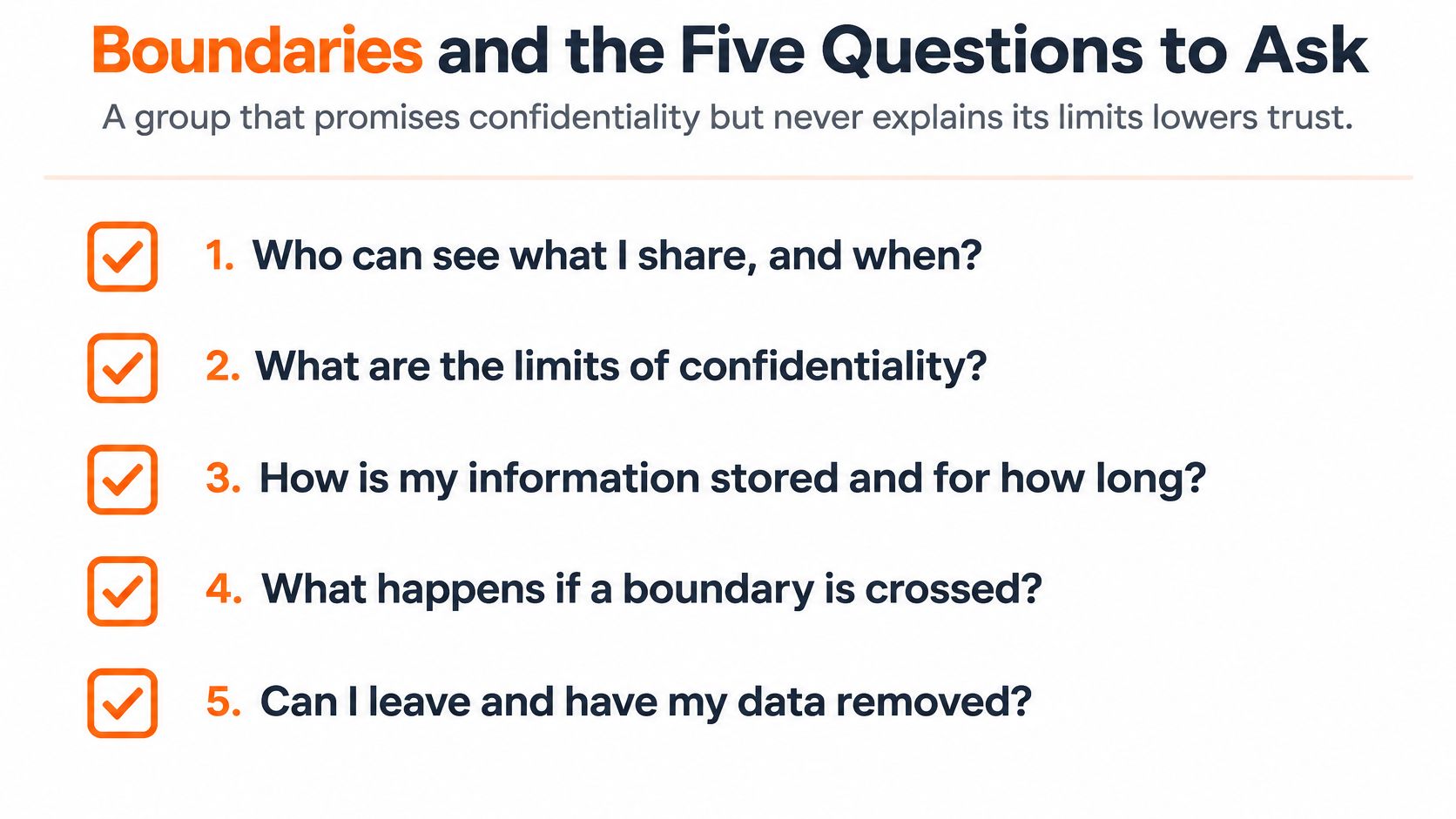
A group that promises confidentiality and never explains the limits lowers trust. I ask five questions before I share, and I want the answers in writing.
Ask these before you talk
1. Who can see what I share, and is my identity attached? Name the moderator, where notes live, and how long chats stay before deletion. If you can't name the person with access, don't talk yet.
2. What happens if someone discloses a safety risk? Suicidal thoughts or an imminent threat go to professional or emergency care, not to the group alone. You should hear that rule before you need it.
3. How big is the group, how often do you meet, and are the same people there? I look for six to eight members on a set schedule. A rotating crowd is networking with softer lighting.
4. Does advice wait for consent? Members ask whether you want validation or a next step. Unsolicited fixes turn a confession into a pitch.
5. What happens to chats, notes, or recordings after the session? "We don't really save things" isn't a rule. Require a written retention and deletion line.
Law you can borrow, law you don't have
A private founder conversation isn't automatically HIPAA-protected. The U.S. Department of Health and Human Services says the HIPAA Privacy Rule treats mental-health information like other protected health information, while psychotherapy notes get extra protection. Covered providers usually need the patient's authorization before sharing those notes, even for treatment with another provider. Exceptions include legally required abuse reporting and some serious, imminent threats. Your circle has to write its own plain rule and name the safety exceptions before anyone shares.
HHS guidance allows a provider to share mental-health information with family or others involved in care when the patient can agree or object and doesn't object, and only what that person needs. An informal business community isn't a medical provider. I still copy the habit. Share only what the group needs to understand the problem. Don't forward screenshots or identifying details. Ask before you bring another person in.
In our community, what is said stays in confidence. We keep an active group chat where members share thoughts, advice, strategies, and support, and the chat follows the same line as the room. I lay out the reason for that line in what confidentiality is and why it matters.
How to Join a Confidential Peer Circle
You want support without being sold to, judged, or pushed into performative positivity. I run six checks, and each one blocks a specific mess.
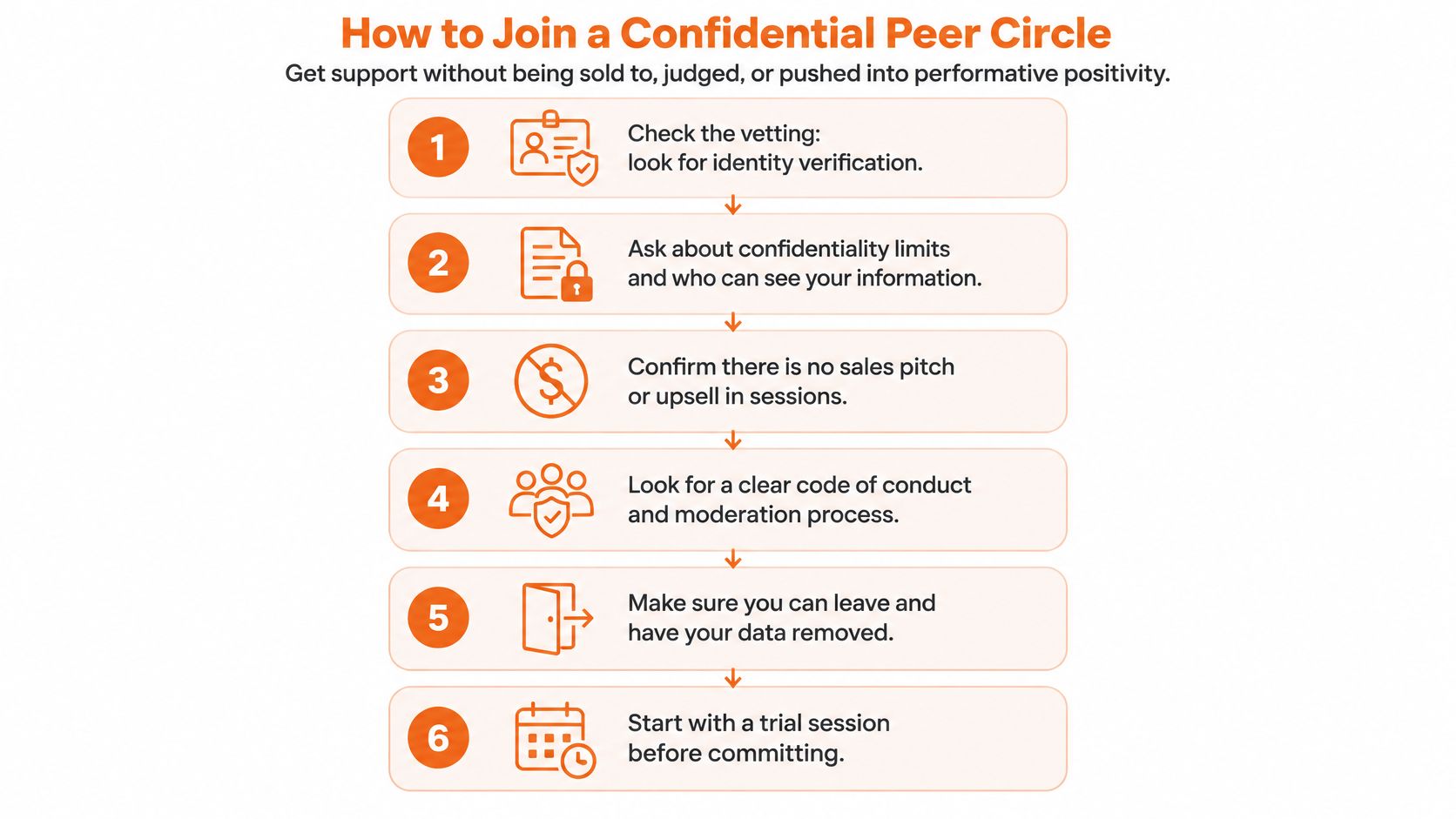
1. Check the vetting. Look for identity verification and a filter that removes people who came to sell. We remove the selfish, the inauthentic, the service-sellers, the toxic, and the self-promoters. That blocks a support night that is really a pitch deck.
2. Check the format. Big rooms create performance. We run small private dinners of 6-8 people every two weeks. A repeating table builds a memory that one-off networking can't. This blocks the stranger problem.
3. Lock the written rules before you share. Use the five questions. If the answers are fuzzy and verbal, wait. This blocks a surprise exception after you've already talked.
4. Set the tone on purpose. Our rule is a bias for vulnerability over "toxic" positivity. Bring the stalled launch, not the polished win. Ask whether someone wants validation or a next step before anyone advises. This blocks cheerleading that leaves you lonelier.
5. Start with one problem. Watch how the room holds it. Decide later whether you feel safer sharing more. This blocks you from dumping a whole year on people you haven't tested.
6. Reciprocate. Follow up on someone else's problem at the next meeting. Support runs both ways. This blocks a circle that becomes free consulting for the loudest voice.
A 2025 Fortune report on a global study of 308 entrepreneurs said access to mentors and emotional backing was associated with a 50% greater likelihood of reporting higher resilience and better stress management. I don't treat that as magic. I treat it as the follow-up question at the next session. What did you do with the thing you named?
Idea-stage and pre-revenue founders belong in the room. You may not have a workplace that would notice you're sinking. Appearing incompetent to a future cofounder, an investor, or your family is a specific fear, and so is mixing a failed test with a failed self. A small recurring group can hold both the feeling and one concrete next step, if you asked for the step.
Watch how a small founder room sounds before you score a group near you.
What Confidential Support Looks Like for Founders
The side project that still has a boss
You work a 9-to-5. The idea sounds naive if you say it at the office, so you don't. In a vetted small group, pre-revenue is ordinary. You say the scary version out loud. Members who have already made early-stage mistakes share where they stalled. You leave with the problem named, which is more than you had at your desk.
The month the big client left
Revenue dropped, and your family doesn't have the spreadsheet. The group starts with validation. Nobody opens with a funnel trick. Then someone asks if you want a next step. You say yes, and you pick a pipeline review or a pricing conversation. Two weeks later they ask what you did. The check-in is the support. The tactic is optional.
The founder who looks fine from the outside
You're growing toward seven figures, and you're afraid that naming burnout will spook a cofounder or an investor. The room separates a hard quarter from your worth as a person. People talk about getting help while you can still choose it, before exhaustion makes the choice for you. You don't have to perform stability to keep your seat.
Nathan said, "This friendly group helped me solve some problems in my business that had been troubling me for a long time."
Copy the order. Witness the feeling first. Give advice only after a yes. Follow up at the next session. Skip any step and the room turns into either a complaint club or a consulting hour. Neither one is what you came for at 2 a.m.
Start Your Own Circle or Join One
Pick a space that is small, recurring, vetted, and explicit about confidentiality. This week, run the five questions on any group before you share a real problem. A missing answer means that group isn't ready for you.
If you're building in Chicago or the Midwest, apply to Chicago Brandstarters, bring one real problem, and watch whether people listen or perform. You'll know in a single night.
If you're somewhere else, score a local or online circle with the same questions. Or start one with two founder friends and the ground rules in this guide. Finding people who truly listen takes longer than collecting contacts, and it's the part that changes the week.
Peer support doesn't replace therapy or crisis care. If you or someone in the room faces a safety risk, contact a professional or an emergency service first. Come back to the circle afterward if you want to. A peer circle gives you a room where you can be honest first.
Chicago Brandstarters has free, vetted small dinners and a private group chat for kind, hard-working founders in Chicago and the Midwest who want confidential emotional support without a sales pitch. You can bring the fear you won't put in a board update and sit with people who are building too. Visit Chicago Brandstarters and apply with one real problem.
Leave a Reply