
You’re probably seeing Contrarian Thinking everywhere right now.
A short clip about buying a laundromat. A tweet about skipping startups and buying cash flow instead. A polished pitch that says you do not need to invent the next big thing. You just need to buy something boring that already works.
I get why that message hits. If you’re a Chicago founder with more grit than cash, building from zero can feel like pushing a car through snow. Every step takes effort. Every mistake costs time you do not have. So when someone says, “Stop creating from scratch. Buy the machine that already prints money,” you lean in.
I did too.
But contrarian thinking reviews either worship the brand or dunk on it. That’s lazy. If you’re an early-stage Midwest entrepreneur, the question is simpler. Can you use this stuff if you are not already rich, not already connected, and not trying to become some internet finance character?
Here’s my take.
| Option | Best for | Main upside | Main downside | My advice |
|---|---|---|---|---|
| Free newsletter | Curious beginners | Low-risk way to learn the philosophy | Can feel broad and repetitive over time | Start here |
| Entry-level products | Self-starters who want structure | More organized than social content | Price jumps fast, value depends on execution | Only buy if you like learning solo |
| Mastermind or premium community | Operators actively pursuing a deal | Access to calls, community, mentors, events | Expensive, and buying a business still takes real capital and judgment | Only if you are already in motion |
| Ignore it and build your own brand | Creative founders with a strong product vision | Full control, local focus, brand equity | Slower path, no existing cash flow | Better for many Chicago builders |
| Use the ideas without buying the ecosystem | Bootstrapped Midwest founders | You get the mindset without the upsells | Requires discipline and local hustle | This is my favorite path |
Why Is Everyone Talking About Contrarian Thinking
The pitch is clean.
Stop chasing startup glamour. Stop raising money for an app nobody asked for. Go buy a “boring business” like a car wash, plumbing company, or laundromat. Own cash flow. Build wealth. Repeat.
That message spreads because it attacks a frustration many founders feel. We’ve all watched people spend years building decks, brands, and prototypes with no revenue. Then Contrarian Thinking comes along and says, “Buy profits, not projections.” It sounds like common sense because it is.
Why the message lands right now
A lot of founders are burned out on the usual playbook.
They do not want to beg for investor intros. They do not want to play startup theater on LinkedIn. They want something real. A business with customers, invoices, and a phone that rings.
That is where Codie Sanchez has been smart. She wrapped small business acquisition in a sharp media brand. The result feels fresh even though the underlying idea is old school.
Why Midwest founders especially pay attention
In the Midwest, we already respect steady businesses.
We do not need a lecture on the value of a company that fixes roofs, moves freight, cleans offices, or services equipment. We grew up around those businesses. We know they matter. Contrarian Thinking repackages that reality and makes it feel like a movement.
My read: the idea is attractive because it offers a shortcut around the most painful part of entrepreneurship, getting from zero to working revenue.
That does not mean the shortcut is easy.
A lot of contrarian thinking reviews miss that part. They talk like buying a business is a cleaner version of starting one. It is not. You are not skipping risk. You are swapping one kind of risk for another. Instead of wondering whether customers will show up, you wonder what the seller is not telling you.
That’s a big difference.
The Core Philosophy Behind Buying Boring Businesses
The easiest way to understand this model is to compare it to building a house.
If you start a brand from scratch, you are buying raw land. Then you pour the foundation, frame the walls, run the wiring, and hope the house turns out the way you imagined. It can become something beautiful. It can also take forever and drain your your cash.
Buying a boring business is closer to buying an older house with ugly cabinets and good bones.

You are not starting from dirt. You are buying something that already stands. Customers exist. Revenue exists. Maybe the website is terrible. Maybe the owner is tired. Maybe no one ever modernized operations. That is the opening.
What the model gets right
The philosophy has a few strong pillars.
- Buy unsexy demand: Nobody brags at dinner about owning a striping company or a dry cleaner. That is often the point. Less glamour can mean less competition from hype-driven buyers.
- Focus on cash flow: The model cares less about storytelling and more about whether the business reliably makes money.
- Use deal structure as an advantage: A lot of the game is not just what you buy, but how you buy it.
- Improve, do not reinvent: You look for obvious fixes. Better systems. Better hiring. Better marketing. Better follow-up.
That basic thinking is solid. I like it because it forces discipline.
A lot of first-time founders hide in creativity. They tweak logos, write mission statements, and call it progress. Buying a real business strips away fantasy. You either understand operations or you do not.
Where people misunderstand it
People hear “boring business” and think “easy business.”
That is wrong.
A boring business can still have angry customers, messy books, old equipment, employee turnover, and owner habits that never got written down. Buying one is not a cheat code. It is more like taking over a restaurant mid-shift. Food is already on the stove. You have cash coming in. You also inherited the chaos.
Why this matters if you are bootstrapped
If you are short on capital, this philosophy still helps because it changes how you make decisions.
Instead of asking, “What exciting thing should I start?” ask, “What painful, ordinary problem already has buyers?” That one question can save you months. It also fits the kind of practical decision-making I push in my own work around business building, which is why I like frameworks like this one on making decisions as a founder.
Good use of contrarian thinking: let it sharpen how you evaluate opportunities.
Bad use of contrarian thinking: let it trick you into believing operating a local service business is somehow simple.
Is Codie Sanchez Credible Or Just A Great Marketer
Short answer. She is both.
That is not an insult. Great marketers often get dismissed as if they must be fake. That’s sloppy thinking. If someone builds a strong brand and also has operator credibility, you should acknowledge both.
According to Contrarian Thinking’s own event recap, the platform reaches thousands of small business owners, drew about 1,000 owners, investors, and operators to a recent 3-day conference in Austin, and Sanchez says her portfolio has scaled to nine figures in revenue across dozens of businesses. The same post also notes her flagship mastermind increased from $8,000 to $10,000 (Contrarian Thinking event recap).
Those are not small signals.
What I think that proves
It proves she has market pull.
It proves people are willing to pay to learn from her. It proves she knows how to package an idea in a way that cuts through noise. And it suggests she is not just commenting from the sidelines.
That matters. I trust practitioners more than theorists.
What it does not prove
It does not prove that her playbook becomes easy for you just because it worked for her.
A lot of contrarian thinking reviews go sideways because they confuse founder credibility with student outcomes. Those are different things. A brilliant operator can still sell a program that many buyers struggle to apply.
That gap matters particularly if you are early in the game and still figuring out whether to start, buy, or validate an idea. If that’s where you are, I’d spend more time on basics like how to validate a business idea than on dreaming about your future acquisition empire.
My opinion on the credibility question
I do not think Codie Sanchez is just selling air.
I also do not think her success transfers to a bootstrapped founder in Chicago who has limited cash, limited deal experience, and no appetite for expensive mistakes. She has credibility. No question. But you still need to separate “this person knows what she’s doing” from “this product is the right next move for me.”
Those are not the same sentence.
My advice: respect the operator, then interrogate the offer.
What You Get With Contrarian Thinking
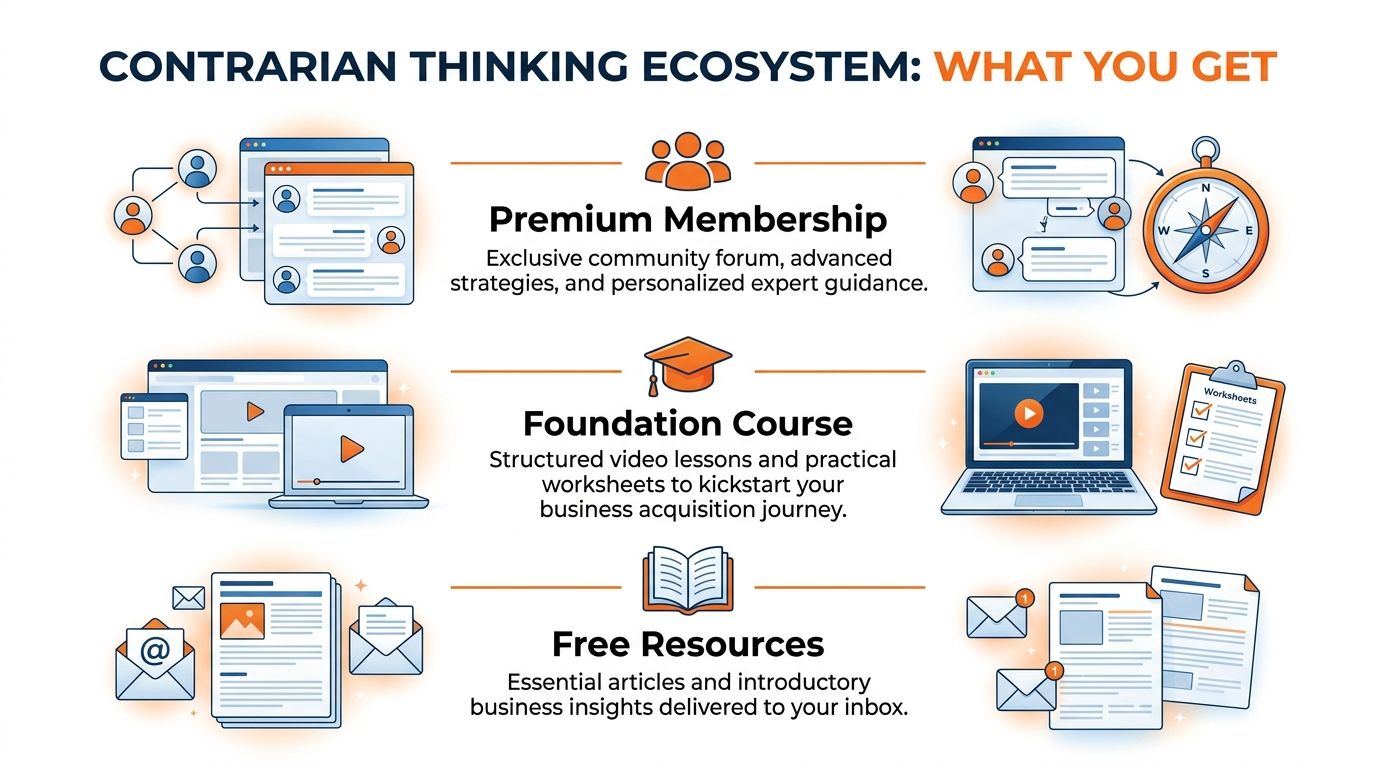
Many people talk about Contrarian Thinking like it’s one product. It’s not.
It’s an ecosystem. Free content at the top. Paid education in the middle. Premium access at the high end. If you do not understand that ladder, you can talk yourself into spending money for the wrong reason.
The simple breakdown
| Tier | What you get | Who it fits | My take |
|---|---|---|---|
| Free newsletter and content | Articles, clips, broad business-buying ideas | Anyone curious about the space | Best starting point |
| Entry-level paid product | More structured education than social posts | Self-directed learners | Fine, but not magic |
| High-ticket mastermind | Weekly live calls, Slack group, in-person events, expert mentors | Buyers actively pursuing deals | Useful if you already have momentum |
The premium offer matters because it shapes expectations. The flagship mastermind includes weekly live calls, Slack access, in-person events, and expert mentors, and the price moved from $8,000 to $10,000, according to the Contrarian Thinking event recap linked earlier.
That tells me the value proposition is not just information. It is access, accountability, and proximity.
The good
There are clear strengths here.
First, people like the community side. One review summary says Contrarian Thinking holds a 4.9-star Trustpilot rating, with praise for community access and the overall value of being around other buyers and operators. The same review summary also says critiques point to repetitive content and high prices, from a $150 entry-level product up to a $10,000 annual mastermind, with complaints about upsells to additional services (YouTube review summary of Contrarian Thinking).
That mix feels believable to me.
A lot of business education products are useful because they compress learning and connect you to people on the same path. That part can be worth paying for, particularly if you need structure.
The bad
The biggest issue is simple. Information is not execution.
You can watch lessons on acquisition. You can sit in a Slack group. You can ask experts questions. None of that means you can evaluate a seller, manage diligence, secure financing, or run the business after closing.
The second issue is pricing creep.
If you are bootstrapped, every purchase has to compete with business uses for cash. Inventory. Samples. Travel. Legal review. Software. A good CPA. A small founder can burn serious money buying education that feels productive without changing their position.
What I would buy and what I would skip
If I were advising a Chicago founder over dinner, I’d say this:
- Start with free: Read the newsletter. Watch the free content. See if the worldview changes how you think.
- Buy structure only if you act: If a course helps you move faster, fine. If you want motivation above all else, save your money.
- Do not buy community to cosplay as a buyer: Join the premium level only if you are already talking to sellers or preparing to.
Rule of thumb: if you are not taking calls, reviewing deals, or preparing financing conversations, a premium acquisition community is likely premature.
A lot of contrarian thinking reviews focus too much on whether the content is “worth it.” That’s the wrong frame. The better question is whether the product matches your stage.
For most early-stage Midwest founders, the free layer is enough at first.
A Midwest Founder's Guide To The Pros And Cons
The idea either gets practical or falls apart here.
If you live in Chicago, Milwaukee, Indianapolis, Grand Rapids, or a smaller Midwest market, the case for buying a business is not abstract. You are surrounded by owner-led companies that run without fanfare, serve local demand, and never trend online.
That is the upside.
The downside is that you still need judgment, stamina, and some way to bridge the capital gap.

The strongest argument for the model
The opportunity exists because the market is messy.
One review of Codie Sanchez’s framework says there are about 2.5 million small businesses for sale, 10,000 baby boomers retiring daily, and that 91% of motivated sellers fail to sell and instead close down (review summarizing the Contrarian Thinking market thesis).
That last number is the one that matters most to me.
It means a lot of owners do not have a clean exit. That creates openings for prepared buyers who know how to have the conversation, structure a deal, and move with seriousness.
The Midwest advantages
If you are local, humble, and willing to do legwork, you have a shot.
- You understand practical businesses: This region respects operators.
- You can build trust faster in person: Local reputation still matters here.
- You may find overlooked sellers: Not every owner wants to list broadly or deal with flashy buyers.
- You can compete with hustle: In smaller circles, reliability beats polish.
The Midwest problems
Now the hard part.
You may love the theory and still be a terrible fit for the business's practical aspects.
Running a boring business can mean staffing headaches, route logistics, old-school customers, and inherited systems that nobody documented. A founder who loves product, brand, and storytelling might hate that life.
There is also an identity issue. Some people do not want to own a small business. They want the status of being someone who owns one. Those people get crushed fast.
My filter
Ask yourself these questions.
| Question | If your answer is yes | If your answer is no |
|---|---|---|
| Do you like operations? | Buying may fit you | Building may fit better |
| Can you talk to sellers without freezing? | You can learn the deal side | You may stay stuck in theory |
| Are you okay owning something unglamorous? | Good sign | Bad sign |
| Do you want cash flow more than personal expression? | Buying gets stronger | Brand building gets stronger |
My opinion: for Midwest founders, the Contrarian Thinking philosophy is strongest as an opportunity lens, not as a personality transplant. Do not force yourself into an operator identity you do not want.
Buying A Business Vs Building Your Brand From Scratch
This is the fork in the road.
A lot of people read contrarian thinking reviews because they are asking a bigger question. Should I buy momentum or create it?
That is not just a money question. It is a lifestyle question.

Building gives you authorship
When you build from scratch, you get control.
You choose the product. You choose the voice. You choose the customer. That matters if you are trying to create something with emotional resonance or long-term brand equity. For creative founders, this path is hard but honest. The business feels like yours because it is.
The downside is brutal. No customers at the start. No systems. No proof. You must create trust from nothing.
Buying offers an advantage
When you buy, you skip the blank page.
You inherit customers, workflows, and some level of demand. That can shorten the path to revenue. It also means you inherit whatever is broken. If the last owner kept key knowledge in his head, congratulations. You just bought a puzzle with missing pieces.
The practical middle ground
This is the move more Midwest founders should consider.
Use contrarian ideas without going full acquisition guru.
One of the most useful nuances in the broader conversation is seller financing. A review focused on bootstrapped founders says 70% of small business sales under $1M in revenue use seller financing, and frames that as a practical tool for founders who do not have big cash reserves (YouTube discussion focused on bootstrapped application).
That matters because it opens a door between “start from zero” and “buy a whole established company.”
You might not buy a large operating business. But you could explore a small local acquisition, a micro-brand, or a service business add-on. You could also use seller-financing logic as part of your own deal strategy when you evaluate opportunities with a sharper eye.
If you’re serious about that path, I’d start with a practical checklist like these questions to ask when buying a business.
My challenge to the default belief
The default startup belief says the noble path is to invent from scratch.
I reject that.
A lot of founders cling to originality because it flatters the ego. But markets do not care about your ego. Buyers care whether you solve a problem. Sometimes the smartest move is to buy a small machine that already works and improve it.
A short explainer can help if you’re still weighing the tradeoff.
That said, I do not think buying is superior.
If you are the kind of founder who comes alive when shaping product, design, message, and customer experience, then a business acquisition might become a distraction wearing a smart-person costume. You will spend months chasing a path that looks efficient but does not match your strengths.
My bias: buy when you want operations and cash flow. Build when you want authorship and brand. Mix both only if you have the discipline to stay clear-eyed.
My Verdict And Your Next Steps
Here’s my verdict.
Contrarian Thinking is worth studying. It is not worth following uncritically.
I like the core philosophy. I respect the operator angle. Codie Sanchez has earned attention. I also think a lot of founders use this content as fantasy fuel instead of taking real action.
If you are in Chicago or the broader Midwest, I would not ask, “Is Contrarian Thinking good or bad?” I’d ask, “What am I trying to become?”
Who it is for
Contrarian Thinking fits you if:
- You like operations: systems, staff, process, repeatability.
- You care more about cash flow than self-expression: very different founder profile.
- You can handle awkward conversations: sellers, brokers, lenders, employees.
- You want to buy your way into momentum: instead of inventing from zero.
Who should be careful
It is likely a distraction if:
- You are still addicted to idea-hopping
- You want content more than consequences
- You are a creative brand-builder at heart
- You do not yet have the patience to inspect messy realities
What I recommend based on your stage
If you are brand new, do this. Read the free content for a while. Let the framework challenge your assumptions. Do not spend money just because the marketing is good.
If you are considering a purchase, then maybe paid structure helps. But only if you are already in conversations and doing the hard work.
If you are a bootstrapped founder with more hustle than capital, use the mindset without buying the whole ladder. Learn how deals work. Learn what sellers want. Learn how to think about cash flow and structure. Then apply those lessons locally.
If you are building a brand from scratch and making progress, stay focused. Do not let acquisition content become an advanced form of procrastination.
My simplest advice: use Contrarian Thinking as a lens, not an identity.
That’s the cleanest way I can say it.
You do not need to become a Main Street acquisition influencer. You need to become someone who sees opportunities more clearly, makes better decisions, and does not confuse sexy with smart.
If you want a place to talk through these choices with real founders in Chicago, not internet performers, check out Chicago Brandstarters. It’s a free community for kind, hard-working builders who want honest feedback, real relationships, and practical help as they grow.
Leave a Reply